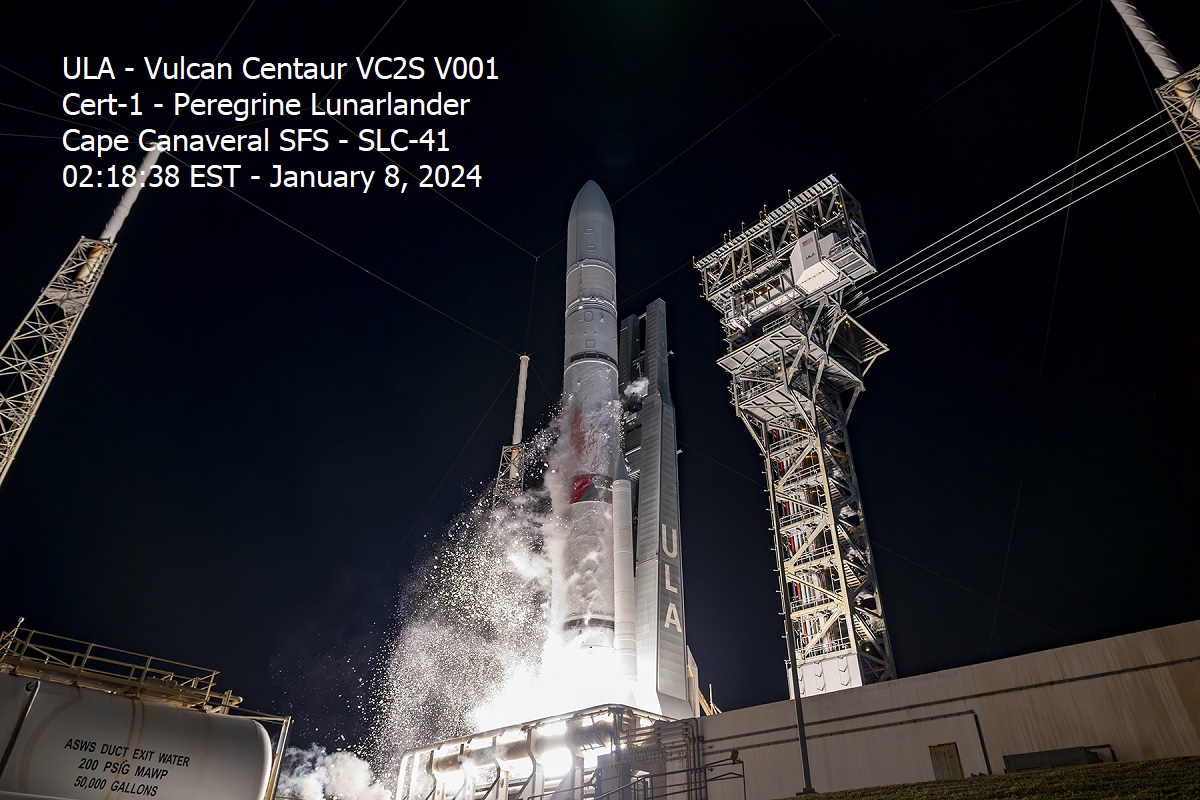
Screenshot from ULA Webcast of the launch of GPS IIF-05.
Mission Rundown: ULA - Delta IV M+4,2 - GPS IIF-05
Written: January 31, 2023
On my way home to you
The United States Air Force is continuing to replenish its fleet of Global Positioning System navigation satellites via the United Launch Alliance (ULA) successful launch of the fifth Block IIF Global Positioning System navigation satellite Friday in an evening lift-off from SLC-37B at Cape Canaveral Air Force Base.
Liftoff from Space Launch Complex 37B at Cape Canaveral was not on schedule Friday, February 21, 2014 at 20:59 EST – 01:59 UTC – at the end of an eighteen-minute window.
Friday’s mission used a Delta IV rocket, flying in the Medium+(4,2) configuration. A single Common Booster Core (CBC), a four-meter Delta Cryogenic Second Stage (DCSS) and a pair of GEM-60 solid rocket motors to augment the CBC’s thrust at liftoff.
The Medium+(4,2) is the most-flown version of the rocket with liftoff marking its tenth flight. Across all configurations it was the twenty-fifth Delta IV to fly.
Friday's launch is targeting a medium high orbit at an altitude of 20,459 kilometers (12,713 statute miles, 11,047 nautical miles) and an inclination of 105.3 degrees to Equator.
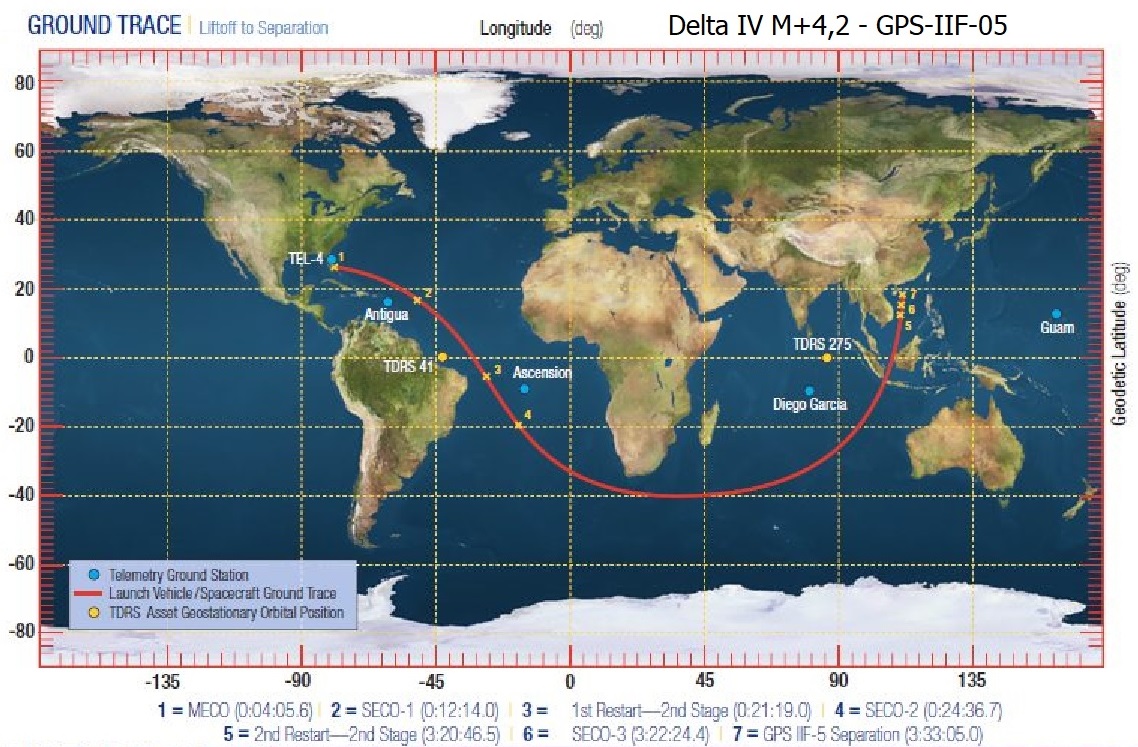
Delta IV M with GPS IIF-05 will head south southeast along South America's northern shore line
The distance from Cape Canaveral to Delta IV’s final resting place in Davy Jones locker is measured to be about 2900 km ±100 km on Google Earth. However the fairings crash site isn’t marked on this map. It’s estimated to be about 1000 km ±100 km down range.
The GPS IIF-05 Payload
Initiated to provide precise location and navigational data to the US military, the GPS constellation is used worldwide for both civil and military purposes – and although Russia and China have developed their own global navigation systems in the GLONASS and Beidou constellations, with Europe continuing to develop its Galileo system, the majority of satellite navigation receivers rely upon GPS satellites.
The GPS Master Control Station, operated by the 50th Space Wing's 2nd Space Operations Squadron at Schriever Air Force Base, Colorado, is responsible for monitoring and controlling the GPS as a 24-satellite system, consisting of six orbital planes, with a minimum of four satellites per plane.
There are currently 35 vehicles in the GPS constellation.
Block IIF represents the halfway point in replenishment of the second-generation GPS constellation, with Friday’s payload, GPS IIF-05, the sixty-fourth GPS satellite to fly and the 56th member of the Block II GPS satellite constellation.
Each GPS satellite broadcasts a pseudo-random noise (PRN) signal encoded with a navigational message that contains the time, orbital properties of the satellite and information on the status of the constellation.
The GPS IIF-05 satellite will join Plane A of the constellation, taking over slot 3A from the SVN-28 or USA-135 satellite which launched on a Delta II rocket in November 1997.
Still fully operational but past the end of its design life, USA-135 – which is also designated GPS IIA-19, was used as a spare in 5A after being relieved and USA-92 who was in 5A will be retired after twenty years of service.
Each satellite is assigned a different PRN signal, with GPS IIF-05 expected to take on PRN-30 from a faulty GPS IIR-20M - USA-203 when it begins broadcasting.
Once it reaches orbit, GPS IIF-05 will be given a designation under the USA series, used to give a uniform designation to American military satellites. Recent designations have been assigned sequentially, so GPS IIF-05 will likely become USA-248.
The satellite is also known by its Space Vehicle Number (SVN) – it's like a production serial or activation number within the GPS series, which is SVN-64. Fact data sheet.
The GPS launch history
The first Block II satellite launched on 14 February 1989, aboard the maiden flight of the Delta II rocket which would carry out a further forty-eight GPS missions over the following twenty-one years.
Block II was the first operational form of the Global Positioning System – the eleven Block I satellites launched by Atlas-E/F rockets between 1978 and 1985 were experimental spacecraft which paved the way for full deployment. The original Block II spacecraft – of which nine were launched – were 1,660-kilogram (3,660 lb) vehicles built by Rockwell.
The Block II was superseded by the enhanced Block IIA spacecraft, which were also produced by Rockwell and derived from the earlier satellites. Heavier, at a mass of 1,816 kg (4,004 lb), the spacecraft were able to operate and maintain accurate navigation signals without input from the ground for up to 180 days – increased from the fortnight that earlier satellites had been able to function autonomously.
The first Block IIA satellite, USA-66, was the longest-lived spacecraft in the constellation achieving over 25 years of service. With the initial GPS constellation nearing completion, in 1997 the US Air Force began to launch Block II Replenishment, or Block IIR, satellites to augment and upgrade the constellation.
Block IIR satellites were built by Lockheed Martin, using the AS-4000 satellite bus, and were designed to provide a minimum of ten years’ service. Thirteen were launched between 1997 and 2004, with a further eight spacecraft being upgraded to the Block IIRM configuration and launched over the following five years.
Blocks IIR and IIRM were followed by the Boeing-developed Block IIF satellites which are the lightest Block II satellites – at 1,630 kilograms (3,590 lb) – which is achieved because of the more powerful rockets used to launch them.
The first Block IIF, GPS IIF-1 or USA-213, was launched atop a Delta IV Medium+(4,2) rocket in May 2010. Launches have been split evenly between the Delta and the Atlas V, with Delta deploying the first, second, third, fifth, sixth and ninth satellites and Atlas carrying the fourth, seventh, eighth, tenth, eleventh and twelfth.
Each mission is named after a star – typically a bright or recognizable one which would be important to navigation. GPS IIF-1 was given the name Polaris, IIF-2 was named Sirius, with the subsequent names being Arcturus, Vega, Canopus, Rigel, Capella, Spica, Deneb, Antares, Altair and Betelgeuse as the twelfth.
GPS IIF-05 is named after Canopus, one of the brightest stars in the southern constellation of Carina - it's known as ‘The navigator for the Spartan King Menelaus’ and is visible in the Southern sky and is considered the second-brightest star in the night sky.
The Atlas V and Delta IV Evolved Expendable Launch Vehicles (EELVs) are both capable of placing the satellites directly into their operational Medium Earth Orbits, whereas earlier spacecraft launched by the Delta II incorporated solid-fuelled apogee motors to inject themselves after initial deployment into a transfer orbit. Block IIF satellites have a design life of twelve years.
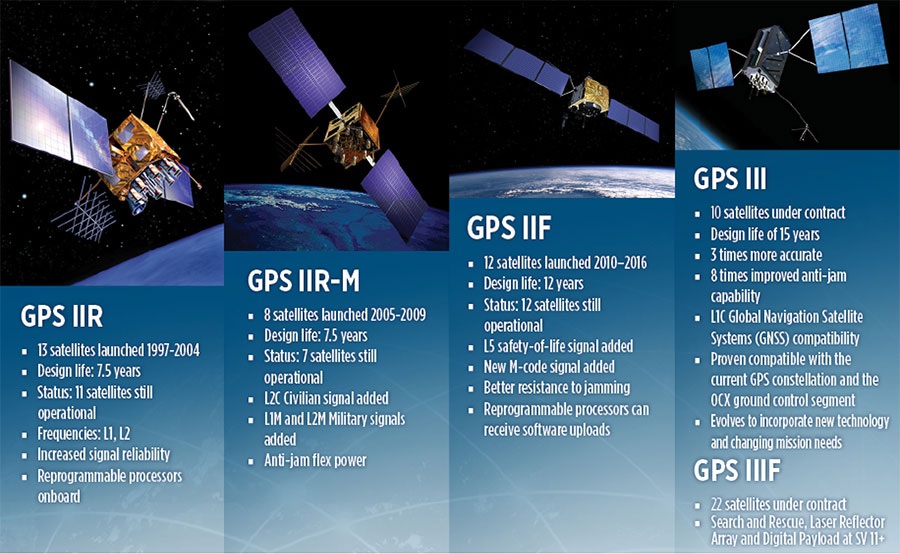
Evolution of GPS satellites so far. link Graphic sourced from: Lockheed Martin and Boeing Co.
At the time of its inception in the mid-late 1990s, Block IIF was expected to consist of up to 33 satellites. This was scaled back to twelve, ten and then finally extended to twelve again, with the series serving as an interim between the end of Block IIR and the introduction of the new next-generation Block III spacecraft.
The Delta IV M+4,2 launch
The launch took place from Space Launch Complex 37B at the Cape Canaveral Air Force Station. Friday’s launch began with ignition of the Delta IV RS-68 main engine. At the zero mark in the countdown the two GEM-60 solid rocket motors ignited and the vehicle began its ascent towards orbit.
Executing a series of pitch and yaw maneuvers beginning eight seconds into the flight, Delta 365 flew out over the Atlantic on an azimuth of 46.16 degrees. The rocket reached Mach 1, the speed of sound, 48.4 seconds after liftoff, passing through the area of maximum dynamic pressure (max-Q) thirteen seconds later.
Burnout of the solid rocket motors occurred one minute and thirty five seconds after liftoff, the spent motors remaining attached for 5.1 seconds before separating. Four minutes and 28.1 seconds after launch Main Engine Cutoff, or MECO, occurred with the RS-68 shutting down to conclude its burn.
Seven seconds after MECO the spent first stage was jettisoned, with second stage ignition taking place fourteen and a half seconds after staging, once the upper stage engine nozzle had been extended.
The Delta Cryogenic Second Stage (DCSS) is powered by a single RL10B-2 engine which, like the first stage, burns liquid hydrogen and liquid oxygen.
Friday’s mission calls for it to make two burns, the first to establish a transfer orbit and the second at apogee to circularize the payload’s deployment orbit. Unlike earlier-generation spacecraft, Block IIF GPS satellites are deployed directly into their operational orbits.
The second stage’s first burn lasted eleven minutes and 1.3 seconds, with separation of the rocket’s payload fairing occurring ten and a half seconds after ignition. At the burn’s conclusion, the flight entered a coast phase, with the upper stage and spacecraft drifting towards apogee for the next two hours, 46 minutes and 29.2 seconds.
A one minute, 46.1-second burn at the end of the coast phase raised the orbit’s perigee. At spacecraft separation, which will take place ten minutes and 41.4 seconds after the end of the second burn, the vehicle was in a circular orbit at an altitude of 20,459 kilometers (12,712 miles, 11,047 nautical miles) and an inclination of 55 degrees.
The Delta IV M+4,2 rocket
United Launch Alliance used a Delta IV rocket to conduct the GPS IIF-05 mission, with the rocket flying in the Medium+(4,2) configuration and with a 1 632 kg payload.
Facts gathered about Delta IV M+4,2 give the following sets of data.
Delta IV M+4,2 stands 62.79 meter - 206.0 feet tall with a short 4 meter fairing
Delta IV M+4,2 stands 66.20 meter - 217.1 feet tall with a medium 4 meter fairing
Delta IV M+4,2 carry 470 000 gallons of liquid propellant - 1792 m3 tank capacity
Delta IV M+4,2 carry liquid Hydrogen, Oxygen, Hydrazine and Helium as propellants
Delta IV M+4,0 weighs 292 732 kilogram - 645 364 pounds alone without boosters
Delta IV M+4,2 weighs 327 040 kilogram - 721 000 pounds with two GEM-60 SRB’s
Delta IV M+4,0 produces 2 850.0 kilonewtons - 663 000 pounds of thrust
Delta IV M+4,2 produces 4 183.20 kilonewtons - 940 421 pounds of thrust with SRB’s
325 696 kg Rocket = 226 400 kg Core + 24 170 kg DCSS + 67 596 kg SRB + 5 898 kg fairing
The 5.9 ton ‘fairing’ part must consist of the Interstage ring, the PAF and the fairing halves which can be extended by one to two 3.66 meter - 12 feet sections depending on payload volume size. The interstage is estimated by me to weigh a third 1.5 ton, the fairings 3.2 ton and the Payload Attach Fitting weighs in this case 1 221 kg given a large payload size.
Payload to Low Earth Orbit 185 km x 185 km x 28.5o - 11 700 kilogram - 25 700 pounds
Payload to ISS 400 km x 405 km x 51.6o - 11 920 kilogram - 25 700 pounds
Payload to GTO 185 km x 35 400 km x 28.5o - 6 270 kilogram - 11 600 pounds
GEM-60 stands 13.20 meter - 43.16 feet tall with a diameter of 1.5 meter - 5 feet
GEM-60 weighs 33 798 kilogram - 74 511 pounds mounted and fully fueled
GEM-60 weighs 3 849 kilogram - 8 485 pounds empty at jettison after 91 second
GEM-60 produces 826.6 kilonewtons - 185 800 pounds of thrust at sea level
Delta IV Core Booster stands 40.80 meter - 133.8 feet tall - diameter 5.1 meter - 16.7 feet
Delta IV Core Booster carry 110 000 gallon LH2 - 416.4 m3 tank capacity
Delta IV Core Booster carry 40 000 gallon LOX - 151.4 m3 tank capacity
Delta IV Core Booster is loaded with a total of 200,000 kg of propellants
Delta IV Core Booster weighs 226 400 kilogram - 499 100 pounds fully fueled
Delta IV Core Booster weighs 26 760 kilogram - 58 990 pounds empty at jettison
Delta IV RD-68 produces 2 950 kilonewtons - 663 000 pounds of thrust at sea level
Delta IV RD-68A produces 3 137 kilonewtons - 705 000 pounds of thrust at sea level
Delta Cryogenic Second Stage - 4 meter DCSS stands 12.20 meter - 40.0 feet tall
DCSS - LH2 tank diameter 4.0 meter - 13.1 feet - LOX diameter 2.44 meter - 8.0 feet
DCSS carry 10 000 gallon LH2 - 37.85 m3 tank capacity - uncertain volume
DCSS carry 4 000 gallon LOX - 15.14 m3 tank capacity - uncertain volume
DCSS is being loaded with a total of 21,320 kg of propellants
DCSS weighs 24 170 kilogram - 53 290 pounds fully fueled + 195700 kg core
DCSS weighs 2 850 kilogram - 6 280 pounds empty after 850 seconds of burn time
DCSS RL-10B-2 produces 110 kilonewtons - 25 000 pounds of thrust in vacuum
This consists of a Common Booster Core first stage with an RS-68 engine, augmented by two GEM-60 solid rocket motors, and a four-meter Delta Cryogenic Second Stage powered by an RL10B-2. The rocket uses cryogenic propellant – liquid hydrogen oxidized by liquid oxygen – in both liquid-fuelled stages.
The Medium+(4,2), or M+(4,2) is the second-smallest of the five Delta IV configurations to have flown; however the smallest, the Delta IV Medium, has not been used since 2006 and is not expected to fly again. The M+(4,2) is the most-flown version of the Delta IV; Friday’s mission will be its tenth launch and the twenty-fifth Delta IV overall.
The GPS IIF-05 launch of the Delta IV M+(4,2) that flies with the RS-68 engine which it was designed with since the first launch in 2002. New Delta IV configurations are flying with the upgraded RS-68A engine; the Medium+(5,2) and Medium+(5,4) and the Delta IV Heavy.
With the Delta IV intermediate configurations being phased out, Friday’s launch is expected to be one of the last flights of the Delta IV Medium+(4,2), and with it the four-meter second stage. The configuration’s final launch is expected to carry the first Block III GPS satellite, and is currently scheduled for 2017. Delayed to 2019 - 20 x 20 hindsight.

Delta IV M+4,2 split in its major parts. Including data from all non specific graphic configurations
The Delta IV was integrated in the pad’s Horizontal Integration Building before being transported to the launch pad and raised to vertical. The GPS IIF-05 satellites, already encapsulated within the payload fairing, were mounted atop the rocket at the pad.
The rocket that conducted Friday’s launch was numbered Delta 365, indicating that it was making the 365th launch of a Delta-family rocket; derived from the Thor-Delta vehicles first launched in the 1960s consisting of a first stage derived from the Thor missile and a second stage derived from the AJ-10-powered Delta.
Known facts about Delta IV M+5,2
Delta IV M+5,2 stands 67.0 meter - 220.0 feet tall with a medium 5 meter fairing
Delta IV M+5,2 weighs 340 194 kilogram - 750 000 pounds with two GEM-60 SRB’s
Delta IV M+5,2 produces 4 450.0 kilonewtons - 1 000 000 pounds of thrust + SRB’s
340 194 kg Rocket - 226 400 kg Core - 30 700 kg DCSS - 67 596 kg SRB = 15 498 kg
Payload to Low Polar Orbit 1 054 km x 106.59o - 9 600 kilogram - 21 164 pounds
Delta IV M+5,2 Cargo - ‘Bullitt’ with 9 600 kg Payload and 5 898 kg medium fairing
Payload Attach Fitting weighs 240 kg to 1 221 kg depending on payload size