torsdag den 8. oktober 2015

ULA - Atlas V 401 - NROL-55

Screenshot from ULA Webcast of the launch of NROL-55. No wind, no light and no matches around

Mission Rundown: ULA - Atlas V 401 - NROL-55

Written: January 7, 2023 

Lift Off Time

October 8, 2015 – 05:49:30 PDT | 12:49:30 UTC

Mission Name

NROL-55

Launch Provider

ULA - United Launch Alliance

Customer

NRO - National Reconnaissance Office

Rocket

Atlas V 401

Launch Location

Space Launch Complex 3E - SLC-3E

Vandenberg Air Force Base, California

Payload

2 NOSS/Intruder Navy Satellites - USA-264-1 & 264-2

9 GRACE CubeSats + 4 ELaNa XII CubeSats

Payload mass

CubeSat mass unknown

6 218 kg ~ 13 708 pounds

Maximum mass lift capacity 6 500 kg

Where did the satellite go?

Medium Earth Orbit - 1 013 km x 1 200 km x 63,43°

Type of launch system?

Atlas Evolved Expendable Launch Vehicle - No SRB

The first stage landing zone?

Bottom of the Pacific Ocean 2 200 km downrange

Type of second stage?

Centaur RL-10C-1 engine - 16m 24s burn time

Is the 2nd stage derelict?

Yes - Main engine 5th start/cutoff wasn’t evident

New orbit was 459 km x 775 km x 64.67° 

Type of fairing?

4.2 meter two part metallic fairing

This will be the:

– 101st flight of all ULA rockets

– 58th flight of an Atlas V rocket - Tail no. AV-058

– 20th ULA mission for NRO

– 10th mission for ULA in 2015

Where to watch

Where to read more in depth

ULA YouTube link provided by Julian Danzer

Want to know or learn more go visit or see Tim Dodd


Launch debriefing

(This did happen)

Direct ascent in a steep elliptical transfer orbit followed by a insertion burn to circularize the target medium orbit

Centaur deorbit burn is observed over Ganden Monastery, Lhasa, Tibet at 14:17 UTC - T+01:28

Deployment of CubeSats begins at 15:56 UTC with three  minute interval on eight P-Pods

Timeline after ULA wrap up is purely guesswork

L-00:20:18

Host:

L-00:07:00

T-00:04:00

T 00:00:00

T+00:01:21

T+00:01:29

T+00:04:04

T+00:04:08

T+00:04:19

T+00:04:27

T+00:15:22

T+00:18:41

T+01:18:27

T+01:21:27

T+01:28:27

T+02:13:27

T+03:07:27

T+03:25:27

T+03:30:27

T+03:40:27

ULA live feed at 00:00

Matt Donovan, Rob Gagnon

Final Polling preparing the launch at 13:18

Release -4 minute hold at 16:18

Liftoff at 20:18 - No T+ clock - 12:49:30 UTC

Mach 1 at 21:39 - Speed Mach One 1225,5 km/h

MaxQ at 21:47 - Maximum aerodynamic pressure

BECO at 24:22 - Core booster is empty - 244 second

Stage separation at 24:26 - Just losing 95% weight

MES-1 at 24:37 - Centaur RL-10C-1 engine start

Fairing separation at 24:49 - Computer graphics on

Wrap up from ULA at 35:40 - Calculated T+

MECO-1 at 53:14 - Coasting toward Antarctica

MES-2 - SECO-2 doing a 60 second MEO insertion burn

ULA doesn’t show deployment of NROL-55 - 14:14 UTC

MES-3 - SECO-3 doing a xx second MEO to LEO burn

MES-4 - SECO-4 doing a xx second LEO insertion burn

Deployment of GRACE and ELaNa XII starts -15:56 UTC

Deployment of GRACE and ELaNa XII ends

Centaur blowout of remaining gasses and fuel

Centaur 2nd stage becomes derelict space debris


Atlas V 501

OTV-4 X-37B

Atlas V 401

GPS IIF-10

Delta IV M+5,4

WGS-7

Atlas V 551

MUOS-4

Atlas V 421

Morelos-3

Atlas V 401

NROL-55

Atlas V 401

GPS IIF-11

Atlas V 401

OA-4 Cygnus

Atlas V 401

GPS IIF-12

Delta IV M+5,2

NROL-45

Take fiftyfive. And we’re rollin’

United Launch Alliance’s Atlas V rocket successfully deployed a National Reconnaissance Office primary payload (NROL-55) – and a host of smaller satellites – Thursday following a pre-dawn liftoff from SLC-3E at Vandenberg Air Force Base.

Liftoff was on schedule at 05:49 Pacific Daylight Time - 12:49 UTC on October 8, 2015.

Just six days after another Atlas flew United Launch Alliance’s (ULA’s) one-hundredth mission with launching Mexico’s Morelos-3 satellite last Friday, Thursday’s launch marked the shortest time between two Atlas V launches.

Atlas V 401 flight path measures 2200 km ±100 km indicates a steep climb into its orbit since the impact area of the core booster is 400 km closer to the launch site at Vandenberg Air Force Base

The NROL-55 Payload

Thursday’s launch, designated NRO Launch 55, or NROL-55, is carrying an unspecified primary payload for America’s National Reconnaissance Office (NRO).

While the nature of this payload is classified, as is usual for NRO missions, much can be inferred from the configuration of the rocket carrying the payload and airspace closures and hazard areas which give away the course that the rocket will take.

In the case of NROL-55, the Atlas V – tail number AV-058 – flew in its 401 configuration, which consists of a Common Core Booster first stage, a single-engine Centaur second stage, no attached solid rocket motors and a payload fairing with a diameter of 4 meters.

This configuration has been used to launch two types of NRO spacecraft – a constellation of communications satellites known as the Satellite Data System (SDS) or Quasar; and ocean reconnaissance spacecraft known as the Naval Ocean Surveillance System (NOSS), or Intruder.

Thursday’s launch used the Extended Payload Fairing which has previously been used for Intruder launches – while Quasar has used the Large Payload Fairing. This points towards NROL-55 carrying an Intruder payload – which is supported by similarities between the hazard areas for Thursday’s launch and the last Intruder launch in 2012, NROL-36.

The Atlas V 401 Launch

Details of the mission profile or flight plan for Thursday’s launch were not revealed – however, a fairly typical two-burn ascent to low Earth orbit can be expected.

The first stage – or Common Core Booster – ignited its RD-180 engine 2.7 seconds before the countdown reaches zero, with the rocket lifting off at about T+1.1 seconds. Rolling to a southeasterly heading along the coast of California – as indicated by the launch hazard areas – AV-058 pitched over for her climb into orbit.

A little over a minute into the flight the RD-180 engine throttled down as the vehicle passed through the area of maximum dynamic pressure, or Max-Q. After navigating this period of flight the engine again throttled up to continue its burn.

First stage powered flight lasted a little over four minutes, with the RD-180 again throttling down a few seconds before cutoff to limit the rocket’s acceleration.

The Centaur second stage separated from the spent Atlas booster about six seconds after cutoff, with the stage’s RL10 engine igniting ten seconds later and the payload fairing separating from the nose of the rocket after a further fifteen seconds. Due to the nature of the mission, live coverage ended at this point of the launch.

Most Centaur stages are now powered by RL10C-1 engines, a new version of the RL10 which was introduced late last year; however, there have been occasional launches that have made use of the older RL10A-4-2. ULA has not announced which engine will be used on Thursday’s mission. This photo is of the Centaur single engine bell.

The first RL10 burn lasted about fourteen and a half minutes, establishing an initial parking and transfer orbit. Following an hour-long coast phase, Centaur restarted for a second burn of around 60 seconds that will circularize the orbit.

Spacecraft separation occurred two minutes after the second burn concludes, based on estimates, with the two NOSS satellites remaining attached to each other at the point of separation from the Atlas, before dividing to begin their mission.

Following deployment of its primary payload – which required an orbit of approximately 1,000 by 1,200 kilometers (620 by 750 miles; 540 by 650 nautical miles) at an inclination of 63.4 degrees, the Centaur maneuvered to deploy its secondary payloads.

Wanna go for a ride?

Accompanying NROL-55 were thirteen CubeSats which comprise the NRO’s Government Rideshare Advanced Concepts Experiment (GRACE). Like the earlier OUTSat, GEMSat and ULTRASat missions, this used a Naval Postgraduate School CubeSat Launcher (NPSCUL) attached to the Centaur’s Aft Bulkhead Carrier to deploy the satellites.

The 13 CubeSats will be deployed from a similar dispenser placed on the Centaur aft bulkhead. Seen here among two green pressure vessels, one gray Hydrazine tank, batteries, avionic boxes and the RL-10C-1 rocket engine with its bell. A timer opens the lids and coil springs deploys them

Three of the spacecraft are three-unit CubeSats being carried as part of the US Army’s SMDC Nanosatellite Program, or SNaP. The SNaP-3 mission, which consists of spacecraft named Alice, Eddie and Jimi, will be used for communications experiments.

The Aerospace Company’s 1.5-unit AeroCube-5C spacecraft will be used for communications and tracking testing. It follows two previous AeroCube-5 satellites launched in December 2013 as part of the GEMSat mission.

The Optical Communications and Sensor Demonstration A (OCSD-A) satellite, also known as AeroCube 7A, is the first member of a three-satellite constellation that will be used to demonstrate laser communications in orbit.

A pair of two-unit SINOD satellites; SINOD-D1 and D3 were carried on the launch for SRI International. These spacecraft will be used for communications experiments while a pair of single-unit PropCube spacecraft – PropCube 1 and PropCube 3 – will accompany them to take measurements of the ionosphere to assist with calibration.

Of the thirteen CubeSats on NROL-55, NASA has funded the launch of four educational research satellites along with the nine CubeSats from NRO’s GRACE program, under its Educational Launch of Nanosatellites (ELaNa) program.

Designated ELaNa XII, the CubeSat payloads consist of:

Alaska Research CubeSat 1 (ARC-1) for the University of Alaska; BisonSat for Salish Kootenai College on Flathead Reservation, Montana; the Low Mass Radio Science Transponder (LMRST-Sat) for the Jet Propulsion Laboratory and Fox-1A for AMSAT.

LMRST-Sat is a three-unit CubeSat while the other NASA-sponsored CubeSat payloads are all single-unit - 1U - spacecrafts.

ARC-1 will be used to study the conditions the satellite encounters as it ascends towards orbit, in terms of the satellite’s temperature and the vibration encountered. Once in orbit the satellite will test attitude control and communications system, using a camera to image Earth’s ice caps in order to provide data for communications tests.

BisonSat, or Nwist Q̓ʷiq̓ʷáy – meaning “Buffalo Up Above” in Salish, will be used for Earth imaging, land classification and studies of clouds. LMRST-Sat will test a low-mass radio system intended for use on future deep space missions to accomplish science objectives.

Fox-1A is an amateur radio satellite, also carrying a physics research experiment and a gyroscope experiment for Penn State University.

The Atlas V 401 rocket

Thursday’s launch of United Launch Alliance’s Atlas V was flying in the 401 configuration.

The Atlas V, tail number AV-058, consists of a Common Core Booster (CCB) first stage, with a single-engine Centaur (SEC) upper stage and a four-meter payload fairing fitted atop the Centaur. Although the Atlas V can fly with up to five Aerojet AJ-60A solid rocket motors boosting the first stage. AV-058 will use none.

Atlas V 401 split in its major parts. This is a generic non mission specific graphic configuration

The Atlas V is an expendable medium lift launch system and member of the Atlas rocket family. The rocket is one of the most reliable in the world, having more than 55 launches with no complete failures.

The Atlas V 401 rocket, tail no. AV-058 is standing 57.32 meters - 188 feet tall on SLC-41.

The rocket has two stages. The first is a Common Core Booster (CCB), which is powered by an RD-180 engine with two bells and burns kerosene (RP-1) and liquid oxygen (LOX). This is accompanied by up to five strap-on solid rocket boosters. The second stage is the Centaur upper stage, which is powered by one or two RL10 engines and burns liquid hydrogen (LH2) and liquid oxygen (LOX).

Atlas V rocket is filled with 344 472 liter - 91 000 gallons of RP-1, liquid oxygen and liquid hydrogen. Question is now how much goes to fill each stage and the four tanks. Together they can contain 344,47 m3 RP-1, cryogenic oxygen and cryogenic hydrogen.

The Common Core Booster holds 184 728 liter - 48 800 gallon liquid oxygen chilled to below -182,96 0C Celsius or -297,33 0F Fahrenheit and can fit in a 184,73 m3 oxygen tank.

The Common Core Booster holds 94 635 liter - 25 000 gallon RP-1 highly refined kerosine at room temperature that can fit in a 94,64 m3 fuel tank.

The Centaur upper stage holds about 15 709 liter - 4 150 gallons of liquid oxygen chilled to below -182,96 0C Celsius or -297,33 0F Fahrenheit that can fit in a 15,71 m3 fuel tank.

The Centaur upper stage holds about 48 075 liter - 12 700 gallons of liquid hydrogen chilled to -252,8 0C Celsius or -423 0F Fahrenheit that can fit in a 48,07 m3 hydrogen tank.

The 350 gallon of extra tank capacity found in the LOX tank could be used by Helium gas, Nitrogen gas and Hydrazine pressure vessels. That could be seven 50 gallon tanks.

Still to find is data on Helium gas, Nitrogen gas, pressures levels used and number of tanks - Carbon Overwrapped Pressure Vessels - COPV to store it. And there are tanks to store Hydrazine N2H4 propellant used to maneuver during launch and in orbit.

HAZ GAS operations are completed when the hydrazine is loaded. The RCS thrusters on the Centaur stage are using hydrazine as a monopropellant during orbit insertion.

The reaction control system (RCS) includes the ullage pressure thrust from the tanks and consists of twenty hydrazine monopropellant engines located around the stage in two 2-thruster pods and four 4-thruster pods.

For propellant, 150 kg (340 lb) of Hydrazine is stored in a pair of bladder tanks and fed to the RCS engines with pressurized helium gas, which is also used to accomplish some of the Centaur RL-10C-1 engine start up functions.

In the 401 configuration, the Atlas V is capable of carrying a structural maximum of 9,050 kg to Low Earth Orbit - LEO, 8,200 kg to the International Space Station - ISS and 4,950 kg to Geostationary Transfer Orbit - GTO.

The Common Core Booster contains a total of 284,089 kilograms - 626,309 pounds of RP-1 kerosene and liquid oxygen, weighs 306,271.7 kilograms - 675,213.5 pounds fully fueled, and is 35.63 meters - 116,9 feet tall and 3.81 meters - 12,5 feet wide.

Its RD-180 main engine produces 3,826.9 kilonewtons - 860,321.35 pounds of thrust at sea level while the thrust level increases to 933,406.73 pounds in space.

The Centaur V1 upper stage contains 20,830 kilograms - 45,922.3 pounds of liquid hydrogen and liquid oxygen, weighs 23,073 kilograms - 50,867.3 pounds fully fueled, and is 12.68 meters - 41,6 feet tall & 3.05 meters - 10 feet wide.

Its RL-10C-1 engine is optimized for vacuum usage with a big nozzle - engine bell, so it only produces 101.8 kilonewtons - 22,885.55 pounds in space.

Atlas V 401 weighs an estimated 338,150.7 kilograms - 745,494.7 pounds, including the NROL-55 spacecraft; and is 57.32 meters - 188 feet tall and 4.2 meters - 13,8 feet wide.

The NROL-55 spacecraft weigh 6,218.0 kilograms - 13,708 pounds on their own, that’s with the fairings weight excluded. Weight of 13 CubeSats and dispenser is missing.

The Atlas V 401 LPF fairings weigh 2,487.0 kilograms - 5,482.9 pounds. The weight of a 3 foot fairing extension is estimated to be a small part of the LPF fairing. 100 kg at most.

Doing the math: 306272 kg + 23073 kg + 6218 kg NROL-55 + 2587 kg = 338150 kg.

The Atlas V 401 rocket has a three number configuration code.

The first number represents the fairing diameter size in 4 or 5 meters, so in this instance there is a 4 meter fairing. This launch will use the 13.1 meter long (43 ft) EPF.

The standard four-meter fairing, named the Long Payload Fairing (LPF), measures 12.2 meter (40 feet) in length and was first introduced as a larger fairing for the Atlas I rocket that was used as a launch vehicle in 1990.

One or two 90-centimeter (3-foot) cylindrical segments can be added to the fairing to form an Extended Payload Fairing (EPF) 13.1 meters (43 feet) or Extra-Extended Payload Fairing (XEPF) 14.0 meters (46 feet) respectively for payloads that require the additional space.

The second number denotes the number of solid rocket boosters (SRBs), which attach to the base of the rocket. The number of SRBs for a 5 meter fairing can range from 0 – 5. In this case there will be no SRB’s attached to the center core.

The third number shows the number of engines on the Centaur Upper Stage, which is 1 in this configuration. So this means that this rocket will have a 4 meter fairing, no solid rocket boosters, and 1 engine bell on the Centaur Upper Stage.

NasaSpaceFlight: William Graham link

Gunter’s Space Page: Details link Atlas link

Coauthor/Text Retriever Johnny Nielsen

link to ULA launch list - Link to ULA Fan


fredag den 2. oktober 2015

ULA - Atlas V 421 - Morelos-3

Screenshot from ULA Webcast of the launch of Morelos-3. Isn’t that Casper the friendly ghost?

Mission Rundown: ULA - Atlas V 421 - Morelos-3

Written: January 8, 2023

Lift Off Time

October 2, 2015 – 06:28:00 EDT | 10:28:00 UTC

Mission Name

Morelos-3

Launch Provider

ULA - United Launch Alliance

Customer

SATMEX - The Mexican Government

Rocket

Atlas V 421

Launch Location

Space Launch Complex 41 - SLC-41

Cape Canaveral Air Force Station, Florida

Payload

Communication Satellite - BSS-702HP GeoMobile

Payload mass

5 300 kg ~ 11 700 pounds

Where did the satellite go?

Geostationary Transfer Orbit

Deployed - 4 801 km x 35 784 km x 26,98°

Type of launch system?

Atlas Evolved Expendable Launch Vehicle + 2 SRB’s

The AJ-60A SRB’s fate?

In the Atlantic Ocean due east of SLC-41

The first stage landing zone?

Bottom of the Atlantic Ocean 2 500 km downrange

Type of second stage?

Centaur RL-10C-1 engine - 16m 24s burn time

Is the 2nd stage derelict?

Yes - Main engine 3rd start/cutoff was 13 seconds

New orbit was 4 309 km x 35 327 km x 26.65° 

Type of fairing?

4.2 meter two part metallic fairing

This will be the:

49 ULA missions with a Atlas V rocket

28 ULA missions with a Delta IV rocket

23 ULA missions with a Delta II rocket

– 100th flight of all ULA rockets

– 57th flight of an Atlas V rocket - Tail no. AV-059

– 10th commercial ULA mission for MEXSAT

– 9th mission for ULA in 2015

Where to watch

Where to read more in depth

ULA YouTube link provided by Matthew Travis 

Want to know or learn more go visit or see Tim Dodd


Launch debriefing

(This did happen)

Direct ascent in a steep elliptical transfer orbit followed by a insertion burn to circularize the geostationary orbit

The actual moments of fairing and spacecraft separation wasn't shown

L-00:20:00

Host:

L-00:07:00

T-00:00:50

L-00:07:00

T-00:04:00

T 00:00:00

T+00:00:47

T+00:00:59

T+00:01:28

T+00:02:09

T+00:04:11

T+00:04:16

T+00:04:26

T+00:04:36

T+00:18:18

T+02:48:15

T+02:51:45

T+03:01:15

T+03:19:27

T+03:49:27

ULA live feed at 00:00

Steve Agid, Marty Malinowski

First polling preparing the launch at 13:54 - 15:54

Extended hold awaiting range clearing at 19:05

Final Polling preparing the launch at 32:25

Release -4 minute hold at 35:25

Liftoff at 39:25 - No T+ clock - 10:28:00 UTC

Mach 1 at 40:12 - Speed Mach One 1225,5 km/h

MaxQ at 40:24 - Maximum aerodynamic pressure

SRB burn out at 40:53 - Delayed release

SRB separation at 41:34 - Two AJ-60A spent

BECO at 43:39 - Atlas V booster is empty - 251 second

Stage separation at 43:41 - Just losing 95% weight

MES-1 at 43:51 - Centaur RL-10C-1 engine start

Fairing separation at 44:04 - Shadows seen flying by

MECO-1 at 53:14 - Coasting toward Africa

MES-2 to SECO-2 doing a 51 second GTO burn

ULA doesn’t show deployment of Morelos-3 at 3:31:10

Wrap up from ULA at 3:41:40 - Calculated T+

Centaur blowout of remaining gasses and fuel

Centaur 2nd stage becomes derelict space debris


Atlas V 501

OTV-4 X-37B

Atlas V 401

GPS IIF-10

Delta IV M+5,4

WGS-7

Atlas V 551

MUOS-4

Atlas V 421

Morelos-3

Atlas V 401

NROL-55

Atlas V 401

GPS IIF-11

Atlas V 401

OA-4 Cygnus

Atlas V 401

GPS IIF-12

Delta IV M+5,2

NROL-45

Morelos. Vamos a la Espacio

United Launch Alliance has conducted its hundredth launch Friday with a rare commercial mission on behalf of Lockheed Martin to deploy Mexico’s Morelos-3 spacecraft.

The launch, which made use of an Atlas V rocket flying out of Cape Canaveral, launched at the end of a twenty-minute window that opened at 06:28 local time (10:28 UTC).

Including Friday’s launch, ULA has launched 49 Atlas V rockets and 51 Deltas – with the Delta launches breaking down into 28 flights for the venerable Delta II and 23 for Delta IV.

Morelos-3 was launched on the fifty-seventh flight of the Atlas V rocket. Having first flown in 2002, the rocket was developed by Lockheed Martin and launches from the former Titan launch pad at Cape Canaveral’s Space Launch Complex 41.

The Morelos-3 Payload

MEXSAT is a constellation of satellites owned by Secretaría de Comunicaciones y Transportes and operated by Telecomunicaciones de Mexico that delivers advanced telecommunications throughout Mexico.

Known as MEXSAT-2, Morelos-3 was constructed by Boeing and is based around the BSS-702HP GeoMobile platform. Using L and Ku-band transponders reflected through 22 and 2-meter (72 and 7-foot) antennas respectively to provide secure communications for the Mexican government, the satellite will serve both military and civilian applications.

With a mass of approximately 5,300 kilograms (11,700 lb), the spacecraft is designed to provide fifteen years of service. Power generation, of up to 14 kilowatts, will be provided by twin solar arrays each consisting of five panels of triple junction gallium arsenide cells.

Friday’s launch came four and a half months after Morelos-3’s sister craft, Centenario – or MEXSAT-1 – was lost in the failure of a Russian Proton-M/Briz-M vehicle.

The name Morelos-3 carries on from two earlier Morelos satellites launched in 1985.

The satellite launched as SATMEX-5 in 1998 to replace Morelos-2 was originally to have been named Morelos-3, however it was renamed after Mexico’s satellite operations were privatized and ownership of the satellites transferred to the new SATMEX organization.

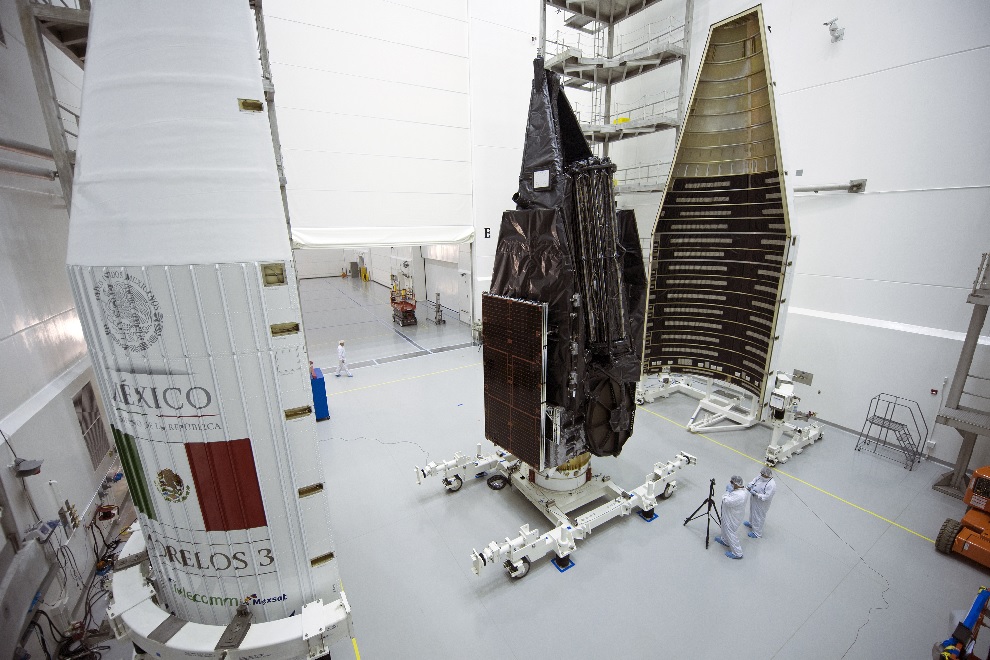
Like a bird, Morelos-3 is standing on its satellite mount awaiting encapsulation by the two XLPF fairing halves. Solar Panels, antennas and ‘what not’ mounted on a Boeing BSS-702HP satellite

The Atlas V 421 launch

Following the countdown, the launch of AV-059 began with the rocket igniting its RD-180 first stage engine 2.7 seconds ahead of the scheduled launch time.

This built up thrust in preparation for booster ignition and liftoff, with the rocket beginning to ascend once the thrust from its first stage and boosters exceeded the mass of the fully-fuelled vehicle – at approximately the T+1.1 second mark.

After clearing the tower, the Atlas began a series of pitch and yaw maneuvers about 5.8 seconds after liftoff to place it onto course for a south-easterly climb over the Atlantic Ocean.

At 46.7 seconds elapsed time AV-059 reached a speed of Mach 1, followed 12.3 seconds later by the rocket passing through the area of maximum dynamic pressure.

The solid rocket motors burnt out around ninety seconds after ignition, remaining attached until 127.4 seconds into the flight due to aerodynamic concerns regarding separation at too low an altitude.

The first stage burned for four minutes and 9.4 seconds, with stage separation taking place six seconds after Booster Engine Cutoff, or BECO.

Atlas V’s is heading south-easterly over the Atlantic Ocean. SRB’s and fairing halves lands close to Cape Canaveral, but the Core Booster crash lands some 2750 kilometer ±100 km downrange

Ignition of the Centaur’s RL10C-1 engine occurred ten seconds after staging, and the payload fairing separated eight seconds into its first burn.

The first burn of the Centaur’s engine lasted thirteen minutes and 36 seconds, establishing an initial parking and transfer orbit.

Following a coast phase lasting three tenths of a second more than two and a half hours, the RL10 will restart to raise the perigee of the orbit, reducing the satellite’s necessary fuel consumption to reach its final orbit. Lasting 51.5 seconds, this burn will conclude AV-059’s powered flight. Spacecraft separation is expected to occur two minutes and 49 seconds after its completion.

The target orbit for Friday’s launch has a perigee of 4,790 kilometers (3,000 miles, 2,600 nautical miles), an apogee of 35,800 kilometers (22,200 miles, 19,300 nautical miles) and inclination of 27 degrees. Morelos-3 will use its onboard RD-4 liquid-propellant motor to raise itself into geostationary orbit.

The Atlas V 421 rocket

The rocket that flew on Friday had tail number AV-059 and was operating in the Atlas’ 421 configuration. This consists of a Common Core Booster first stage powered by a single RD-180 engine, a single-engine Centaur upper stage powered by an RL10, and two Aerojet AJ-60A solid rocket motors augmenting the first stage during the early stages of flight.

The payload is encapsulated in a payload fairing with a diameter of four meters (13 feet); for Friday’s mission an Extra-Extended Payload Fairing (XPF) was used, the longest of the three available four-meter fairings.

Facts on the Atlas V 421 launch vehicle

Height of Atlas V 421: 194 feet (59.1 meters)

Mass at liftoff: 439,758 kg - 969,500 pounds

Thrust at liftoff: 7.1 mega-Newtons - 1.6 million lbf

Fuel onboard: 91,000 gallons of liquid propellant

LOX+LH2 = 66,000 gallon of cryogenic liquid propellant in three tanks

Core stage Atlas: 25,000 gallon RP-1 - 48,800 gallon LOX

Core stage weighs fully fueled 306,271.7 kilograms - 675,213.5 pounds

Core stage measures 35.63 meters - 116,9 feet tall and 3.81 meters - 12,5 feet wide

Core stage RD-180 main engine produces 3,826.9 kiloNewtons - 860,321.35 pounds of thrust at sea level while the thrust level increases to 933,406.73 pounds in space

Upper Stage Centaur: 13,050 gallon LH2 - 4,150 gallon LOX

Upper Stage Centaur weighs fully fueled 23,073 kilograms - 50,867.3 pounds

Upper Stage Centaur measures 12.68 meters - 41,6 feet tall - 3.05 meters - 10 feet wide

RL-10C-1 engine is optimized for vacuum usage with a big nozzle - engine bell, so it only produces 101.8 kilonewtons - 22,885.55 pounds in space

Centaur has 150 kg (340 lb) of Hydrazine - N2H4 is stored in a pair of bladder tanks

Centaur has Helium - He pressure vessel storage tanks: Unknown so far

Centaur has Nitrogen - N2 pressure vessel storage tanks: Unknown so far

Two AJ-60A SRB’s weighs 93,358 kilo - 205,898 pounds

Two AJ-60A SRB’s produces 3,336.8 kiloNewton - 759,200 lbf of thrust

SRB’s measures 17 meter - 55.75 feet in height and 1.6 meter - 5.17 feet in diameter

Atlas V 401 XEPF 4.2 meter fairings weigh 2,487.0 kilograms - 5,482.9 pounds

Atlas V 401 XEPF Payload Fairing measures 14.0 meter - 46 feet in length

Morelos-3 payload weighs 5 300 kg ~ 11 700 pounds

A: Geosynchronous Transfer Orbit - 3,243 x 22,000 miles (834 x 35,739 km x 18.9 deg)

Flight plan A includes a 58 second deorbit burn. Centaur second stage is scuttled. 

B: Geosynchronous Transfer Orbit - 3,243 x 22,000 miles (5,218 x 35,500 km x 17.6 deg)

Flight plan B includes a 58 second perigee raise burn. Centaur is derelict space debris.

Atlas V 421 split in its major parts with a generic satellite. Data details about Atlas V is inserted

NasaSpaceFlight: William Graham link

Gunter’s Space Page: Details Atlas link

Coauthor/Text Retriever Johnny Nielsen

link to ULA launch list - Link to ULA Fan


ULA – Vulcan – Peregrine Lunar Lander

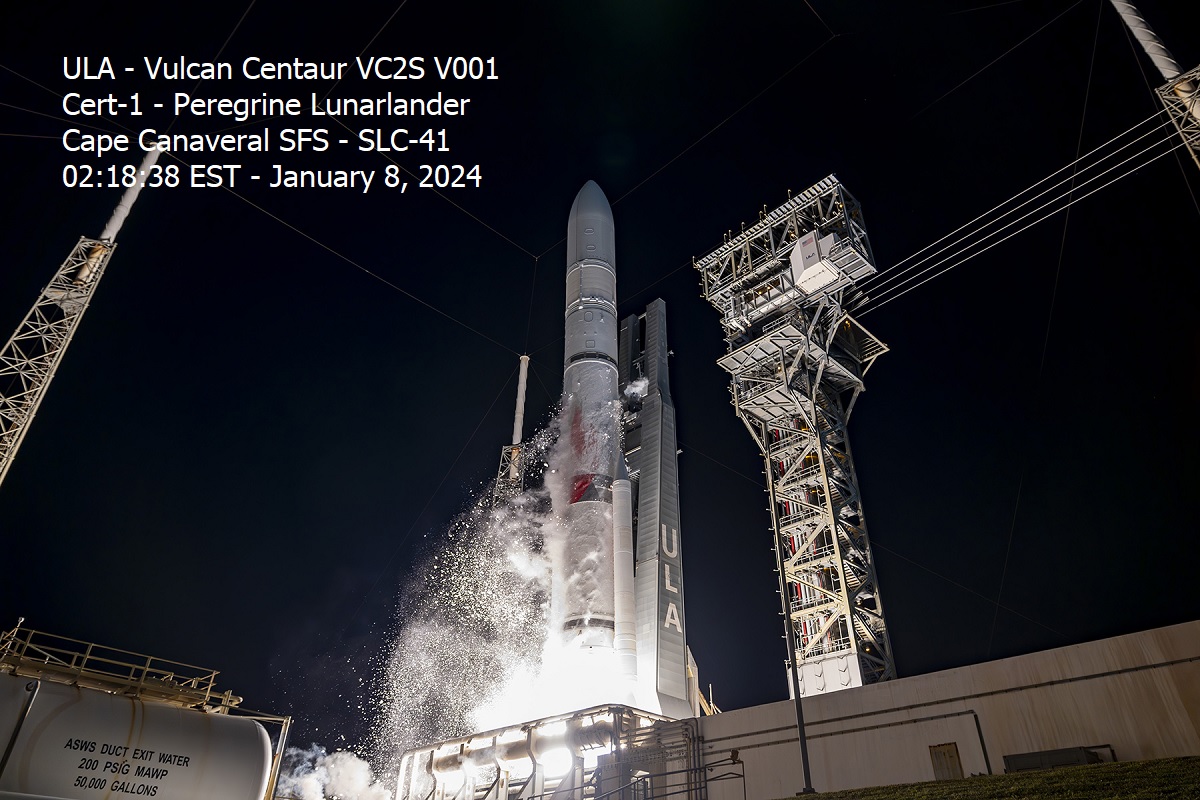
Photo from ULA of the Vulcan launch. I’ll huff. I’ll puff. And I’ll blow your pad away. Just you wait… Mission Rundown: ULA – Vulcan Centaur...