torsdag den 8. august 2019

ULA - Atlas V 551 - AEHF-5

Screenshot from ULA Webcast of the launch of AEHF-5. Caught in the headlights. What to do?

Mission Rundown: ULA - Atlas V 551 - AEHF-5

Written: September 14, 2021 - Edit: December 3, 2022

Lift Off Time

August 8, 2019 - 06:13:00 EDT - 10:13:00 UTC

Mission Name

AEHF-5

Launch Provider

ULA - United Launch Alliance

Customers

US Air Force

Space and Missile Systems Center

Rocket

Atlas V 551

Launch Location

Space Launch Complex 41 - SLC-41

Cape Canaveral Air Force Station, Florida

Payloads

Advanced Electronic High Frequency satellite ~ USA-292

TDO-2 - Laser ranging target - 12U CubeSat

Payload mass

6 113 kg ~ 13 510 pounds

Where did the satellites go?

TDO-1 - Geo- Transfer Orbit 207 x 35 262 km x 26,39° 

Geo- Transfer Orbit 14 435 km x 35 299 km x 9,95° 

Type of launch system?

Atlas Evolved Expendable Launch Vehicle + 5 SRB

The AJ-60A SRB’s fate?

In the Atlantic Ocean due east of SLC-41

The first stage landing zone?

Bottom of the Atlantic Ocean 2600 km downrange

Type of second stage?

Centaur RL-10C-1 engine - 16m 24s burn time

Is the 2nd stage derelict?

Yes - Main engine 3rd start/cutoff was 107 second

Change transfer orbit to 13 870 km x 35 279 km x 9,80° 

Type of fairing?

5,4 meter two part carbon composite fairing

This will be the:

– 134th flight of a ULA rocket

– 80th flight of a Atlas V rocket - AV-083

– 52nd ULA mission for the US Air Force

– 3rd mission for ULA in 2019

Where to watch

Where to read more

ULA YouTube link - Scott Manley saw shadows too

Want to know or learn more visit or see Tim Dodd


Launch debriefing

(That did happen)

FYI computer graphics are 9 seconds delayed

T-00:04:38

Host:

L-00:19:00

L-00:06:26

L-00:08:00

T-00:04:00

T 00:00:00

T+00:00:34

T+00:00:42

T+00:01:30

T+00:01:46

T+00:03:25

T+00:04:26

T+00:04:33

T+00:04:42

T+00:11:49

T+00:22:49

T+00:29:29

T+00:29:43

T+05:35:59

T+05:36:00

T+05:40:36

T+06:06:56

T+06:38:36

ULA live feed at 11:17 - Launch was set at 05:44 EST

Amanda Sterling

Planned 15 minute hold at 11:57

Extended hold awaiting solutions - clock reset at 48:48

Final Polling preparing the launch at 52:57

Release -4 minute hold at 55:57

Liftoff at 59:58 - No T+ clock - 10:13:00.246 UTC

Mach 1 at 1:00:32 - Speed Mach One 1225,5 km/h

MaxQ at 1:00:44 - Maximum aerodynamic pressure

SRB burn out at 1:01:28 - Still coughing up thrusts

SRB separation at 1:01:44 - Drop Off point 2 and 3

Fairing separation at 1:03:23 - Ice breaks away first

BECO at 1:04:24 - It’s all up to you, I’m empty now

Stage separation 1:04:31 - Just losing 90% weight

MES-1 at 1:04:44 - Doing 425 second of burn time

SECO-1 at 1:11:47 and coasting for 12 minutes

MES-2 to SECO-2 doing a 402 second GTO burn at 1:29:03

TDO-1 deployment at 1:29:31

Wrap up from ULA at 1:29:45 - End of broadcast

Coasting in 5 hours 36 minutes 0.0 seconds

MES-3 - SECO-3 in 107 seconds increased apogee

ULA doesn’t show AEHF-5 deployment

Centaur blowout of remaining gasses and fuel

Centaur 2nd stage becomes derelict space debris


Atlas V 551

AEHF-4

Delta IV Heavy

NROL-71

Delta IV M+5,4

WGS-10

Atlas V 551

AEHF-5

Delta IV M+4,2

GPS III SV02

Atlas V N22

OFT Starliner

Atlas V 411

Solar Orbiter

Atlas V 551

AEHF-6

Atlas V 501

OTV-6

Atlas V 541

Mars 2020

Oh can you see by dawn's early light

With the AEHF-5 mission, we get to experience another spectacular Atlas V 551 launch! Atlas V is built and launched by United Launch Alliance (ULA). For this mission an Atlas V 551 configuration will launch an Advanced Extreme High Frequency-5 (AEHF-5) satellite to Geostationary Earth Orbit for the United States military.

The attachment of five side-mounted solid rocket boosters (SRBs) to the Atlas first stage will generate three-quarters of the energy necessary at liftoff to power the vehicle on a complex, six-hour flight. The core Atlas booster will do the remaining 25%.

ULA’s Atlas V 551 launched from SLC-41, CCAFS August 8, 2019 at 06:13 EDT.

NOTAM hazard areas where Atlas V 551 will drop off SRB boosters, fairings and 1st stage

The number 5 obviously means a 5 meter fairing. The second number determines the number of strap on solid rocket boosters (SRBs). It can range from 0 to 5, and in this case, there are five on various sides of the center common core. The third and final number refers to the number of engine bells on the Centaur Upper Stage, which can be either one or two. In this case there will be one engine.

The AEHF-5 Payload

The fifth Advanced Extreme High Frequency-5 (AEHF-5) which is built by Lockheed Martin (power or bus) and Northrop Grumman. Its main goal is to provide a fast, highly reliable and secure connection for United States soldiers in all levels of conflict. The backbone of the Department of Defense communication are these satellites. Once they are in orbit they will be integrated into the Milstar (Military Strategic & Tactical Relay) constellation of military satellites.

For power, the A2100M satellite has two expandable five segment solar arrays that will use solar energy and convert it into electrical energy for the satellite to use. That conversion happens in the “bus” or the main power unit. There are batteries for nighttime operations, and fuel tanks feeding the Aerojet Rocketdyne XR-5 Hall Thrusters for station keeping purposes and a BT-4 liquid apogee motor to reach geostationary orbit from the transfer orbit Atlas 551 delivers it to.

Lockheed Martin is the prime contractor for the AEHF satellites, which are based on the company’s A2100M platform. With a mass at liftoff of 6,168 kilograms (13,600 lb), these large satellites have an expected on-orbit lifespan of at least fourteen years.

Each AEHF carries an IHI Aerospace BT-4 liquid apogee motor for initial orbit-raising, along with four Aerojet Rocketdyne XR-5 Hall thrusters which will complete insertion into geostationary orbit and aid in stationkeeping operations. Monopropellant thrusters are also present on the satellite to assist with control and maneuvering.

The AEHF constellation adds new enhancements over its Milstar predecessors, including an extreme data rate (XDR) capability in addition to the legacy low data rate (LDR) and medium data rate (MDR). XDR became fully operational with the entry into service of the AEHF-4 satellite, now named USA-288.

Launched last October, this satellite completed a ring of AEHF spacecraft in geostationary orbit, allowing signals to be routed around the globe. XDR offers data transfer at speeds of up to 8.192 megabits per second – up from maximums of 2.4 kilobits and 1.544 megabits per second achievable with LDR and MDR respectively. A single AEHF satellite provides greater total capacity than the entire legacy Milstar constellation.

Several different types of communications antennae are carried aboard AEHF-5 to support different applications. A low-gain antenna is used to transmit and receive across the visible disc of the Earth, while six medium-resolution coverage antennas (MRCA) produce 24 spot-beams covering specific areas.

A pair of high-resolution coverage antennae (HRCA) can be used to cut through jamming to ensure tactical communications with units in the field. Phased array antennae are used to provide worldwide spot beams where needed. An AEHF satellite provides enhanced global coverage compared to Milstar, operating up to 68 simultaneous worldwide beams.

Two cross-link antennas allow AEHF satellites to conduct bi-directional communications with other spacecraft in the AEHF and Milstar constellations. This allows signals to be routed across the constellation, passing directly between satellites without using a ground station as a relay.

AEHF crosslinks have a bandwidth of 60 megabits per second, compared to the 10 megabits per second possible between Milstar satellites. The enhanced capabilities of AEHF over Milstar give warfighters in the field access to faster and more resilient communications than were previously available to them.

As well as benefiting the United States, AEHF will be used by allied nations, including the United Kingdom, Canada and the Netherlands.

With its focus on secure tactical communications, AEHF is part of a US Military Satcom fleet that also includes the Wideband Global Satcom system geared towards more strategic communications. The US Navy’s Multi-User Objective System (MUOS) and the National Reconnaissance Office’s Satellite Data System (SDS), which relays data from surveillance satellites back for analysis.

The US Air Force’s Space and Missile Systems Center has since introducing its SMC 2.0 business model, a reorganization of the way the Air Force procures space missions aimed at making the process more efficient which was initiated at the end of July.

SMC have also integrated a Multi-Manifest Space Vehicle (MSV) rideshare into the launch mission, with the TDO satellite mounted to the aft bulkhead of the Centaur upper stage. TDO, a 12U CubeSat carrying a space debris investigation and tracking experiment, will share AEHF-5’s ride into orbit, separating before the primary – or anchor – payload.

The Atlas V 551 launch

Atlas quickly cleared its launch pad, beginning a series of pitch and yaw maneuvers to attain its proper trajectory 3.9 seconds after liftoff.

Climbing to the east over the Atlantic Ocean, Atlas reached the speed of sound, Mach 1, 34.4 seconds into her flight. Atlas passed through the area of maximum dynamic pressure – Max-Q – 11.8 seconds later. When flying with a five-meter fairing Atlas follows a steep ascent path, climbing to get above the atmosphere while the first stage is still burning.

The five AJ-60A solids burned for about 90 seconds, providing additional thrust to augment the RD-180 in the early stages of flight. After burning out the motors remained attached awaiting more favorable aerodynamic conditions for them to separate – minimizing the risk of the spent casings colliding with the rest of the rocket. The first two boosters separated 105.8 seconds after liftoff, with the other three following about a second later.

Once Atlas was clear of Earth’s atmosphere it shed the payload fairing that has encapsulated and protected AEHF-5 and Centaur during their ascent through the atmosphere.

Separating three minutes and 23.3 seconds into the flight, the fairing split into two parts and fell away from the vehicle, exposing AEHF-5 to space for the first time.

Just under 63 seconds after fairing separation, the Common Core Booster concluded its burn with Booster Engine Cutoff (BECO), when the RD-180 shut down having exhausted its supply of propellant. Stage separation six seconds later saw the spent booster discarded: Centaur then began its prestart sequence, igniting ten seconds after staging.

Centaur is powered by the RL10C-1 engine, a cryogenic power plant capable of making multiple burns to inject its payload into the planned orbit. For Thursday’s launch, the Centaur is equipped with a Geosynchronous Orbit Kit, allowing it to perform an extended mission and place AEHF-5 into a higher orbit than would otherwise be possible.

Centaur will make three burns to place AEHF-5 in a high-perigee geosynchronous transfer orbit. The first of these established an initial parking orbit – with the RL10 burning for 0.7 seconds short of seven minutes before main engine cutoff 1 (MECO-1).

After coasting for eleven minutes and 8.4 seconds Centaur restarted for its second burn, firing for six minutes and 3.4 seconds to raise the orbit’s apogee – the point farthest from Earth – to about 35,300 kilometers (21,900 miles, 19,100 nautical miles). TDO separated in this orbit, with the satellite deploying from Centaur’s aft bulkhead carrier 31 seconds after the burn ended.

Once TDO separated, Centaur’s mission entered an extended coast phase as the stage climbed towards apogee. Five hours and thirty-six minutes after liftoff it will reach apogee and the RL10 restarted for its third burn. This lasted one minute and 46.6 seconds, raising the perigee – or lowest point – of Centaur’s orbit. This burn reduces the amount of fuel AEHF-5 must burn to reach geostationary orbit, giving the satellite increased prospects for an extended mission.

At five hours, 40 minutes and 35.7 seconds mission elapsed time – two minutes and 49.1 seconds after the end of the third Centaur burn, AEHF-5 separated to begin its mission. The target separation orbit is 14,435.3 by 35,298.7 kilometers (8969.66 by 21933.6 miles, 7794.42 by 19,059.8 nautical miles) at an inclination of 9.95 degrees and with an argument of perigee of 180 degrees.

About 26 minutes and 20 seconds after AEHF-5 has separated, a blowdown of Centaur’s tanks will be performed to reduce pressure and minimize the danger of the stage exploding in orbit. With this complete, the Atlas mission will officially end six hours, thirty-eight minutes and 35.7 seconds after lifting off from Cape Canaveral.

Once on orbit, AEHF-5 will receive a designation under the USA series, assigned to most US military satellites. It is expected to become USA-292 in orbit.

The satellite will use its own propulsion systems to climb out of its initial deployment orbit and reach geostationary orbit. After determining its position and orientation relative to the Earth, the satellite will execute a series of three burns with its liquid apogee motor, raising the perigee and inclination of its orbit.

The Atlas V 551 rocket

Atlas V is a two-stage rocket consisting of a Common Core Booster (CCB) first stage with a Centaur upper stage. Depending on the size and mass of its payload, the target orbit and other mission requirements, Atlas can fly in several different configurations.

These use varying numbers of solid rocket boosters to augment the first stage, single and dual-engine versions of the Centaur and four or five meter (13.1 or 16.4 foot) diameter payload fairings to accommodate different satellites.

Thursday’s launch used the 551 configuration, with a five-meter fairing, five solid rocket boosters and a single-engine Centaur. This is the most powerful version of Atlas V to have been developed. The rocket that performed Thursday’s launch has tail number AV-083.

Atlas V with production number AV-083 launched from Space Launch Complex 41 (SLC-41) of the Cape Canaveral Air Force Station on Florida’s Space Coast.

AV-083 was moved to the launch pad on Tuesday ahead of the AEHF-5 launch. With Atlas in position, on Wednesday RP-1 propellant, a form of rocket-grade kerosene was loaded into its first stage tanks.

The Atlas V first stage will hold 94.6 cubic meters or 25 000 gallons of RP-1 kerosene fuel and 185.5 cubic meters or 49 000 gallons of liquid oxygen to feed the RD-180 main engine during the initial four-and-a-half minutes of the rocket's ascent.

Varius tweets from ULA launch stating the following numbers: 48800 gallon lox in 1st stage - 66000 gallon lox and H2 in both 1st and 2nd stage - 4150 gallon lox in 2nd stage - 12300 gallon H2 in 2nd stage. It’s a numbers game until confirmed by other sources.

The fully-assembled Atlas V 551 rocket stands 197-foot-tall. Weighs 1.3 million pounds.

The first stage burns RP-1, oxidized by liquid oxygen, while Centaur uses liquid hydrogen and liquid oxygen. Because of their extremely low boiling points, these cryogenic liquids were not loaded onto the rocket until Thursday’s countdown was well underway.

The three different orbits LEO - GTO - HGTO that AEHF-5 will use during this mission - Centaur 2nd stage will after payload separation be derelict space debris in the last orbit - High GTO

Thursday’s launch began with ignition of the RD-180 main engine at the base of Atlas’ Common Core Booster, which roared to life 2.7 seconds before the countdown reached zero. Atlas lifted off at T+1.1 seconds, with the five Aerojet AJ-60A solid rocket motors clustered around the first stage igniting.

The AEHF-5 mission, this rocket has a five-meter fairing, five solid rocket boosters, and one engine on the Centaur Upper Stage.

It’s unique to the Atlas rocket to have their solid rocket boosters (SRBs) positioned in this way. When, like in this case, 5 SRBs are used, they are positioned with two on one side and three directly opposite of them. If you notice carefully in the image of Atlas core boosters, there are long and somewhat flat pipes “running” down the side of the first core stage. These are raceways and carry fuel from the tanks down to the engines and some carry gasses back up to the tanks to pressurize them so the fuel stays flowing out the pipes.

Graphic of Atlas V 551 split in its major parts. Four fairing parts are put together when Centaur and AEHF-5 are stacked on top of eachother in the High Integration Facility HIF.

When Atlas was designed, these two raceways were placed in their positions without the thought of SRB placement. So when more SRBs were needed, they were placed in the most convenient spot. Two SRB between the raceways and three opposite them.

The offset of the thrust won’t make it fly in the wrong direction. The engines on the core stage can gimbal, they counteract that offset of thrust by vectoring their thrust which is known as thrust vector control, or TVC. The SRBs, and most of them for that matter, do not have TVC abilities, but their nozzles can be angled and turned slightly sideways. That will counteract some of that offset SRB thrust.

Everyday Astronaut: Lost in pre 2020’s

NasaSpaceFlight: William Graham link

Coauthor/Text Retriever Johnny Nielsen

link to ULA launch list - Link to ULA Fan


fredag den 15. marts 2019

ULA - Delta IV M+5,4 - WGS-10

Screenshot from ULA Webcast of the launch of WGS-10. Don’t worry. I’ll hold you until you must go

Mission Rundown: ULA - Delta IV M+5,4 - WGS-10

Written: September 16, 2021 - Edit: December 3, 2022

Lift Off Time

March 15, 2019 - 20:26:00 EDT

March 16, 2019 - 00:26:00 UTC

Mission Name

WGS-10

Launch Provider

ULA - United Launch Alliance

Customer

DoD - Department of Defence

Rocket

Delta IV M+5,4

Launch Location

Launch Complex 37B - LC-37B

Cape Canaveral Air Force Station, Florida

Payload

Wideband Global Satcom Satellite ~ USA-291

Payload mass

5 987 kg ~ 13 172 pounds

Where did the satellite go?

Geo- Transfer Orbit - 470 km x 44 255 km x 26,98° 

Type of launch system?

Delta Evolved Expendable Launch Vehicle + 4 SRB

The GEM-60 SRB’s fate?

In the Atlantic Ocean due east of SLC-37B

The first stage landing zone?

Bottom of the Atlantic ocean 2600 km downrange

Type of second stage?

5 meter Delta Cryogenic Second Stage (DCSS) with a RL10B-2 engine - 16m 24s burn time

Is the 2nd stage derelict?

No - DCSS engine 3rd start/cutoff was 10 seconds

New orbit is -180 km x 44 520 km x 26.17° - Diving in

Type of fairing?

5.4 meter two part carbon composite fairing

This will be the:

– 133rd flight of all ULA rockets

– 383rd flight of all Delta rocket of all types

– 39th flight of a Delta IV M rocket

– 51st ULA mission for US Air Force and DoD

– 2nd mission for ULA in 2019

Where to watch

Where to read more

ULA YouTube link

Want to know or learn more visit or see Tim Dodd


Launch debriefing

(This did happen)

Lift off occurs when thrust equals the mass of the rocket

Thrust higher than the mass is G force over the normal gravity on Earth - Its so called drag

All rockets must fight the gravity drag during ascent

Every second of launch fuel is wasted beating the gravity drag

Thrust in g force always start at minus one g

T-00:09:39

Host:

T-00:04:00

L-00:12:28

L-00:07:00

T-00:04:00

T 00:00:00

T+00:00:35

T+00:00:47

T+00:01:33

T+00:01:40

T+00:03:19

T+00:03:56

T+00:04:02

T+00:04:15

T+00:19:29

T+00:29:29

T+00:36:50

T+00:37:01

T+01:12:00

T+02:19:30

T+11:58:27

ULA live feed at 18:28

Andrea Lehnhoff

Planned 10 minute hold at 24:10 - Hold extended

Extended hold solved all problems by 1:42:42

Final Polling preparing the launch at 1:47:10

Release -4 minute hold at 1:50:10

Liftoff at 1:54:10 - No T+ clock - 00:26:00.18 UTC

Mach 1 at 1:54:45 - Speed Mach One 1225,5 km/h

MaxQ at 1:54:57 - Maximum aerodynamic pressure

SRB burn out at 1:55:43 - Still coughing up thrusts

SRB separation at 1:55:50 - Drop Off point 2 and 2

Fairing separation at 1:57:29 - It’s too dark to see

BECO at 1:58:06 - It’s a relay, here’s the batton

Stage separation 1:58:12 - Just losing 90% weight

MES-1 at 1:58:25 doing a 914 second orbit burn

SECO-1 at 2:13:39 - Coasting for 10m - Unseen

MES-2 to SECO-2 - Doing a 200 seconds GTO burn

ULA shows deployment of WGS-10 at 2:31:04

Wrap up from 2:31:13 - End of webcast

MES-3 - SECO-3 - Doing a 10 seconds deorbit burn

DCSS blowout of remaining gasses and fuel

DCSS enters Earth's atmosphere in 44 g dive


Atlas V 551

AEHF-4

Delta IV Heavy

NROL-71

Delta IV M+5,4

WGS-10

Atlas V 551

AEHF-5

Delta IV M+4,2

GPS III SV02

Atlas V N22

OFT Starliner

Atlas V 411

Solar Orbiter

Atlas V 551

AEHF-6

Atlas V 501

OTV-6

Atlas V 541

Mars 2020

Time to set up more antennas

United Launch Alliance deployed a Wideband Global Satcom satellite for the US Air Force Friday on a Delta IV M+5,4 rocket. WGS-10 lifted off from SLC-37B on the Cape Canaveral Air Force Station at 20:26 EDT on Friday, March 15, 2019 - 00:26 UTC on Saturday.

WGS-10 was carried into orbit by United Launch Alliance’s Delta IV rocket, which will be flying in its Medium+(4,5) configuration. Friday’s launch was expected to be the last time that this version of the Delta IV – which has been used exclusively to launch WGS satellites – flies. One more GPS launch was approved, so this Friday's launch was the penultimate second to last medium class Delta IV launch remaining on ULA’s manifest – July’s GPS launch will be the final flight of the Delta IV Medium+.

Friday’s launch was targeting a low-inclination geosynchronous transfer orbit; the rocket needs to fly to the East and be launched from the East Coast on SLC-37B.

The WGS-10 Payload

Wideband Global SATCOM - WGS-10 satellite vehicle is the latest part of a growing constellation of highly-capable communications satellites that serve the armed forces of the United States and its allies.

WGS satellites are based around Boeing’s BSS-702 bus, with each satellite equipped for a service life of at least fourteen years. The satellites are powered by solar panels, with propulsion coming from a liquid-fuelled R-4D-15 High Performance Apogee Thruster (HiPAT) and four Xenon-Ion Propulsion System 25 (XIPS-25) stationkeeping thrusters. Each satellite has a mass of about 6,000 kilograms (13,200 lb).

As WGS launches have continued, the capabilities of the satellites have been upgraded. The first three spacecraft were built to the Block I specification, while from the fourth spacecraft onwards the Block II spacecraft featured an RF bypass function to allow for extremely high bandwidth operations – such as relaying data from unmanned aerial vehicles (UAVs) on reconnaissance flights.

WGS-10 is the fourth Block II follow-on satellite and supports communications links in the X-band and Ka-band spectra. While Block I and II satellites can instantaneously filter and downlink up to 4.410 GHz, WGS-10 can filter and downlink up to 8.088 GHz of bandwidth. Depending on the mix of ground terminals, data rates and modulation and coding scheme employed, a single WGS satellite can support data transmission rates over 6 Gbps, and WGS-10 with its advanced digital channelization may support over 11 Gbps.

The Delta IV Medium+ launch

Delta IV is designed around the Common Booster Core (CBC), a modular rocket stage fuelled by liquid hydrogen and liquid oxygen, with an Aerojet Rocketdyne RS-68A engine providing thrust. In the rocket’s Medium configuration, one CBC serves as the rocket’s first stage, while the Medium+ versions augment this with two or four GEM-60 SRB’s.

Delta IV M+ first stage tank is being loaded with 416.4 cubic meters or 110,000 gallons of super-cold liquid hydrogen that is chilled to minus 222 degrees Celsius or -423 degrees Fahrenheit. The tank must be bigger to hold the hydrogen excess gas pressure.

The Oxygen tank holds 40 000 gallon of liquid Oxygen chilled to below -182,96 0C Celsius or -297,33 0F Fahrenheit in a tank measuring about 151,4 m3 in estimated tank volume.

I wonder how many gallons of liquid Oxygen can fit in the pipelines in the raceway?

The Delta Cryogenic Second Stage (DCSS) is powered by an RL10B-2 engine and also burns liquid hydrogen and oxygen. Versions of the DCSS with diameters of four and five meters have been used: 4 meters with the Medium and Medium+(4,2) configurations, and 5 meters with the remaining Medium+ versions and the Delta IV Heavy.

Delta IV Medium+(5,4) split in its major parts. The bottom tank holds 416.4 M3 liquid hydrogen.

Continuing up the rocket comes the second stage. The smaller Delta Cryogenic Second Stage (DCSS) is powered by a single, vacuum optimized RL10B-2 engine. For its fuel, the DCSS uses liquid hydrogen (LH2) and for the oxidizer, liquid oxygen (LOX).

The LH2 tank - volume of 38 m3 holding 10 000 gallon LH2 - being on top, has the job of supporting the payload and the payload fairing with a strut gage of two rings and is also structurally separated from the other ‘half’ of DCSS.

The even smaller LOX tank - volume of 23 m3 holding 6 000 gallon LOX - is suspended in a strut gage of two rings below it and is responsible for structurally supporting the RL10B-2 engine. The LOX tank is spherical in size of material, insulation and structural purpose.

The Delta IV Medium+(5,4) that will perform Friday’s launch had one five-meter Common Booster Core, four GEM-60 solid rocket motors, and a five-meter DCSS. The continuous numbering of Delta launches that began with NASA’s Thor-Delta vehicles in the 1960s, this launch will be marked as Delta 383.

Friday’s launch was the thirty-ninth flight for the Delta IV. The launch began with ignition of Delta 383’s first stage RS-68A engine with about 2.7 seconds remaining on the countdown clock. At zero, the four GEM-60 boosters ignited and Delta lifted off, beginning the journey into orbit. After clearing its launch pad, Delta executed a series of pitch, roll and yaw maneuvers beginning 5.8 seconds after liftoff to put it onto the correct trajectory for geosynchronous transfer orbit.

A little over 35 seconds after liftoff, Delta IV reached Mach 1, the speed of sound. At 47.2 seconds into its flight, the rocket passed through Max-Q, the area of maximum dynamic pressure. This is the point in Friday’s launch at which the rocket experienced the greatest stress from aerodynamic forces, as a result of the combined effect of its increasing velocity, and the outside air density which decreases as the rocket climbs.

Delta 383’s solid rocket motors burned out and separated in pairs. The first two – motors 3 and 4 – burned out 93.4 seconds into the mission, with the second pair following a second later. The first pair of boosters separated at 100 seconds mission elapsed time, with the second booster separation after another 2.4 seconds.

Once it reached space, Delta IV no longer needed its payload fairing – the structure at the nose of the rocket which was used to protect WGS-10 from the atmosphere during ascent. This was jettisoned three minutes and 19 seconds into the flight, separating into two halves that fall away from the rocket as it continues toward orbit. Booster Engine Cutoff (BECO) – the shutdown of the Common Booster Core’s engine after it has depleted its propellant – came at three minutes and 55.8 seconds after launch.

The spent first stage separated six and a half seconds after cutoff, with the second stage’s RL10B-2 engine deploying its extendable nozzle to prepare for its own startup. It lit 13 seconds after staging, to begin the first of three planned burns during Friday’s mission.

The first burn lasted fifteen minutes and 14.3 seconds, placing Delta and its payload into an initial parking orbit. Exactly ten minutes later the RL10 ignited again for its second burn – this three-minute, 20.4 second burn injected WGS-10 into its transfer orbit. The satellite separated from the launch vehicle four minutes later, at 36 minutes and 50 seconds mission elapsed time.

At separation, Delta and WGS-10 was in an elliptical geosynchronous transfer orbit with a perigee of 433.9 kilometers (269.6 miles, 234.3 nautical miles) and an apogee of 44315.6 kilometers (27536.4 miles, 23928.5 nautical miles), inclined at 27.0 degrees to the equator and with an argument of perigee of 178.0 degrees. This is a supersynchronous transfer orbit, taking WGS-10 slightly above the geostationary belt, which reduces the amount of fuel that the satellite needs to use to raise its orbit. WGS-10 will perform a series of maneuvers under its own power to reach its final slot in geostationary orbit.

Delta’s upper stage made its third and final burn 35 minutes and 10.2 seconds after spacecraft separation. Lasting just ten seconds, this deorbited the stage, placing it on course to re-enter the atmosphere over the Pacific Ocean a little under eleven hours later. The upper stage burns up when it re-enters the atmosphere, with any surviving debris falling harmlessly into the sea. The deorbit burn is performed to ensure that as little unnecessary debris is left in orbit as possible – since the stage serves no further useful purpose after deploying its payload.

Everyday Astronaut: Lost in pre 2020’s

NasaSpaceFlight: William Graham link

Coauthor/Text Retriever Johnny Nielsen

link to ULA launch list - Link to ULA Fan


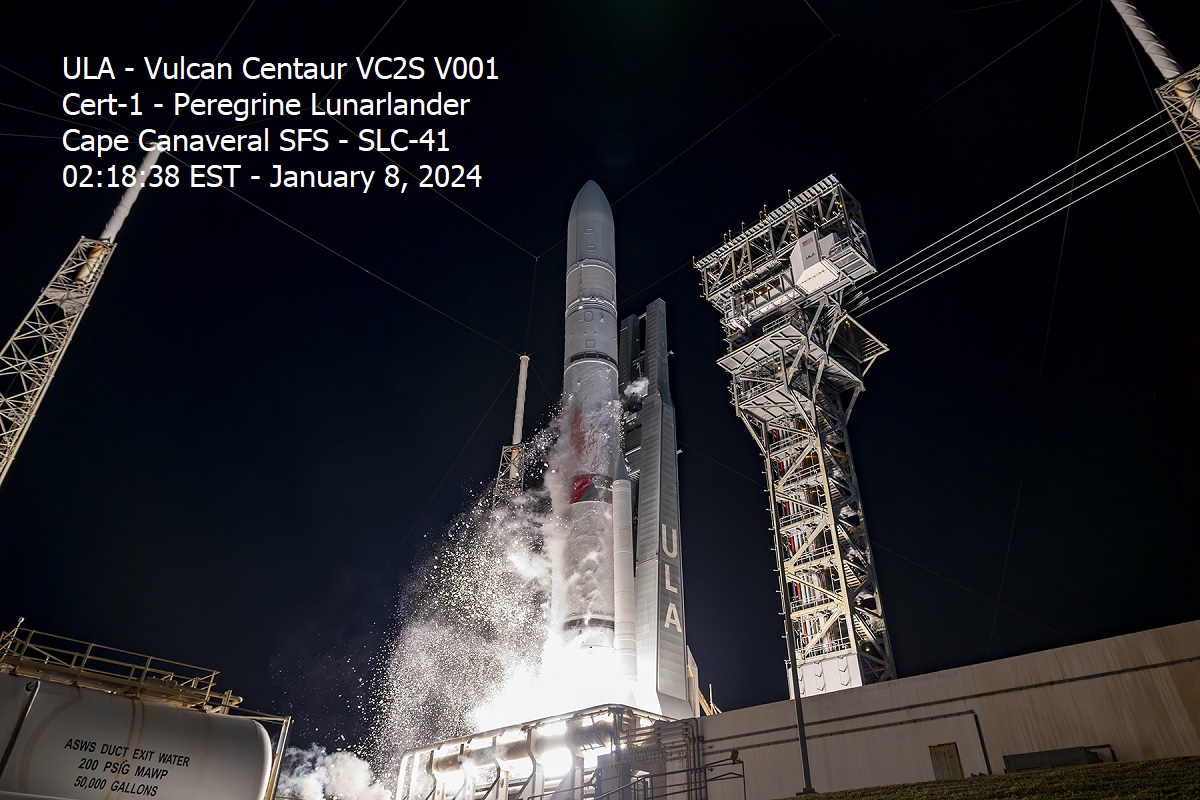
ULA – Vulcan – Peregrine Lunar Lander

Photo from ULA of the Vulcan launch. I’ll huff. I’ll puff. And I’ll blow your pad away. Just you wait… Mission Rundown: ULA – Vulcan Centaur...