torsdag den 30. juli 2020

ULA - Atlas V 541 - Mars 2020

Screenshot from ULA/NASA Webcast of the launch of Mars 2020. Boiling of LOX vapors just now

Mission Rundown: ULA - Atlas V 541 - Mars 2020

Written: September 7, 2021 - Edit: November 28, 2022

Lift Off Time

July 30, 2020 - 07:50:00 EDT - 11:50:00 UTC

Mission Name

Mars 2020 - Perseverance

Launch Provider

ULA - United Launch Alliance

Customer

NASA

Rocket

Atlas V 541

Launch Location

Space Launch Complex 41 - SLC-41

Cape Canaveral Space Force Station, Florida

Payload

Cruise spacecraft with the Aeroshell EDL, Skycrane and the Perseverance Rover as the final payload

Payload mass

1 050 kg ~ 2 315 pounds

Where did the satellite go?

Initial orbit is 167 km x 250 km x 29.11° 

Planet Transfer Orbit - Jezero Crater, Mars

Type of launch system?

Atlas Evolved Expendable Launch Vehicle + 4 SRB

The SRB rocket’s fate?

In the Atlantic Ocean due east of SLC-41

The first stage landing zone?

Bottom of the Atlantic ocean 2600 km downrange

Type of second stage?

Centaur RL-10C-1 engine - 875 second burn time used

Is the Centaur stage derelict?

Yes - Main engine 3rd start/cutoff was impossible

New Heliocentric orbit is unknown

Type of fairings?

5,4 meter two part carbon composite fairing

This will be the:

– 140th flight of all ULA rockets

– 85th flight of an Atlas V rocket - Tail no. AV-088

– 5th flight to Mars using an Atlas V rocket

– 35th mission for NASA Launch Service Program

– 4th mission for ULA in 2020

Where to watch

Where to read more

ULA and NASA YouTube link - Perseverance landing link

Want to know or learn more visit or see Tim Dodd


Launch debriefing

(This to happen)

The second burn gave Mars 2020 a boost from 7,35 m/s in a Low Earth Orbit to 12,84 m/s into a Mars transfer orbit

T-00:18:07

Hosts:

L-00:47:14

Hosts 2:

T-00:04:00

L-00:06:00

T-00:04:00

T 00:00:00

T+00:00:35

T+00:00:50

T+00:01:32

T+00:01:49

T+00:03:26

T+00:04:23

T+00:04:27

T+00:04:40

T+00:11:25

T+00:45:00

-

T+00:57:32

T+00:58:32

T+01:23:53

ULA/NASA live feed at 00:35

NASA: Derrol Nail, Moogega Cooper, Lori Glaze

Launch clock in the corner at 01:29

Mic Woltman, Joshua Santora, Raquel Villanueva JPL

Planned 30 minute hold at 14:42 - L-00:34:00

Final Polling preparing the launch complete at 42:42

Release -4 minute hold at 44:42

Liftoff at 48:42 - Flight telemetry on - 11:50:00.2 UTC

Mach 1 at 49:18 - Speed Mach One 1225,5 km/h

MaxQ at 49:32 - Maximum aerodynamic pressure

SRB burn out at 50:15 - Small thrusts coughing up

SRB separation at 50:32 - First 2 then 2 drop of

Fairing separation at 52:09 - We’re in space now

BECO 53:06 - Atlas V core booster is empty

Stage separation 53:10 - Just losing 95% weight

MES-1 at 53:23 - 405 second burn time

SECO-1 at 1:00:09 - Centaur coasting in Low Earth Orbit

MES-2 to SECO-2 in 470 seconds gave a velocity boost from 26 477 km/h to 46 136 km/h? at 1:33:43

Deployment at 1:46:15 - Follow Perseverance 

Wrap up from ULA only - NASA in chat mode - 1:47:15

MES-3 - SECO-3 was not evident - Blow out link


Atlas V N22

OFT Starliner

Atlas V 411

Solar Orbiter

Atlas V 551

AEHF-6

Atlas V 501

OTV-6

Atlas V 541

Mars 2020

Atlas V 531

NROL-101

Delta IV Heavy

NROL-44

Delta IV Heavy

NROL-82

Atlas V 421

SBIRS GEO-5

Atlas V 401

Landsat 9

All that just to fly by Mars

Liftoff of the third mission to Mars during the current interplanetary transfer window at the start of a Earthly two hour launch window that opens at 07:50 EDT.

ULA’s Atlas V 541 launched from SLC-41, CCAFS at 07:50 EDT with the Perseverance rover in its 5 meter fairing. Climbing to an initial orbit of 270 km (167 miles), the Centaur upper stage then boosted the rover towards Mars.

The accuracy of the launch was to ULA standards only using 3.3% of the requirement for a successful launch towards Mars, that’s a bullseye. Actually the 2nd stage Centaur is deliberately missing Mars, the cruise stage spacecraft will correct its course toward Mars after the Centaur 2nd stage has secured itself for a life as a piece of deep space debris going in a Heliocentric orbit between Earth and Mars.

For the Mars 2020 mission, the configuration of the Atlas V is a 541 configuration. The last three numbers or letters in the Atlas V’s name denote the configuration of the rocket. The first number/letter shows the fairing diameter size (in meters, of course). The number 5 in this case stands for a 5 meter fairing. Following, the second number determines the number of strap-on solid rocket boosters (SRBs) which can range from 0 to 5, and in this case, there are 4 strapped on to the side of the center common core. Finally, the number refers to the number of engine bells on the Centaur Upper Stage.

The Atlas V 541 rocket is being loaded with 25000 gallon RP-1 and 48800 gallon LOX in the first stage. The Centaur stage is being loaded with 4500 gallon LOX and 12300 gallon LH2. About 500 gallon is reserved for Helium backfill and RCS thruster propellants.

The Atlas V 541 rocket AV-088 stands 60 meters - 197 feet tall and weighs in at 530770 kg - 1170150 pounds at liftoff.

The Mars 2020 Payload

The only part of the spacecraft left after launch was Perseverance which is enclosed in its aeroshell. This shell acts as protection, but also hosts the power and course correction propulsion systems. Throughout this time, mandatory health and communications checks were performed by NASA’s specially trained team of engineers and mission specialists. Towards the end preparations began for the Entry, Descent and Landing (EDL).

Also known as the “7 minutes of terror”, this phase of Perseverance’s flight is dubbed as the most terrifying by engineers and space fans. Due to the fact that Mars is so far away from Earth and communications are limited to the speed of light, the transmission signals can take about 12 minutes to reach Earth. That’s a 24 minute round-trip. All the data that the teams saw happened 12 minutes prior. By the time engineers received the signal that Perseverance had entered the atmosphere, it was already on the ground.

After six months of cold space travel, the Perseverance rover, as part of the Mars 2020 mission, has safely touched down on Mars at 20:43 UTC with the signal being received at 20:55 UTC. The sequence from cruise stage separation to the sky crane deployment and lowering of the rover, everything was nominal and Mars now has another human-made marvel on its surface.
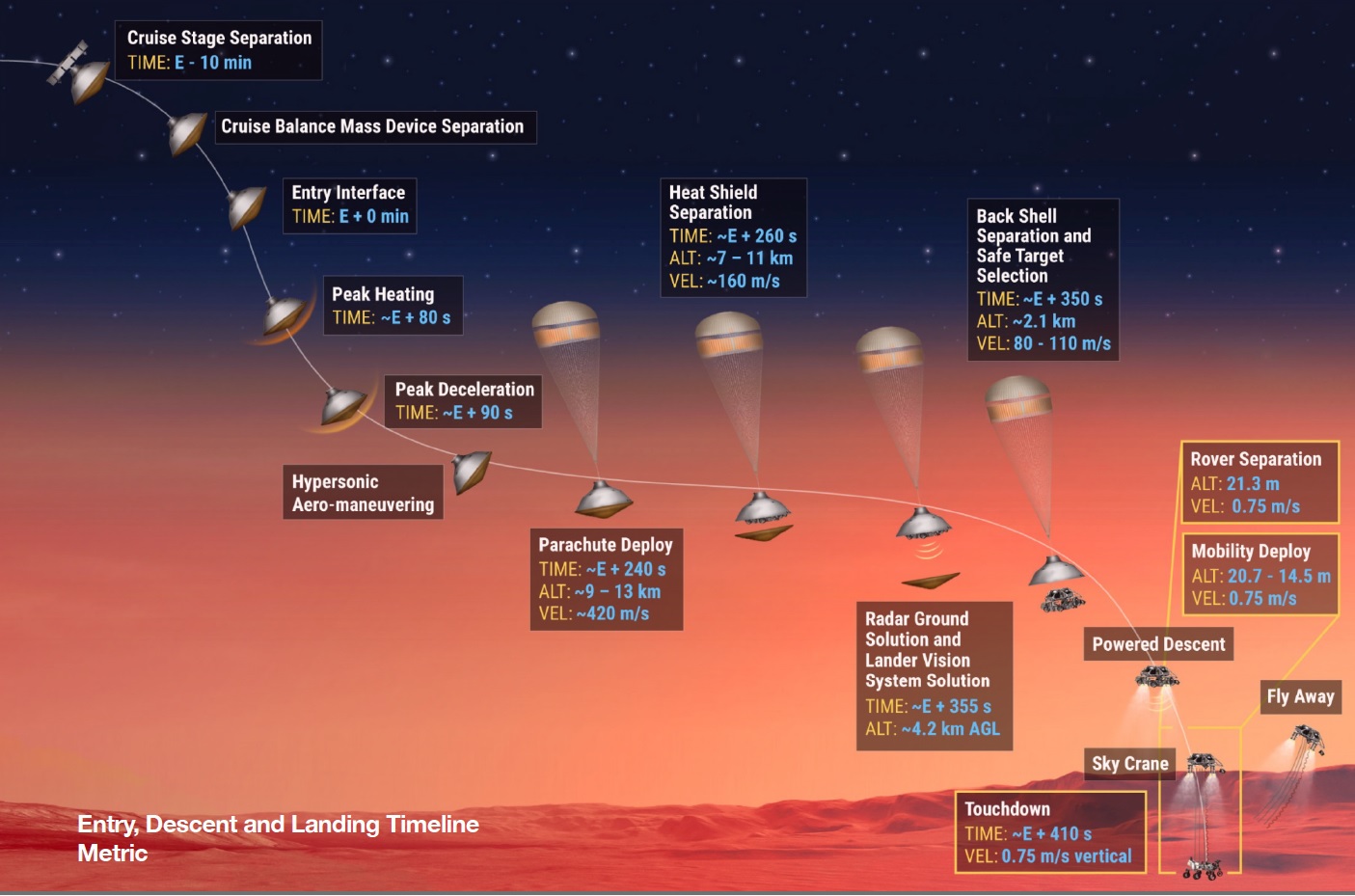
Graphic of Perseverance descent in the Aeroshell and landing on Mars. Credit: NASA/JPL

List of events happening during EDL

Cruise stage separated to be burned up in the Martian atmosphere

Entry of the landing craft into the Martian atmosphere began

At roughly 2,100 degrees Celsius, the heat shield experienced maximum heating

The landing craft experienced the maximum deceleration. Slowing from 21 200 km/h (13 200 mph) to just 1 600 km/h (1 000 mph) in only two and a half minutes

The parachute deployed from the back shell at an altitude of 9 to 13 km (6 to 8 miles)

Heat shield separation from the back shell and the ground radar systems on the Skycrane activated to define a suitable landing area

Back shell separation from the Skycrane as the rover began a moment of freefall before the landing motors on the Skycrane ignited

At around 21 meters (70 feet), the rover separated from the Skycrane landing stage tethered to it by three nylon ropes and was gently set down at 2.7 km/h (1.7 mph). The Skycrane then flew away and crashed into the surface at a safe distance.

Perseverance takes a number of pictures, selfies and establish contact with Earth

NASA sought to capitalize on the success of Curiosity and the overall science platform of that rover’s design with the Mars 2020 vehicle, incorporating lessons learned and expanding the new rover’s overall capabilities to include detection of the biosignatures of past microbial life as well as collection and bottling of Martian samples.
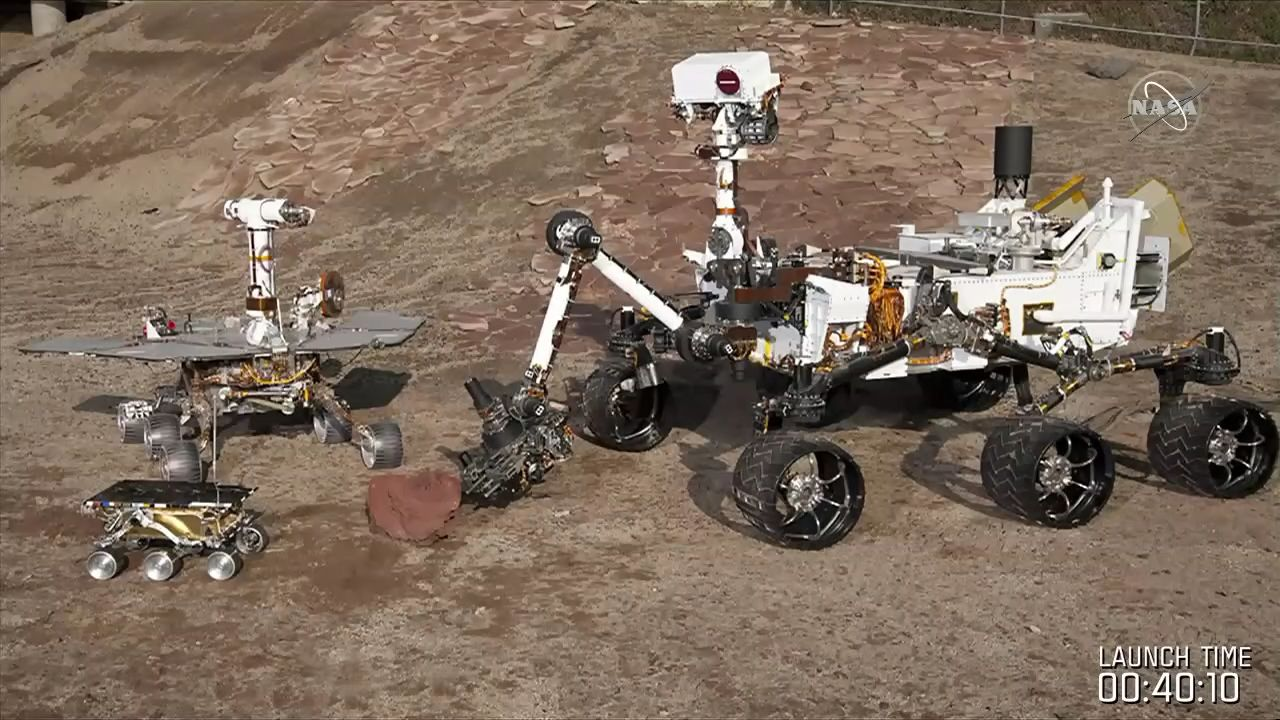
Screenshot of the size difference between rovers on Mars. Perseverance is slightly bigger than Curiosity. The rovers Spirit and Opportunity were dropped encapsulated with lots of airbags

These changes with the finalized suite of scientific instruments, brought Perseverance’s overall mass to 1,025 kg, heavier than Curiosity (at 899 kg). Unpacked from its aeroshell of heat shield, back shield, skycrane and parachutes, that’s all that's left.

Given the overall demand of the mission and its baseline from that of Curiosity’s, Perseverance carries a Multi-Mission Radioisotope Thermoelectric Generator, or MMRTG, that is in fact a backup to the one used for Curiosity.

The MMRTG — via the natural decay of plutonium-238 — will provide a consistent 110 watts of power as well as heat throughout the mission and offers a potential operational lifetime of 14 years for the rover. MMRTG is the last loading item on the VIF building, it weighs 44.9 kilos - 99 pounds and is placed on Perseverance through access doors in both the fairing and the back shell of the aeroshell.

The Ground Support Equipment - GSE - needed to install the Radioisotope Thermoelectric Generator - RTG - is bulky at best. It takes two technicians with supervising support personnel to shift the RTG through the fairing access door, place it on a hydraulic slide, open the access panel in the back shell, press it in place, hook up all electric and fluid connectors and bolt the RTG fast to Perseverance.

All this happens while the rocket is vertical in the VIF building 400 meters from the launch pad SLC-41, and the spacecraft with Perseverance is placed upside down in the fairing. Another problem is the production of heat and electricity by the RTG. That must be dealt with and be removed by cooling the spacecraft with chilled nitrogen gas and using the electricity to charge batteries or power the rocket during launch.

Use of a nuclear power source allows science operations to occur at any time and during most seasonal conditions on Mars, including during the planet’s notorious dust storms — the last major one of which claimed the operational life of the Opportunity rover and the InSight mission which both relied on their solar panels for power.

Future solar powered missions to other planets must have a tool to clean solar cells.

Perseverance is also equipped with two rechargeable lithium-ion batteries to aid operations during peak scientific demands, a few of which are predicted to exceed the maximum continuous output of 110 watts from the MMRTG.

Surface Operations after arrival

Landing is timed for approximately 3:45 p.m. local mean solar time at Jezero Crater, Mars, on 18 February 2021.

After landing, the rover’s computers will automatically switch from Entry, Descent, and Landing mode to Surface mode and begin a series of autonomous activities and checkouts for its first day on Mars, officially known as Sol 0.

A “Sol” is a single Martian day, lasting 24 hours 39 minutes 35 seconds, and will be the official time keeping designation used for the mission.

Surface Operations will commence in a few days and weeks after arrival. Some of the initial operations included deployment of the communications antennae and taking images of its surroundings.

The mission is scheduled to last about one Martian year, or 687 Earth days. However, the team will often refer to mission days as “Sols” or Martian days. In this case, the mission will last 669 sols. The first 90 sols will consist of initial checkouts of all of Perseverance’s systems to ensure that they are all functioning properly.

Shortly after touchdown, Perseverance began taking images of the surface and its surroundings so scientists and engineers had a better idea of the landing site.

During this initial period, the team will be on Martian time, which means starting their shifts 40 minutes earlier each day because one Sol is approximately 40 minutes longer than one Earth day.
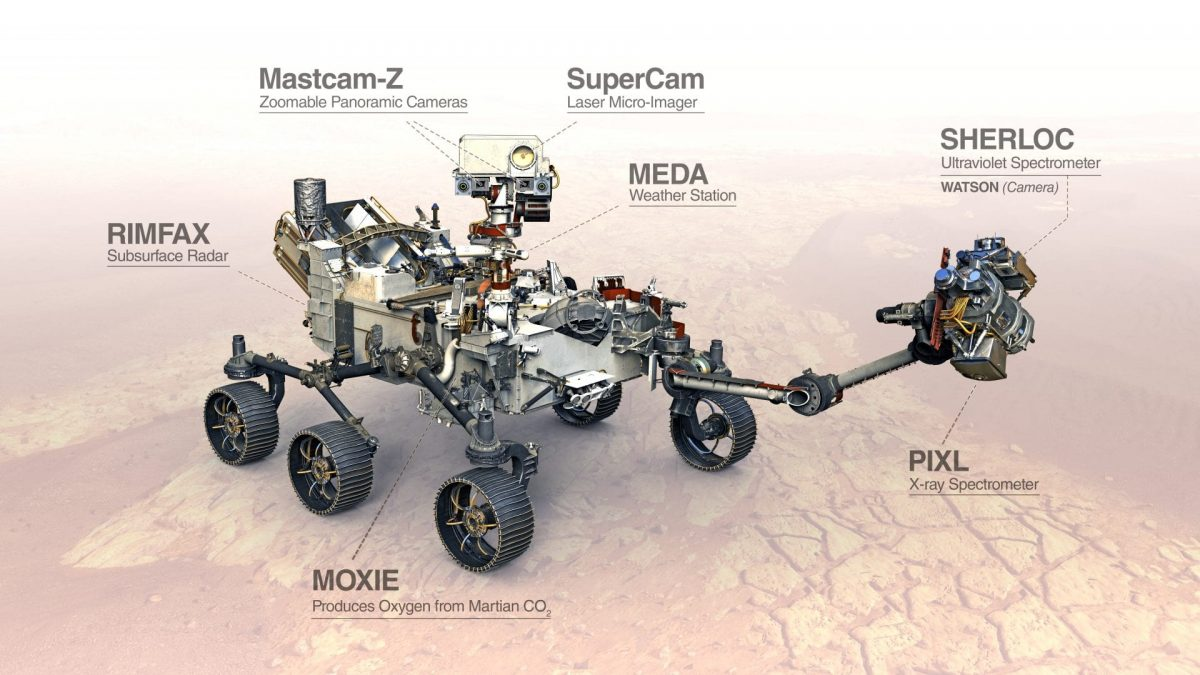
The Perseverance rover with labeled instruments. (Credit: NASA/JPL)

The payload consists of the Perseverance rover and the attached drone, Ingenuity.

The Perseverance rover is slightly bigger and the most complex and most technologically advanced piece of hardware to travel to another planet. Similar in shape/size to the former, and still operating, Curiosity rover, launched on November 26, 2011.

But it’s not just the instruments mounted to or used by the rover that are a highlight of the mission.  Perseverance also carries the Ingenuity Mars helicopter, the first-ever helicopter to be sent to another planet. Source. At just 1.8 kg (4 lb), two pairs of carbon-fiber, counter-rotating blades moving at 2,400 rpm will allow this small, solar-powered helicopter to perform 90 second flights every Martian day.

Everyday Astronaut: Austin Desisto link

NasaSpaceFlight: Chris Gebhardt link

Coauthor/Text Retriever Johnny Nielsen

link to ULA launch list - Link to ULA Fan


søndag den 17. maj 2020

ULA - Atlas V 501 - USSF-7 or OTV-6

Screenshot from ULA Webcast of the launch of USSF-7 or OTV-6. It’s cloudy today. Let’s go anyway

Mission Rundown: ULA - Atlas V 501 - OTV-6 - X-37B

Written: September 7, 2021 - Edit: November 28, 2022

Lift Off Time

May 17, 2020 - 09:14:00 EDT - 13:14:00 UTC

Mission Name

USSF-7 or OTV-6 - X-37B

Launch Provider

ULA - United Launch Alliance

Customers

U.S. Space Force, US Air Force, NASA and US Navy

Rocket

Atlas V 501

Launch Location

Space Launch Complex 41 - SLC-41

Cape Canaveral Space Force Station, Florida

Payload

X-37B Space Plane ~ Orbiter 1

FalconSat-8 - a 12U ‘toolbox sized’ CubeSat

Payload mass

8 113 kg ~ 17 848 pounds - Maximum liftoff weight

Where did the X-37B go?

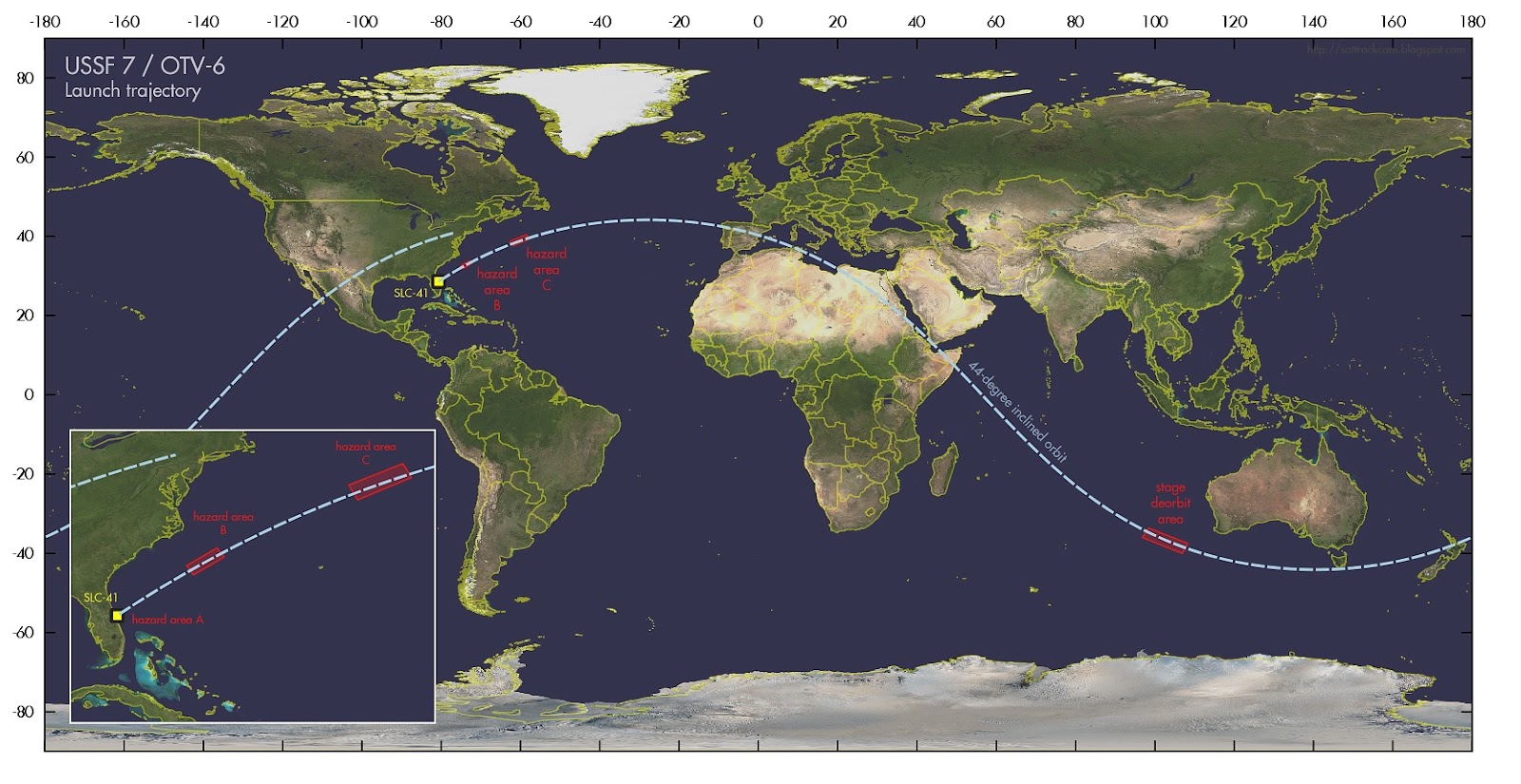
Low Earth Orbit - 391 km x 392 km x 45,0° 

Type of launch system?

Atlas Evolved Expendable Launch Vehicle - No SRB

The first stage landing zone?

Bottom of the Atlantic Ocean 2 600 km downrange

Type of second stage?

Centaur RL-10C-1 engine - 12m 56s burn time + xx?

Is the Centaur stage derelict?

No - Main engine 2nd start/cutoff length unknown

Deorbited southwest of Australia

Type of fairing?

5,4 meter two part carbon composite fairing

This will be the:

USSF-7 indicates it’s the seventh mission for US Space Force - this however is the second launch since the Space Force was formed as an independent branch of the US military split of from the US Air Force

– 139th flight of all ULA rockets

– 84th flight of an Atlas V rocket - Tail no. AV-081

– 7th flight of an Atlas V in the 501 configuration

– 6th flight for X 37B

– 2nd mission for U.S. Space Force

– 3rd mission for ULA in 2020

Where to watch

Where to read more

ULA YouTube link

Want to know or learn more visit or see Tim Dodd


Launch debriefing

(What happens)

At MaxQ a contrail was seen forming after the rocket. This to me is a sign of the rocket flying through the Jetstream

Wind Shears and a high humidity is present so it can be a backbreaking straw on the rocket

At 41:45 video time the centaur was still burning since MES-1 at 28:49 so unless it was a replay - burn time is 776+ seconds + deorbit burn

L-00:19:38

Host:

L-00:07:00

T-00:04:00

T 00:00:00

T+00:01:28

T+00:01:32

T+00:03:38

T+00:04:24

T+00:04:27

T+00:04:40

T+00:17:32

T+xx:15:07

T+00:15:39

T+00:30:00

+908 days

ULA live feed at 04:31 - In the planned 30 minute hold

Tyler Strickland

Final Polling preparing the launch at 17:09

Release -4 minute hold at 20:09

Liftoff at 24:10 - No T+ clock - 13:14:00.241 UTC

Mach 1 at 25:38 - Speed Mach One 1225,5 km/h

MaxQ at 25:42 - Maximum aerodynamic pressure

Fairing separation at 27:48 - We’re in space now

BECO 28:34 - Atlas V booster is empty

Stage separation 28:37 - Just losing 90% weight

MES-1 at 28:49 - 627 second burn time

Wrap up from 41:42 - End of launch broadcast

SECO-1 - Centaur coasting in Low Earth Orbit

X-37B deployment scheduled? - is unknown

MES-2 - SECO-2 - doing a xx seconds deorbit burn

X-37B landed in secrecy 05:22 EDT Nov. 12, 2022


Atlas V N22

OFT Starliner

Atlas V 411

Solar Orbiter

Atlas V 551

AEHF-6

Atlas V 501

OTV-6

Atlas V 541

Mars 2020

Atlas V 531

NROL-101

Delta IV Heavy

NROL-44

Delta IV Heavy

NROL-82

Atlas V 421

SBIRS GEO-5

Atlas V 401

Landsat 9

Flying on wings in space

This launch of an Atlas V marks United Launch Alliance’s 139th mission. Atlas V is built and launched by ULA. It will ferry the X-37B orbital test vehicle (OTV-6) with the most payloads it has ever carried into a Low Earth Orbit (LEO). For this mission an Atlas V in a 501 configuration will launch from Space Launch Complex (SLC) -41, Cape Canaveral Air Force Station. The primary customer for this launch is the U.S. Space Force.

Atlas V tail number AV-081, a unique designation assigned to each individual Atlas rocket which began with Atlas-Centaur rockets in the 1960s. The Atlas-Centaur tail numbers (first with the AC-001) were continued by the Atlas I, Atlas II and Atlas III rockets which evolved the Atlas-Centaur design, before being replaced with the “AV” series for Atlas V.

ULA’s Atlas V 501 launched from SLC-41, CCAFS May 17, 2020 at 09:14 EDT

Atlas V 501 with OTV-6 seems to launch in a 44/45 degree orbit from SLC-41 at Cape Canaveral

USSF-7 launched aboard United Launch Alliance’s Atlas V rocket, which flew in the 501 configuration for this launch. This was the eighty-fourth flight of an Atlas V rocket, one of the most proven and reliable rockets currently in service.

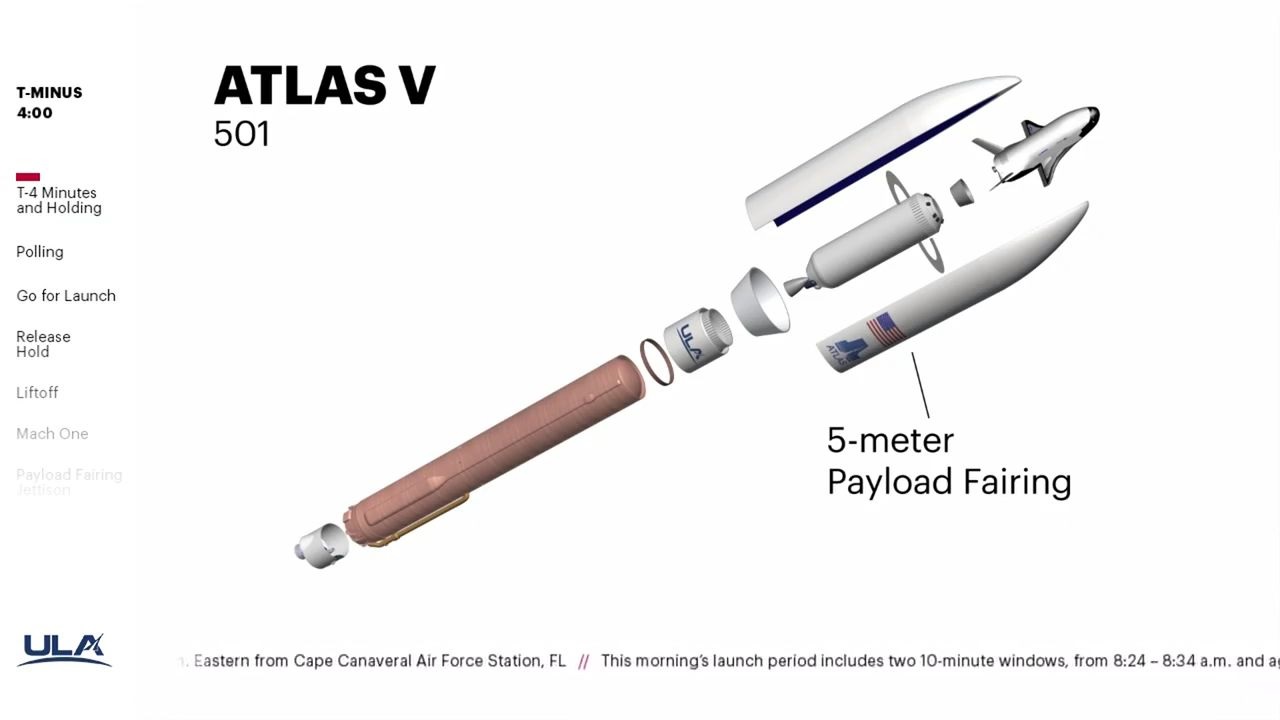
Atlas is a two-stage rocket, consisting of a Common Core Booster (CCB) and a Centaur upper stage. It can fly with up to five AJ-60A solid rocket boosters to provide additional performance for heavier payloads or where the rocket is targeting a higher-energy orbit. However, with lightweight payloads like the X-37B Atlas flies without these additional motors. In the 501 configuration there's a 5 meter fairing and a single Centaur engine.

This launch will use the shortest version of the five-meter fairing, which is 5.4 meters (17.7 feet) wide and measures 20.7 meters (68 feet) in length. The composite structure is produced by Swiss manufacturer RUAG, who also makes a similar fairing for the European Ariane 5 rocket.

When Atlas V flies with a five-meter fairing, the fairing attaches to the interstage between the first and second stages, completely enclosing the Centaur upper stage as well as the payload. Because of this, the fairing must be jettisoned during first-stage flight.

By around three minutes, 40 seconds mission elapsed time mark Atlas reached space, and the fairing was no longer needed, so it could be safely discarded. A few seconds later the forward load reactor also separated. This device, which attaches at the forward end of the Centaur, helps to spread some of the payload’s weight across the lower half of the fairing.

Screenshot of Atlas V 501 with X-37B as its payload. It's a tight fit for a space plane. The wings are far too asymmetrical so they will make the rocket veer of course during its atmospheric ascent.

This inclosure of the Centaur 2nd stage makes the fairing far larger than necessary, and also make the fairing look too big. The fairing half is actually made of two ¼ sections, top and bottom bolted together in the middle.

This design feature makes no sense, and increases the fairing mass. Does the Centaur 2nd stage need this fairing design as a reinforcement during assent and MaxQ?

Another reason for this design is the highly volatile Hydrogen gas ability to penetrate any material in fuel tanks, fuelpipes, valves and even the fairings themself.

The payload in the top compartment is pressurized with a dry nitrogen gas, preventing hydrogen gas from penetrating into the payload. With no oxygen there can be no fire or explosion so the payload is secure from this source of destruction.

The sheer number of vent holes in the lower part of the fairings tells me that hydrogen gas is present and abundant enough to cause a major accident. Liquid hydrogen tanks are in their supercooled state even more prone to hydrogen gas penetration and therefore even more dangerous around oxygen and electric spark sources.

The X-37B Payload

This sixth flight of the X-37B is designated United States Space Force 7 (USSF-7) – formerly Air Force Space Command 7 (AFSPC-7) – part of a series of generic designations that are increasingly being used to identify US military space launch missions. As the sixth X-37B mission, the flight is also designated OTV-6.

Now in orbit, the X-37B will acquire another public designation, under the USA series that is used for American military satellites. Each X-37B receives a new USA designation each time it enters space. USA designations have been assigned sequentially since 2006, so USSF-7 is expected to become USA-299 on orbit.

As well as flying on Atlas V, OTV spacecraft can be deployed by SpaceX’s Falcon 9 rocket, a capability that was demonstrated with the OTV-5 launch in 2017.

On its USSF-7 flight, the X-37B is expected to demonstrate new capabilities – including flying with the service module for the first time. This module, which is attached to the aft end of the spacecraft, hosts additional equipment and experiments for the mission.

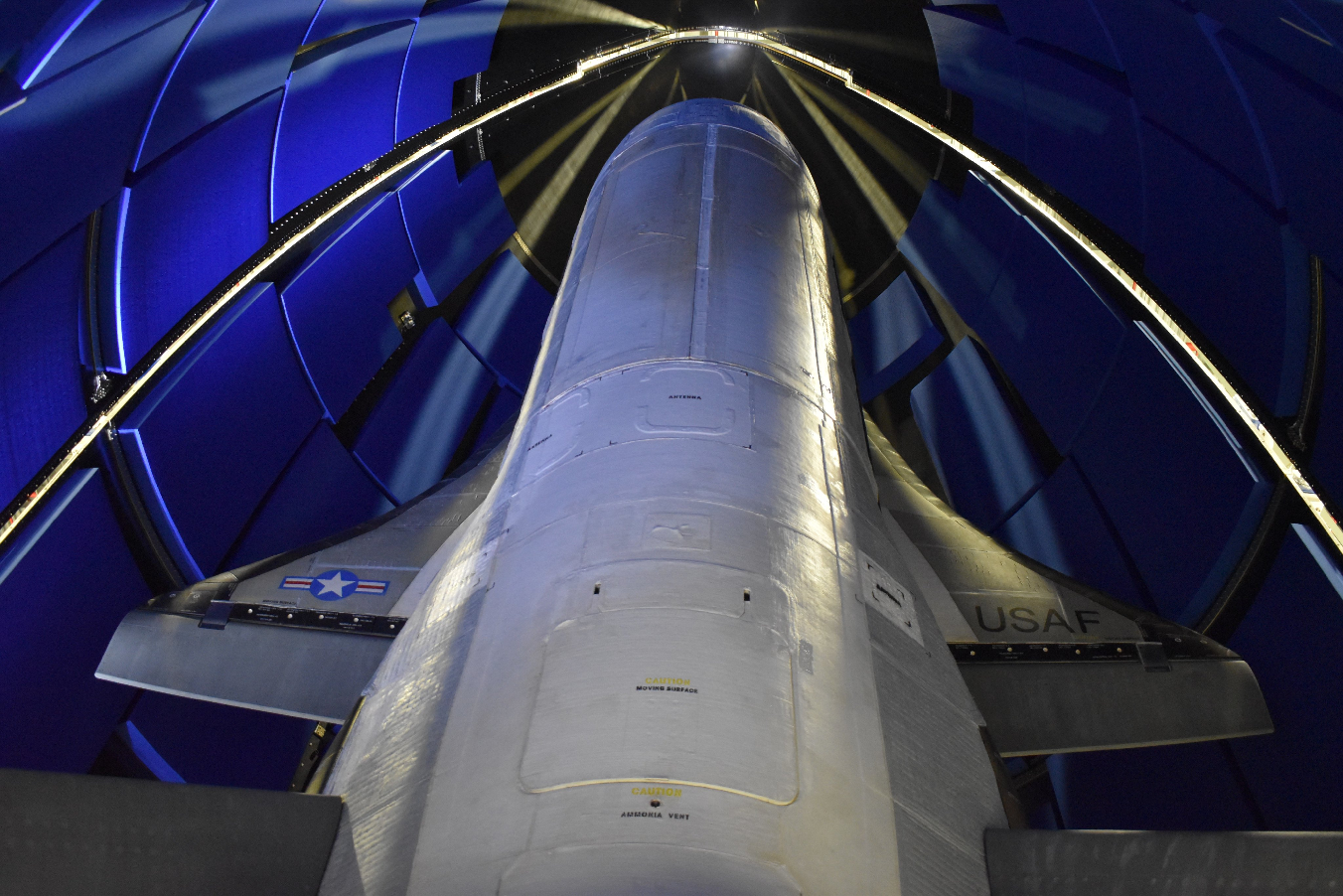
Photo of X-37B in its fairing. The blue tiles are soundproofing. Can’t you see that it's a padded cell?

Ahead of launch Barbara Barrett, the Secretary of the Air Force, stated that this mission would carry out more experiments than any previous OTV flight. The X-37B spacecraft incorporates a payload bay that can be opened in orbit to expose experiments to space. A solar panel, deployed from the bay, provides power to the spacecraft and its experiments.

During the course of its mission, X-37B will deploy the small FalconSAT-8 satellite for the US Air Force Academy. The latest in a series of experimental satellites built by the Academy for technology demonstration and to give cadets experience constructing and operating spacecraft. FalconSAT-8 carries eight experiments.

Two of these are being carried out on behalf of NASA, investigating the effects of the space environment and radiation on material samples in one experiment, and on seeds in the other.

FalconSAT will also conduct an experiment for the Naval Research Laboratory to investigate wireless power transfer, generating electrical power through the satellite’s solar panels and transmitting it to the ground as microwave radiation.

Deployment of FalconSat-8 happened around or before May 29, when USA-300 appeared on the NORAD list of classified satellites. OTV-6 is designated USA-299.

The planned duration of the X-37B’s mission has not been announced, although the spacecraft has already shown that it is capable of remaining on orbit for over two years.

When it is time for the X-37B to return to Earth it will fire its engine for a deorbit burn, lowering the perigee – or lowest point – of its orbit into the Earth’s atmosphere. Following re-entry into the atmosphere the spacecraft will glide down to a runway landing at one of its three designated landing sites.

It is not clear whether the new service module will remain attached to the X-37B for the duration of its mission, or whether it will be jettisoned partway through. However it’s clear that it is enabling X-37B to change orbit altitude and inclination during the mission, and since the initial orbit allowed it to pass three KH-11 spy satellites.

OTV-6 passed USA-290 at a distance of 29 km--this would allow the KH-11 satellite to perform extremely high resolution sat-squared visual imaging.

Two other passes of KH-11 satellites also occurred that would allow approximately a more "normal" KH-11 resolution: ~10 cm (no atmosphere to muddle actual resolution). OTV-6 passes USA-224 at a distance of 370 km and then USA-245 at a distance of 490 km.

Maybe this is a calibration test of the KH-11 cameras.

Everyday Astronaut: Florian Kordina link

NasaSpaceFlight: William Graham link

Coauthor/Text Retriever Johnny Nielsen

link to ULA launch list - Link to ULA Fan


ULA – Vulcan – Peregrine Lunar Lander

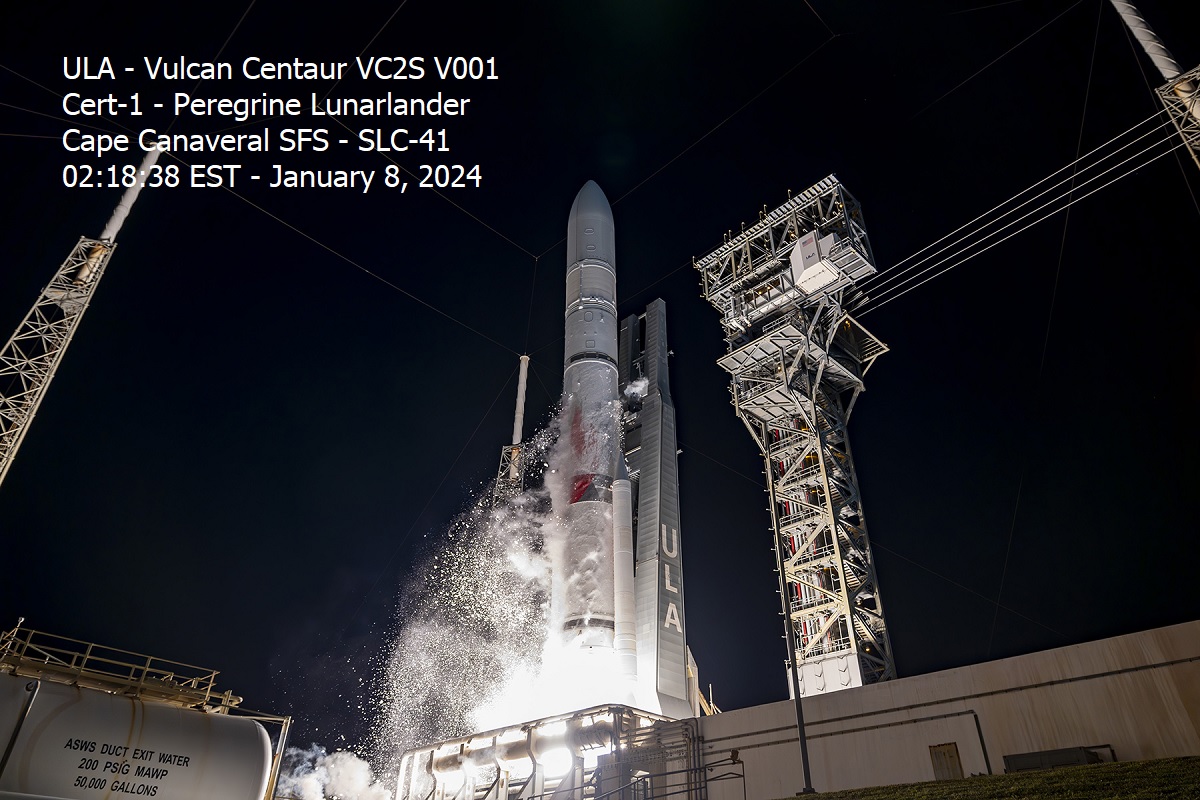
Photo from ULA of the Vulcan launch. I’ll huff. I’ll puff. And I’ll blow your pad away. Just you wait… Mission Rundown: ULA – Vulcan Centaur...