torsdag den 10. december 2020

ULA - Delta IV Heavy - NROL-44

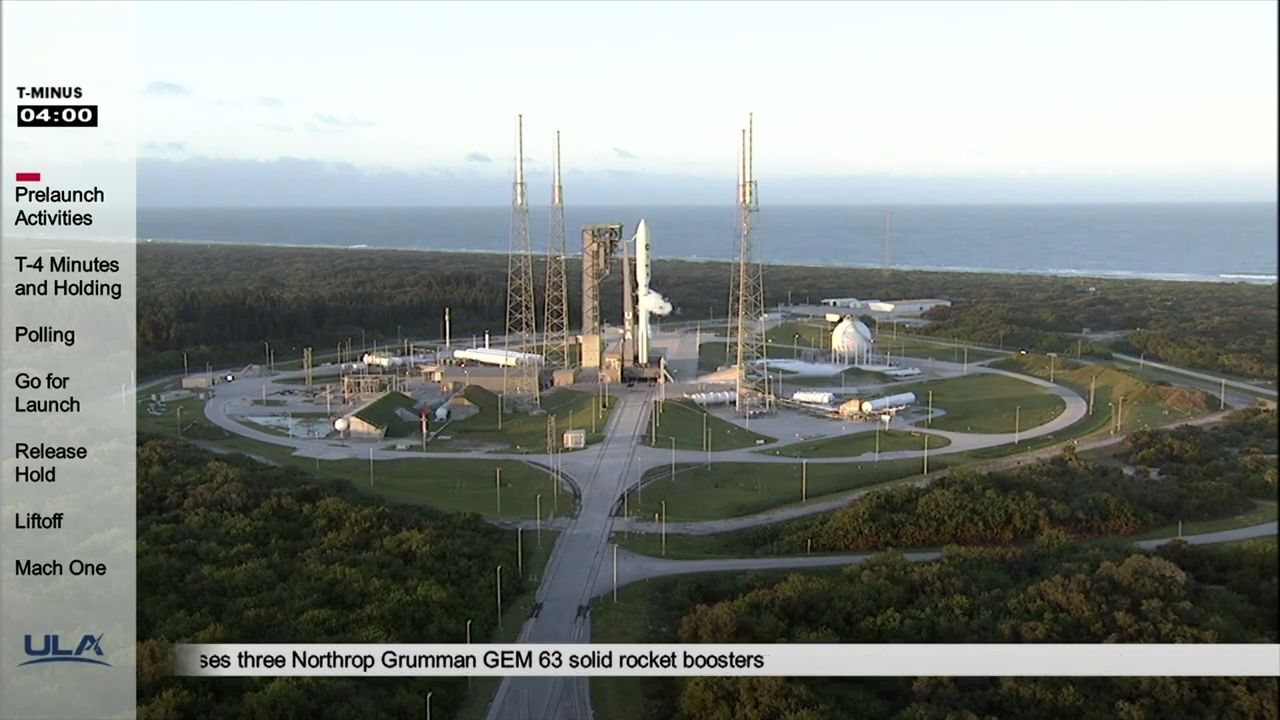
Screenshot from ULA Webcast of the launch of NROL-44

Mission Rundown: ULA - Delta IV Heavy - NROL-44

Written: September 5, 2021 - Edit: November 29, 2022

Lift Off Time

December 10, 2020 - 20:09:00 EST

December 11, 2020 - 01:09:00 UTC

Mission Name

NROL-44

Launch Provider

ULA - United Launch Alliance

Customer

NRO - The National Reconnaissance Office

Rocket

Delta IV Heavy

Launch Location

Launch Complex 37B - LC-37B

Cape Canaveral Air/Space Force Station, Florida

Payload

Maybe a Orion 10 Electronic Intelligence Satellite

Payload mass

Unknown - 6 580 kg ~ 14 500 pounds is maximum GEO

Where did the satellite go?

Geostationary Orbit - 35 784 x 35 786 km x 0,01° 

Type of launch system?

Delta Evolved Expendable Launch Vehicle - 3 Core’s

The Delta side boosters fate?

In the Atlantic Ocean east of SLC-37B

The Delta center core landing?

Bottom of the Atlantic Ocean at 40° West

Type of second stage?

Delta DCSS + RL-10B-2 engine - 18m 15s burn time?

Is the 2nd stage derelict?

Yes - Main engine 4th start/cutoff was not evident

New orbit - 34 180 km x 34 520 km x 26.17° I guess?

Type of fairing?

5 meter three part metallic fairing

This will be the:

About the 385th launch of a Delta rocket is there a 4 for 1 kind of a count here, since there are 4 Delta rocket boosters should it not be counted as the 385th - 388th Delta?

– 142nd flight of all ULA rockets

– 12th flight of a Delta IV Heavy rocket - D-385

– 385th launch of all Delta rocket types

– 89th mission for U.S. National Security

– 30th ULA mission for NRO

– 6th mission for ULA in 2020

Where to watch

Where to read more

ULA YouTube link

Want to know or learn more visit or see Tim Dodd


Launch debriefing

(This happens)

DCSS is a acronym for Delta Cryogenic Second Stage and is a 5 meter wide extension of the Delta IV core booster

No specific details from the flight is evident after the fairing deploy - so it’s a best guess scenario to what happens

T-00:18:40

Host:

T-00:04:00

T-00:06:59

T-00:04:00

T 00:00:00

T+00:01:18

T+00:01:20

T+00:03:50

T+00:04:00

T+00:05:35

T+00:05:45

T+00:06:00

T+00:06:35

T+00:07:25

T+00:15:07

T+00:31:05

-

T+04:42:47

T+05:19:27

?

ULA live feed at 01:50

Dillon Rice

Planned 15 minute hold at 16:30

Final Polling preparing the launch at 23:32

Release -4 minute hold at 26:31

Liftoff at 30:30 - No T+ clock - 01:09:00 UTC

Mach 1 at 31:48 - Speed Mach One 1225,5 km/h

MaxQ at 31:50 - Maximum aerodynamic pressure

Delta booster burn out at 34:20 - Running on fumes

Delta booster separation at 34:30 - Double drop off

BECO at 36:05 - Delta IV Common Core Booster is dry

Stage separation at 36:15 - Just losing 95% weight

MES-1 at 36:30 - DCSS RL-10B-2 engine starts up

Fairing separation at 37:05 - So this is space

Wrap up from ULA at 37:55 - Nothing to see here

SECO-1 at 45:27 and coasting - Unseen - Target 7.4 m/s

MES-2 and SECO-2 in 480 seconds gave a velocity boost from 26 477 km/h to 36 136 km/h - Maybe

MES-3 - SECO-3 - Orbit expansion - 195 seconds burn

ULA doesn’t show the NROL-44 deployment

MES-4 - SECO-4 - No graveyard burn was evident


Atlas V 531

NROL-101

Delta IV Heavy

NROL-44

Delta IV Heavy

NROL-82

Atlas V 421

SBIRS GEO-5

Atlas V 401

Landsat 9

Atlas V 401

Lucy

Atlas V 551

STP-3

Atlas V 511

USSF-8

Atlas V 541

GOES-T

Atlas V N22

OFT-2 Starliner

And the gist of this is...

In a succession of launches for the National Reconnaissance Office (NRO), United Launch Alliance returns with NROL 44. This launch is for the NRO, noting much is known about the size, mass, and capabilities of the payload.

This was the 12th launch of a Delta IV Heavy at 20:09 EST on December 10, 2020.

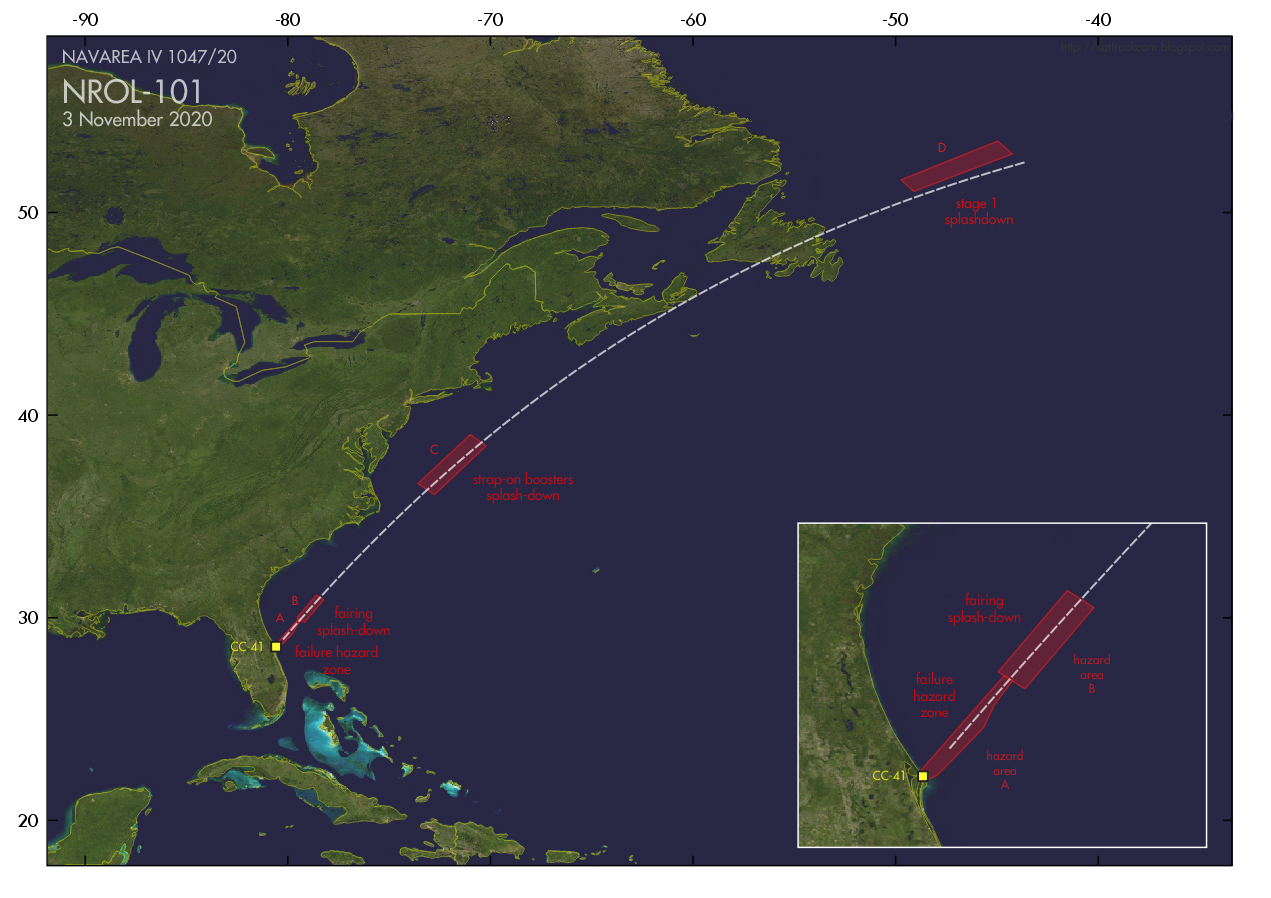
NOTAM with three splashdown areas. A is launch failure. B is Delta side boosters. C is the Delta core booster and fairing parts. There is no DCSS splashdown area specified

After 7 attempts NROL-44 finally launched. The Delta IV Heavy was prepared for launch in the summer of 2019 by being onsite and made ready for launch June 28, 2020, but the launch was delayed to August 26 for unknown reasons then moved to August 27 by request of the customer NRO.

The aging pad 37B ground equipment wasn’t properly maintained, so first a pneumatic sensor failed to perform properly. Two days later another pad abort was caused by a faulty helium valve with a broken rubber seal that failed to open the port Delta booster oxygen valve just prior to launch at T-00:00:03 seconds. Apparently outside helium pressure spins up the Delta IV Heavy turbopumps during startup. This must save weight.

September 26 the Delta IV Heavy was made ready for launch once again and postponed 24 hours because of a swingarm retraction issue then to 48 hours, because the launch tower's components are mostly 20 years old.

On September 28 the launch was scrubbed due to thunderstorms, and the next day a major hydraulic leak was discovered in the launch tower's swingarm retraction systems, which led to a major refurbishment of these systems of valves, hoses and replacement of at least 2000 gallon new hydraulic fluids.

October 1 they tried to launch for a sixth time but a valve in the Delta IV Heavy’s RS68A engines didn’t cooperate, so it was scrubbed again. It read closed when it actually was open. Delta IV Heavy consists of a million parts, and some can fail in two ways.

The NROL-44 Payload

Because United Launch Alliance has built up the reputation over the past few decades of being an incredibly reliable launch provider, they can often be trusted with high value payloads such as Mars missions, future piloted missions, and government contracts. In this case, the National Reconnaissance Office (NRO) has designed and built another satellite, which will be launched by ULA.

Not to mention that this has been a mission, ready to go for a while. In November of 2019 the Delta IV Heavy rocket for this mission was transported and erected at Space Launch Complex (SLC)-37B. Due to multiple complications with range violations, mechanical and electrical problems found during the Wet Dress Rehearsals - WDR, NROL-44 has been pushed back farther and farther.

Keep in mind that the only purpose of ULA is to boost the satellite into orbit. After it separates from the Delta Cryogenic Second Stage (DCSS), ULA no longer is in charge of the satellites and the NRO takes over. No one knows for sure what the payload is, but it’s speculated that NRO-44 is a combined mission satellite.

NROL-44: Orion 10 (RIO 10, Mission 8306, Mentor 8) - Delta IV-H [D-385] - SLC-37B link

The payload Orion 10/Mentor 8 is an advanced Orion who merged all of the COMINT, SIGINT, ELINT, MASINT, TECHELINT, and OPELINT satellite project programs together into a massive single satellite payload bus which significantly reduced launch rates compared to previous satellites which this 8300 series slowly replaces.

NROL-44 is likely a replacement for the eleven-and-a-half-year-old USA-202, with the displaced satellite taking on a reserve role in the constellation – either providing auxiliary data collection or serving as an on-orbit spare.

This will likely be the start of a new wave of Orion launches, with the NROL-68 and NROL-70 missions slated to fly from the Cape aboard Delta IV Heavy missions in 2022 and 2024 as probable candidates for the next flights.

Regarding the size or mass of the payload the following is known from ULA’s press office.

The 5 meter DCSS orbit insertion vehicle is from Cape Canaveral or Vandenberg capable of lifting several thousand pounds of payload into orbit. The graphic below lists how much to which type of orbit. Unless NROL-44 were prepared to loft itself into a geostationary orbit GEO by being its own third stage, it had a limited size and mass.

Graphic showing ULA rocket Delta IV Heavy’s capacity to loft various payloads to different orbits

From Cape Canaveral 6580 kilos of payload can be put into a geostationary orbit, so NROL-44 is limited by that mass and must put together a satellite with everything needed to perform its duty on station for at least 15 years.

If the United States should decide to launch from French Guiana in South America even more payload can be launched. Polar launches from Vandenberg are usually retrograde sun synchronous orbits, but high inclination 70 degree orbits can be achieved. The price to pay a lesser payload depending on orbit type.

A lot of research goes into minimizing every part in the satellite, improving everything and extending its operative life before it becomes obsolete or is due to be replaced by a new satellite. Propellant requirements are the major drain on satellite performance.

In orbit station keeping is necessary because against all logic the satellite will drift from its place. Gravitational pulling from the Moon, the Sun and Earth's own movements makes it drift through the seasons. A geostationary 24 hour orbit isn’t stable enough without small burns, gyroscopes and modern satellites are therefore employing a high specific impulse system like plasma or ion thrusters.

The Delta IV launch

Five seconds before the scheduled launch, Delta’s three RS-68A engines ignited. At this point, a fireball formed around the base of the rocket. This is caused by the engines igniting residual hydrogen that has boiled off from the rocket.

The process is well understood and harmless but has charred or set fire to the insulation on several previous flights.

Once the three engines had built up to full thrust, Delta IV Heavy lifted off to begin its mission. Liftoff occurred at the T-0 mark in the countdown when the thrust the rocket’s engines are generating exceeds the weight of the vehicle. For the first 9.4 seconds of flight, Delta climbed straight up, before initiating a pitch and yaw maneuver to place it on an easterly trajectory for the climb into orbit.

Shortly after this, the center core throttled down into partial-thrust mode, limiting loads on the vehicle early in the mission and conserving fuel so it can continue to burn after the side boosters separated.

One minute and 18.4 seconds into the mission, Delta reached Mach 1, the speed of sound. A second and a half later it passed through the area of maximum dynamic pressure – Max-Q – where it experienced peak mechanical stress from aerodynamic forces.

Three minutes and 56 minutes after liftoff, the two side boosters engines shut down, with the spent CBCs separating from the vehicle two seconds later. Around this time, the center core throttled back up to full thrust as it continued the boost phase of the mission. Its role in the flight ended with Booster Engine Cutoff, or BECO, at five minutes, 42.8 seconds mission elapsed time.

About six and a half seconds after BECO, the first and second stages separated, with the final CBC falling away from the rocket. The second stage RL10B-2 engine extended its deployable nozzle and initiated its pre-start sequence – with ignition coming 13 seconds after stage separation.

About 42 seconds after the second stage ignited, Delta’s payload fairing separated. The fairing is the nose cone of the rocket which protects the payload during ascent through Earth’s atmosphere and gives the rocket a consistent aerodynamic profile. Once the rocket reaches space, the fairing is no longer needed and can be discarded to reduce mass.

There are two different payload fairings that can be used on the Delta IV Heavy – a composite fairing which was designed for the Delta, and a metallic fairing made of aluminum which was inherited from the Titan IV. The launch will use the latter, which measures 19.8 meters (65 feet) in length.

This is a trisector fairing, meaning that when it falls away from the rocket it separates into three segments, not two as with most contemporary fairings. The metallic fairing was first used on Delta IV for the DSP-23 launch in 2007, and has subsequently been used for all of the NRO’s geostationary launches on the Heavy.

After fairing separation, the mission will enter a media blackout.

Graphic of the three way fairing separation. Note the spacecraft should be Hubble sized

The only likely official updates after this point will be a confirmation of mission success once the NROL-44 payload has separated from Delta IV Heavy. Given that the launch is targeting a geostationary orbit, this will not occur until six or seven hours after liftoff.

In this time, the DCSS upper stage can be expected to perform three burns. The first, which began after separation from the first stage, will continue for about seven minutes. This will establish the upper stage and its payload in their initial parking orbit.

Based on the published flight profile of Delta IV Heavy’s initial demo mission – which was rumored to be simulating deployment of an Orion satellite – after coasting for a little under eight minutes, the rocket will fire its RL10 engine again for another eight-minute burn.

Now in geostationary transfer orbit, DCSS will coast for about five hours before commencing its final burn. This will last for about 3 minutes and 15 seconds, increasing the orbit’s perigee and decreasing its inclination to deploy its cargo directly into a circular geostationary orbit.

Following spacecraft separation, the DCSS will perform a collision avoidance maneuver to take itself out of the geostationary belt and minimize the risks of a future collision with a satellite. DCSS will then have used 1105 second burn time, so how much propellant can be left for a fourth disposal burn? 18 minutes 15 seconds equals 1105 seconds.

The Delta IV Heavy

One of the more powerful rockets currently in operation, the Delta IV Heavy has launched payloads including NROL satellites and the Parker Solar Probe, a mission to study the Sun. All 12 of the previous Delta IV Heavy launches have been successful.

Customers can choose between different payload fairing sizes to better optimize for their specific payload.
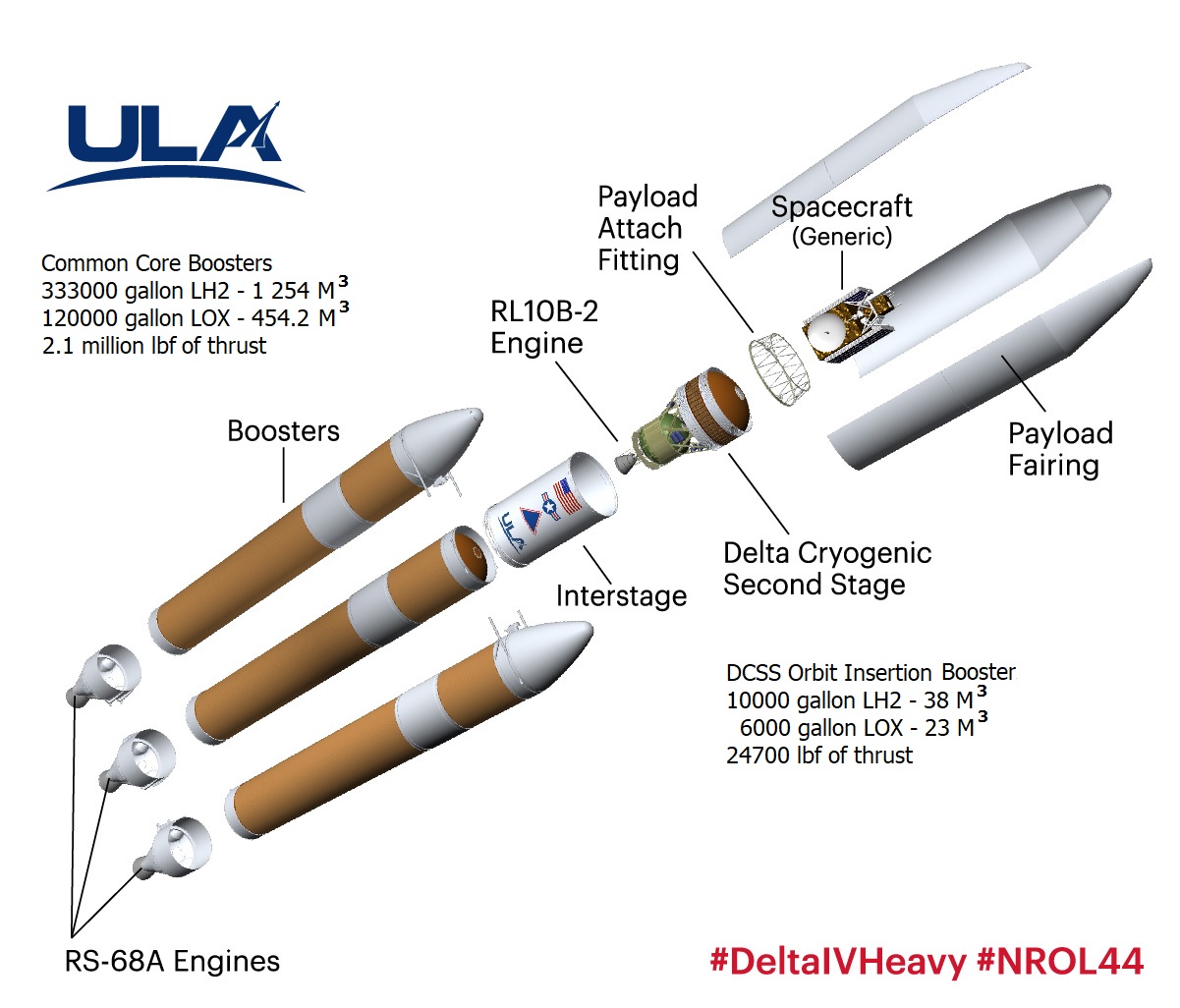
Graphic of Delta Heavy IV split in its major parts. Note the generic spacecraft can be Hubble sized

The Delta IV Heavy is a 725,7 ton heavy lift launch vehicle, meaning that it can take bigger and heavier payloads into orbit. It can launch up to 28,000 kg (61,000 lbs) to a 90 degree inclination Low Earth Orbit (LEO) and 14,000 kg (30,000 lbs) to a 27 degree inclination geostationary transfer orbit (GTO).

To accommodate payloads of all sizes, ULA offers two different payload fairing types with three heights both at 5 m (16 ft) in diameter. A 14 meter (47 ft) tall fairing and a 19.1 m (62.7 ft) tall fairing. As types go it's a three part fairing and a two part fairing.

The Delta IV Heavy first stage consists of three nearly identical 40.8 meter - 170 foot boosters strapped together. The Hydrogen and Oxygen tanks hold together 470 000 gallon of liquid propellant in 6 tanks measuring about 1 792 m3 in needed tank volume.

NROL-82 states that 120 000 gallons of liquid Oxygen is loaded. NROL-44 gave me these numbers. Second source found. Is 470 000 gallon of liquid propellant with DCSS +?

Each booster has one RS-68A engine also manufactured by Aerojet Rocketdyne. Together with DCSS and fairing they stand 71,6 meters - 235 feet tall on the launch pad.

The Hydrogen tanks hold 330 000 gallon of liquid Hydrogen chilled to -252,8 0C Celsius or -423 0F Fahrenheit in 3 tanks measuring about 1 254 m3 in estimated tank volume. The three Hydrogen tanks each hold at least 418 m3 cubic meter liquid Hydrogen.

The Oxygen tanks hold 120 000 gallon of liquid Oxygen chilled to below -182,96 0C Celsius or -297,33 0F Fahrenheit in 3 tanks measuring about 454,2 m3 in estimated tank volume. The three Oxygen tanks each hold at least 151,4 m3 cubic meter liquid Oxygen.

The first stage is infamously known for lighting itself on fire just before launch to burn off extra hydrogen. It does this because it needs to get rid of any hydrogen so it does not explode unintentionally during liftoff.

The hydrogen comes from the purging or chilling of the engines prior to ignition. The engine can’t handle the freezing chock of liquid Hydrogen and Oxygen and will split itself apart especially in the turbopump bearings. They will become brittle and shatter.

Each RS-68A engine has the capability to produce 3,160 kN (705,000 lbf) of thrust for a combined 9,420 kN of total thrust. The RS-68A engine has a Specific Impulse of 362 seconds and uses a combination of liquid hydrogen (LH2) and liquid oxygen (LOx).

During the flight, the center booster burned at a slightly slower throttle setting than the two side boosters. This is because the Delta IV Heavy needs all three boosters in order to get enough velocity to pass through the thick parts of the atmosphere. However, after that, they are expended and jettisoned as to not carry any extra weight.

As the vacuum optimized second stage is very efficient, but not very powerful, the Delta IV Heavy burns its center booster longer than other rockets so the second stage will be able to put its payload into orbit.

Continuing up the rocket comes the second stage. The Delta Cryogenic Second Stage (DCSS) is powered by a single, vacuum optimized RL10B-2 engine. For its fuel, the DCSS uses liquid hydrogen (LH2) and for the oxidizer, liquid oxygen (LOX).

The LH2 tank - volume of 38 m3 holding 10 000 gallon LH2 - being on top, it has the job of supporting the payload and the payload fairing and is structurally separated from the other ‘half’ of DCSS. The clearly smaller LOX tank - volume of 23 m3 holding 6 000 gallon LOX - is suspended below it and is responsible for structurally supporting the RL10B-2 engine.

The RL10B-2 was originally built by Aerojet Rocketdyne and first flew in 1998. It has the capability to produce 110 kN (24,700 lbf) of thrust in a vacuum and has a specific impulse of 462 seconds. It will light up at least four times with 18 minutes 15 seconds of burn time and an unknown throttle setting during the mission.

In order to save costs and weight, the gimbal system uses electromagnetic actuators over normal hydraulics; this also increases reliability.

Everyday Astronaut: Austin Desisto link

NasaSpaceFlight: William Graham link

Coauthor/Text Retriever Johnny Nielsen

link to ULA launch list - Link to ULA Fan


fredag den 13. november 2020

ULA - Atlas 531 - NROL-101

Screenshot from ULA Webcast of the launch of NROL-101. It’s a ocean view right on the beach

Mission Rundown: ULA - Atlas V 531 - NROL-101

Written: September 6, 2021 - Edit: November 28, 2022

Lift Off Time

November 13, 2020 - 17:32:00 EST - 22:32:00 UTC

Mission Name

NROL-101

Launch Provider

ULA - United Launch Alliance

Customer

NRO - The National Reconnaissance Office

Rocket

Atlas V 531

Launch Location

Space Launch Complex 41 - SLC-41

Cape Canaveral Air Force Station, Florida

Payload

Unknown satellite type - USA-310

Payload mass

Unknown - 7 450 kg ~ 16 420 pounds max GTO

Where did the satellite go?

Medium Earth Orbit - 11 033 km x 11 068 km x 58,5°

A medium high orbit shared by older satellites

Type of launch system?

Atlas Evolved Expendable Launch Vehicle + 3 SRB

The GEM 63 SRB rocket’s fate?

In the Atlantic Ocean northeast of SLC-41

The first stage landing zone?

At the bottom of the Ocean south of Greenland

Type of second stage?

Centaur RL-10C-1 engine - 875 second burn time

Is the Centaur stage derelict?

Yes - No main engine 3rd start/cutoff is evident

Transfer orbit is at 280 km x 10 520 km x 58.57° 

Type of fairings?

5,4 meter two part composite carbon fiber fairing

This will be the:

– 141st flight of all ULA rockets

– 86th flight of all Atlas V rockets - Tail no. AV-090

– 29th ULA mission for NRO

– 5th mission for ULA in 2020

Where to watch

Where to read more

ULA YouTube link

Want to know or learn more visit or see Tim Dodd


Launch debriefing

(This happens)

T-00:23:33

Host:

T-00:04:00

L-00:17:30

L-00:07:00

T-00:04:00

T 00:00:00

T+00:00:39

T+00:00:46

T+00:01:37

T+00:01:54

T+00:03:20

T+00:03:53

T+00:04:14

T+00:04:29

T+00:15:07

T+00:31:05

T+00:42:47

-

T+01:19:27

?

ULA live feed at 02:13 - L-00:00:00 is launch time

Dillon Rice

Planned 15m hold at 21:45 - T0 reset 22:32 zulu

Extended Launch hold at 23:17

Final Polling preparing the Launch at 33:46

Release -4 minute hold at 36:44

Liftoff at 40:45 - 22:32:00.2 UTC

Mach 1 at 41:24 - Speed Mach One 1225,5 km/h

MaxQ at 41:31 - Maximum aerodynamic pressure

SRB burn out at 42:22 - Small coughing thrusts

SRB separation at 42:39 - All three drop of

Fairing separation at 44:05 - Cool camera shot

Wrap up from 44:38 - Rest of NROL-101 isn’t shown

BECO at 34:30 - Atlas V booster is empty

Stage separation at 34:33 - Just losing 95% weight

MES-1 at 34:45 - 405 second burn time

SECO-1 at 45:27 - Centaur coasting in Low Earth Orbit

MES-2 to SECO-2 in xx seconds gave a velocity boost from 26 477 km/h to 36 136 km/h at 1:01:25

ULA doesn’t show deployment at 1:13:03

MES-3 - SECO-3 isn’t evident - Blow out?


Atlas V N22

OFT Starliner

Atlas V 411

Solar Orbiter

Atlas V 551

AEHF-6

Atlas V 501

OTV-6

Atlas V 541

Mars 2020

Atlas V 531

NROL-101

Delta IV Heavy

NROL-44

Delta IV Heavy

NROL-82

Atlas V 421

SBIRS GEO-5

Atlas V 401

Landsat 9


Just jumping the NRO launch line

United Launch Alliance (ULA) will use an Atlas V rocket in the 531 configuration to support and deliver a payload for the National Reconnaissance Office (NRO) – NROL-101.

This was the 17th NRO launch with an Atlas V that debuted three of the new GEM-63 solid rocket boosters from Northrop Grumman — switching away from the old AJ-60A Aerojet Rocketdyne solid rocket boosters.

Liftoff is set from Florida’s Cape Canaveral Air Force Station on SLC-41 at 17:32 Eastern Standard Time (22:32 UTC) on Friday, November 13, 2020.

The Atlas rocket that carried the NROL-101 payload into orbit had tail number AV-090. It was the 86th mission for United Launch Alliance’s workhorse Atlas V rocket and the fourth Atlas V to use the 531 configuration.

From the NOTAM it’s known that the SRB will land in area C and 1st stage will land in area D

The GEM 63s measure 1,6 meter - 63 inches in diameter and 20,12 meter - 66 feet in length. They will be ignited at the launch pad and burn for 94 seconds, each consuming 44,250 kilograms - 97,500 pounds of propellant to produce 371,550 foot pounds (1.65 mega-Newtons) of max thrust to augment the 860,200 pounds (3.83 mega-Newtons) of thrust produced by the RD-180 main engine to power the Atlas V rocket skyward.

The Atlas V 531 stack produces three x 1.65 mega-Newtons plus 3.83 mega-Newtons from the SRB’s and the Core booster - a total of 8.74 mega-Newtons thrust at liftoff.

The United Launch Alliance Atlas V rocket will come off the pad on 1.8 million pounds of thrust produced by the RD-180 main engine and three solids. 8.74 mega-Newtons thrust converts to 1.97 million pounds of thrust. Evidence of throttling down during liftoff?

The NRO is one of the United States’ main intelligence agencies and is tasked with operating and maintaining the nation’s fleet of spy satellites, with its spacecraft designed to gather electronic and photographic reconnaissance data directly, or to support intelligence gathering through other means – such as with communications relays.

While details of most of its spacecraft and its operations are highly classified, past leaks and observation of the satellites in orbit have revealed many details of the types of satellites operated and how they can collect data.

The NROL-101 Payload

As other National Reconnaissance Missions are, the public, and even some members of ULA, are kept out of the loop about the payload. Government satellites are mostly highly classified due to their technologically advanced nature.

The United States government aims to keep this information within the United States as it is highly valuable to world success.

This launch appears consistent with a launch into Molniya orbit (including a dog-leg, somewhere halfway on the dotted line below). But it was later proven to be a medium earth orbit with a high inclination.

The NRO already operates several types of satellite in inclined orbits – including Trumpet signals intelligence satellites and Quasar communications spacecraft in elliptical Molniya orbits and Intruder ocean surveillance spacecraft in low Earth orbits – all at inclinations of around 63.4 degrees.

Some Lacrosse/Onyx radar satellites were launched into 57° orbits.  While the next gen. Topaz Block 1 satellites all went to retrograde orbits, perhaps this is Topaz Block2 satellite, reverting to the old 57° orbit.

Topaz Bl 1 was in the medium 5m fairing, but was using an Atlas V-501 launch vehicle.

If NROL-101 is carrying a Quasar payload, it is unlikely to be a single satellite of the same configuration as the most recent geostationary missions, as these fit within a 4-meter payload fairing and the Atlas rockets that carried them only required two boosters.

A single large fourth generation satellite with a MUOS-style dish for mobile terminal communications is possible, or alternatively the mission may include 2-4 smaller satellites sent to replace old existing satellites in this orbit.

The payload is designated USA-310, indicating that NROL-101 is a single large satellite.

The Atlas V rocket

The Atlas V is an expendable medium lift launch system and member of the Atlas rocket family. The rocket is one of the most reliable in the world, having more than 76 launches (As of November 2020) with no complete failures.

Screenshot of Atlas V 531 graphic split in its major parts. Note the 5.4 meter wide fairings mounted on the ‘boat tail’ interstage extension who carries most of the fairing mass load past the 3.1 meter wide Centaur second stage - which is totally encapsulated by the 5.4 meter fairings

The rocket has two stages. The first is a Common Core Booster (CCB), which is powered by an RD-180 engine with two bells and burns kerosene (RP-1) and liquid oxygen (LOx). This is accompanied by up to five strap-on solid rocket boosters. The second stage is the Centaur upper stage, which is powered by one or two RL10 engines and burns liquid hydrogen (LH2) and liquid oxygen (LOx).

In the 531 configuration, the Atlas V is capable of carrying up to 14,067 kg to Low Earth Orbit (LEO), and 6,890 kg to Geostationary Transfer Orbit (GTO).

The Atlas V 531 rocket has a three number configuration code.

The first number represents the fairing diameter size in meters, so in this instance there is a 5,4 meter fairing. The second number denotes the number of solid rocket boosters (SRBs), which attach to the base of the rocket. The number of SRBs for a 5 meter fairing can range from 0 – 5. In this case there will be 3 SRBs attached to the center core.

The third and final number refers to the number of engines on the Centaur Upper Stage, which can be either one or two. In this case there will be one Aerojet Rocketdyne RL-10C engine. So this means that this rocket will have a 5 meter fairing, 3 solid rocket boosters, and 1 engine bell on the Centaur Upper Stage.

Solid Rocket Booster - SRB

The GEM-63 builds on the wealth of experience with solid motor design that Northrop Grumman inherited through its 2018 purchase of Orbital ATK, itself originating from a string of mergers including companies such as Orbital Sciences Corporation, Alliant Techsystems and Thiokol.

The company’s Graphite Epoxy Motor (GEM) series of boosters was originally developed for the Delta II rocket, being introduced with the 7000-series in November 1990.

The name Graphite Epoxy Motor comes from the carbon epoxy composite used in the construction of its casing, making the GEM-40 – as the original version was named – significantly lighter than the steel-cased Castor boosters that had been used on earlier Delta rockets.

The number 63 in the motor’s designation gives its diameter in inches – so the original GEM-40 measured 40 inches, or 102 centimeters, across, while the GEM-63 for Atlas V has a diameter of 63 inches, or 160 centimeters. Each booster is filled with QDL-4, a propellant compound based on hydroxyl-terminated polybutadiene (HTPB).

The GEM 63s measure 66 feet in length. They will be ignited at the launch pad and burn for 94 seconds, each consuming 97,500 pounds of propellant to produce 371,550 pounds (1.6 mega-Newtons) of max thrust to augment the 860,200 pounds of thrust already produced by the RD-180 main engine to loft the Atlas V rocket.

GEM 63s are a lower-cost alternative to the solid rocket boosters that have been used by Atlas V since 2003, yet they deliver the same level of thrust and lift-capacity to enable replacement. They also offer a streamlined process for attaching them to the launch vehicle at the Vertical Integration Facility.

What's more, the upcoming Atlas V launches with the new motors will build flight experience in preparation for using GEM 63XLs on Vulcan Centaur's first flight.

The XL variant will stand 72 feet tall, contain 105,800 pounds of propellant and generate approximately 450,000 pounds of thrust each. They will be the longest single-segment solid rocket motors ever built.

The Space Shuttle’s solid rocket boosters are bigger and more powerful, but they are built of 5 big segments screwed together with the infamous O-rings between the segments.

Atlas V can be fitted with as many as five GEM 63s, the Vulcan Centaur can incorporate up to six GEM 63XLs, depending on the weight of the payload and its orbital destination. All motors will have stationary nozzles.

They are manufactured using state-of-the-art automation and robotics. The cases are filaments wound by computer-controlled winding machines using high-strength graphite fiber and durable epoxy resin.

ULA entered a long-term strategic partnership with Northrop Grumman in 2015 to become the sole provider of solid rocket boosters for Atlas V and Vulcan Centaur.

GEM 63s will be added to future Atlas V missions throughout 2021 using a predefined schedule to complete a full transition in the near future.

Everyday Astronaut: Austin Desisto link

NasaSpaceFlight: William Graham link

Coauthor/Text Retriever Johnny Nielsen

link to ULA launch list - Link to ULA Fan


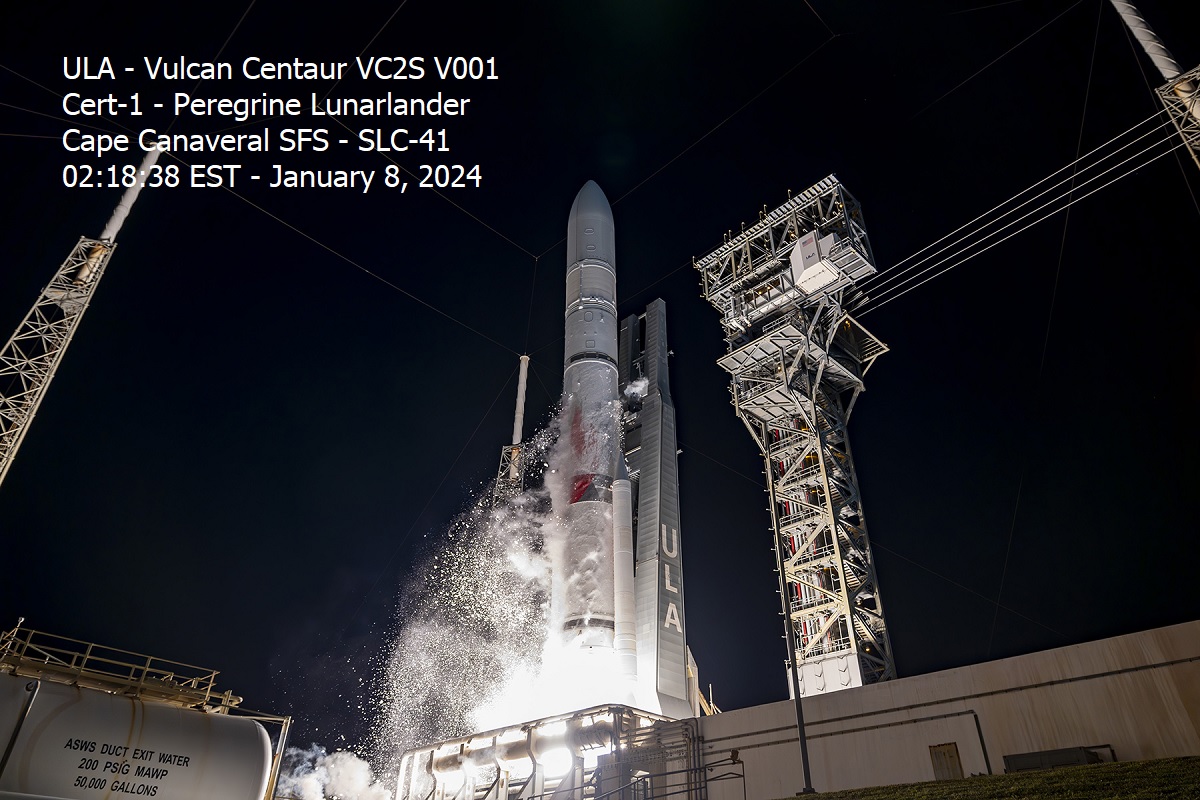
ULA – Vulcan – Peregrine Lunar Lander

Photo from ULA of the Vulcan launch. I’ll huff. I’ll puff. And I’ll blow your pad away. Just you wait… Mission Rundown: ULA – Vulcan Centaur...