tirsdag den 7. december 2021

ULA - Atlas V 551 - STP-3

Screenshot from ULA Webcast of the launch of STP-3. Duck you sucker. The ‘Soup’ is flying today

Mission Rundown: ULA - Atlas V 551 - STP-3

Written: November 25, 2022

Lift Off Time

December 7, 2021 - 05:19:00 EST - 10:19:00 UTC

Mission Name

STP-3

Launch Provider

ULA - United Launch Alliance

Customers

Department of Defense - Space Test Program 3

NASA, U.S. Air Force and U.S. Space Force

Rocket

Atlas V 551

Launch Location

Space Launch Complex 41 - SLC-41

Cape Canaveral Space Force Station, Florida

Payloads

STP Sat-6 will be hosting nine experiments

LDPE-1 - Maneuverable ESPA ring with six payloads

Payload mass

6 113 kg ~ 13 510 pounds

Where did the satellites go?

After GTO directly to a Geostationary Orbit

36 096 km x 36 112 km x 0,01° inclination

Type of launch system?

Atlas Evolved Expendable Launch Vehicle + 5 SRB’s

The GEM-63 SRB’s fate?

In the Atlantic Ocean east of SLC-41

The first stage landing zone?

Bottom of the Atlantic ocean a lot further downrange

Type of second stage?

Centaur RL-10C-1 engine - 16m 24s burn time

Is the Centaur stage derelict?

YES - Main engine 4th start/cutoff was used to raise the orbit apogee to 38 655 km and followed by a safety venting of gasses and liquids in deep space.

Type of fairings?

5,4 meter two part carbon composite fairing

This will be the:

– 147th flight of all ULA rockets

– 90th flight of an Atlas V rocket - Tail no. AV-093

– 13th mission for DoD Test Program

– 5th mission for ULA in 2021

Where to watch

Where to read more

NASA/ULA YouTube link or near the polling link

Want to know or learn more go visit or see Tim Dodd


Launch debriefing

(This did happen)

Centaur upper stage MES-1 to SECO-2 burn time was 350 seconds

Centaur upper stage will coast approximately for an hour before its next transfer 2nd burn

Centaur upper stage will coasting in 5 hours 7 minutes 37.4 seconds to reach its geostationary insertion 3rd burn

L-01:48:15

Hosts:

T-00:04:00

L-00:00:00

L-00:07:00

T-00:04:00

T 00:00:00

T+00:00:48

T+00:00:59

T+00:01:30

T+00:01:45

T+00:03:39

T+00:04:31

T+00:04:37

T+00:04:47

T+00:10:37

T+00:20:40

T+01:07:22

T+06:24:48

T+06:30:15

T+07:10:02

T+06:03:09

T+08:08:02

NASA/ULA live feed at 06:20

Megan Cruz, Andrea Lehnhoff, Jesse Gonzalez

ULA in a planned 30 minute hold at 19:31

Extended hold due to weather

Final Polling prior to the launch at 1:47:34

Release -4 minute hold at 1:50:35 - 26:15

Liftoff at 1:54:35 - No T+ clock - 10:19:00 UTC

Mach 1 at 1:55:12 - Speed Mach One 1225,5 km/h

MaxQ at 1:55:23 - Maximum aerodynamic pressure

SRB burn out at 1:56:12 - Delayed release of 2 then 3

SRB separation at 1:56:25 - Five GEM-63 spent

Fairing separation at 1:58:18 - Computer graphics on

BECO 1:59:10 - Atlas V booster is empty - 271 seconds

Stage separation 1:59:16 - Just losing 95% weight

MES-1 at 1:59:26 - Centaur RL-10C-1 engine start

MECO-1 at 2:05:16 - Coasting toward Africa

Wrap up from ULA at 2:15:12

MES-2 to SECO-2 in a 362 seconds GTO burn

MES-3 - SECO-3 in 158 seconds insert in GEO orbit

ULA doesn’t show deployment of STP Sat-6

ULA doesn’t show deployment of LDPE-1

Centaur blowout of remaining gasses and fuel

Centaur 2nd stage becomes derelict space debris


Atlas V 401

Lucy

Atlas V 551

STP-3

Atlas V 511

USSF-8

Atlas V 541

GOES-T

Atlas V N22

OFT-2 Starliner

Atlas V 541

USSF-12

Atlas V 421

SBIRS GEO-6

Delta IV Heavy

NROL-91

Atlas V 531

SES 20 & 21

Atlas V 401

JPSS-2

Testing the Alphabet Soup

ULA (United Launch Alliance) launched its 90th flight with an Atlas V 551 rocket and its fifth and final mission of 2021. Launching from SLC-41 (Space Launch Complex 41) in Cape Canaveral, Florida, the STP-3 mission is lofting two experimental satellites for the United States Space Force.

The mission will also test several new technologies onboard the company’s Atlas V launch vehicle during the longest duration mission for an Atlas rocket to date. Liftoff occurred on December 7 at 05:19 EST (10:19 UTC) after several holds for high altitude winds.

The attachment of five side-mounted solid rocket boosters (SRBs) to the Atlas first stage will generate three-quarters of the energy necessary at liftoff to power the vehicle on to a complex, seven-hour flight. The core Atlas V booster will do the remaining 25%.
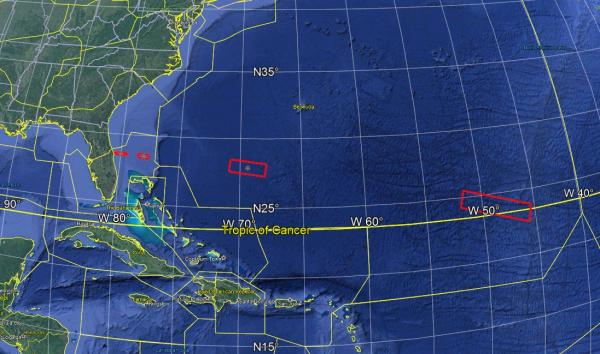
NOTAM hazard areas where Atlas V 551 will drop off SRB boosters, fairings and 1st stage

The number 5 obviously means a 5 meter fairing. The second number determines the number of strap on solid rocket boosters (SRBs). It can range from 0 to 5, and in this case, there are five on various sides of the center common core.

The third and final number refers to the number of engine bells on the Centaur Upper Stage, which can be either one or two. In this case there will be one engine. The only time that there have been two engines (while on an Atlas V) was on Starliner’s OFT-1. So to review, for the STP-3 mission, this rocket has a five-meter fairing, five solid rocket boosters, and one engine on the Centaur Upper Stage.

It’s unique to the Atlas rocket to have their solid rocket boosters (SRBs) positioned in this way. When, like in this case, 5 SRBs are used, they are positioned with two on one side and three directly opposite of them. If you notice carefully in the image of Atlas core boosters, there are long and somewhat flat pipes “running” down the side of the first core stage.

These are raceways and carry fuel from the tanks down to the engines and some carry gasses back up to the tanks to pressurize them so the fuel stays flowing out the pipes.

When Atlas was designed, these two raceways were placed in their positions without the thought of SRB placement. So when more SRBs were needed, they were placed in the most convenient spot. Two SRB between the raceways and three opposite them.

The offset of the thrust won’t make it fly in the wrong direction. The engines on the core stage can gimbal, they counteract that offset of thrust by vectoring their thrust which is known as Thrust Vector Control, or TVC. The SRBs, and most of them for that matter, do not have TVC abilities, but their nozzles can be angled and turned slightly sideways. That will counteract some of that offset SRB thrust.

During the STP-3 mission, ULA plans to demonstrate three new technologies onboard its Atlas V rocket: a new fairing design, an upgraded power system for the two spacecraft, and what the company calls “Enhanced Navigation.” All of these technologies will feature on the company’s future Vulcan Centaur rocket.

Manufactured in Decatur, Alabama–right next door to ULA’s factory–by RUAG Space, the new fairing uses a manufacturing method called Out-of-Autoclave, and will replace the fairings made by RUAG in Switzerland. While they are the same size as previous Atlas V 5.4 meter-class fairings, the new process “weighs and costs less while being easier and quicker to make,” according to ULA.

Due to STP-3’s nearly seven hour journey to a circular geosynchronous orbit, the Atlas V rocket is flying for the first time with what the company calls an IFPS (In-Flight Power System) which keeps the batteries of both spacecraft fully charged throughout the flight. This means that the spacecraft have more time on battery power before needing to rely on their deployable solar panels after separation from the Atlas V’s Centaur upper stage.

ULA is also debuting what the company refers to as “Enhanced Navigation,” a system that uses GPS data to compliment the rocket’s onboard flight computer in order to increase orbital insertion accuracy. According to ULA, the system was tested on a previous launch last year, and “will be available for use on all Atlas V missions going forward.”

The ULA-manufactured upper stage for Boeing’s Space Launch System, called ICPS, will also use “Enhanced Navigation.” ICPS is short for Inner Cryogenic Propulsion System and is a modified Centaur second stage loaded with liquid Hydrogen and Oxygen.

The STP-3 Payload

STP-3 marks the third dedicated launch for the U.S. Space Force’s Space Test Program. The program is designed to fly experimental payloads in order to mature technologies for future Department of Defense missions. The STP-3 mission is composed of two payloads: a primary spacecraft and a rideshare spacecraft.

The primary spacecraft is known as STPSat-6, and was designed and built by Northrop Grumman. STPSat-6 will host nine experiments including those for NASA and the NNSA (National Nuclear Security Administration).

The NNSA’s main experiment, called the SABRS-3 (Space and Atmospheric Burst Reporting System 3), is designed to detect nuclear detonations on Earth. SABRS will complement Global Burst Detector payloads on GPS satellites as well as the SBIRS (Space-Based Infrared System) constellation.

NASA’s LCRD (Laser Communications Relay Demonstration) is designed to test laser communications as an alternative to typical radio communications for NASA spacecraft. LCRD will communicate with ground stations as well as future in-space experiments such as a payload called ILLUMA-T that will be attached to the ISS in 2022.

Other payloads aboard STPSat-6 include “several of DoD Space Experiments Review Board space weather and situational awareness payloads,” according to ULA.

The rideshare spacecraft, LDPE-1, which stands for Long Duration Propulsive ESPA number 1 — E in ESPA meaning EELV (Evolved Expendable Launch Vehicle) a secondary payload adapter. E in EELV stands for ESPA is a EELV Standardized Spacecraft Adapter size originally designed for use on the Atlas V and Delta IV launch vehicles, and it is now also used on Falcon 9. - Did anyone get those letters? - I still don’t get it.

  • ESPA is a EELV Standardized Spacecraft Adapter

  • EELV is a Evolved Expendable Launch Vehicle

  • LDPE-1 is a Long Duration Propulsive ESPA

Sir. Can I have another bowl of ‘Alphabet’ Soup? :Oliver Twist

LDPE-1 was also built by Northrop Grumman, and it is based off of the ESPAStar line of spacecraft the company produces. It also derives technologies from another ESPAStar named EAGLE that was flown on a previous Atlas V 551 mission in 2018.

While LDPE-1 will carry several payloads, the exact nature of them are currently unknown. At least two more LDPE spacecraft are scheduled to launch on Space Force missions, including a Falcon Heavy launch called USSF-67.

Both STP-3 payloads will be delivered directly into a geosynchronous orbit approximately 36,100 kilometers above the Earth.

This is a six port ESPA ring under construction being fitted with 3U CubeSat dispensers. Source

The Atlas V 551 rocket

The Atlas V core in use for this mission is AV-093. Atlas V 551 stacking will begin working in the coming days, five GEM 63 solid rocket boosters and the Centaur upper stage with its RL10C-1 engine will be hoisted into place. STP-3 payload attachment occurs later in November before rollout to Space Launch Complex-41.

Inside the Vertical Integration Facility - VIF, a team of engineers fastened the payload fairing, which houses the U.S. Department of Defense’s (DoD) Space Test Program Satellite-6 (STPSat-6) spacecraft. LCRD is hosted on STPSat-6. The mission is scheduled to launch on Dec. 5 from Launch Complex 41 on CCSFS, with a two-hour launch window beginning at 4:04 a.m. EST.

The fully stacked rocket and payload stands 196 feet tall and is anticipated to roll out on a mobile launch platform from the VIF to the launch pad on Dec. 3. The rocket’s Centaur second stage and spacecraft will remain attached until 4 minutes, 33 seconds after launch, with deployment of STPSat-6 scheduled about 6 hours, 30 minutes after launch.

On December 6, the Atlas V 551 was rolled from its Vertical Integration Facility to its launch pad at Space Launch Complex 41. Afterward, the rocket’s first stage was filled with its kerosene fuel, which can be loaded ahead of time as Atlas V does not yet rely on the use of super-chilled kerosene, such as Falcon 9.

Seconds before launch, the RD-180 engine on the first stage ignited. At T-0 seconds, the five GEM-63 solid rocket boosters ignited, followed by liftoff at T+1.1 seconds.

About 35 seconds after launch, the Atlas V passed the speed of sound, or Mach 1.

At one minute and 47 seconds after launch, all five solid rocket boosters were jettisoned. First, two separated, followed by the other three about two seconds later. The payload fairing separated from the rocket about three and a half minutes after launch.

At four minutes and 27 seconds after launch, the RD-180 engine on Atlas’ first stage shut down, and the Centaur upper stage carrying the STP-3 payloads separated. Centaur’s RL-10 engine burned for about six minutes to reach an initial orbit.

An hour and seven minutes after launch, Centaur ignited once more and burned for about six minutes to raise the apogee, or highest point in the orbit, to a geostationary altitude.

After a roughly five hour long coast phase, the Centaur ignited again, circularizing its orbit and changing its orbital inclination from about 26 degrees to zero degrees with a roughly three minute burn.

At six hours and 30 minutes after launch, STP Sat-6 separated, followed by LDPE-1 at seven hours and 10 minutes, ending the longest duration mission in Atlas rocket history.

The upper stage Centaur’s RL-10 engine depleted its last reserves of propellant to lift itself into a graveyard orbit some 38 655 km away from earth. The remaining gasses and fuel vapors will be vented at apogee in order to raise the perigee just a little.

The Centaur’s propellant tanks must be empty to avoid exploding like a rotting toad in the sunlight. At least three upper stage Centaur’s weren't purged and exploded in 10-15 large pieces of space debris.

Everyday Astronaut: Austin Desisto link

NasaSpaceFlight: Colin Fletcher link

Coauthor/Text Retriever Johnny Nielsen

link to ULA launch list - Link to ULA Fan


lørdag den 16. oktober 2021

ULA - Atlas V 401 - Lucy

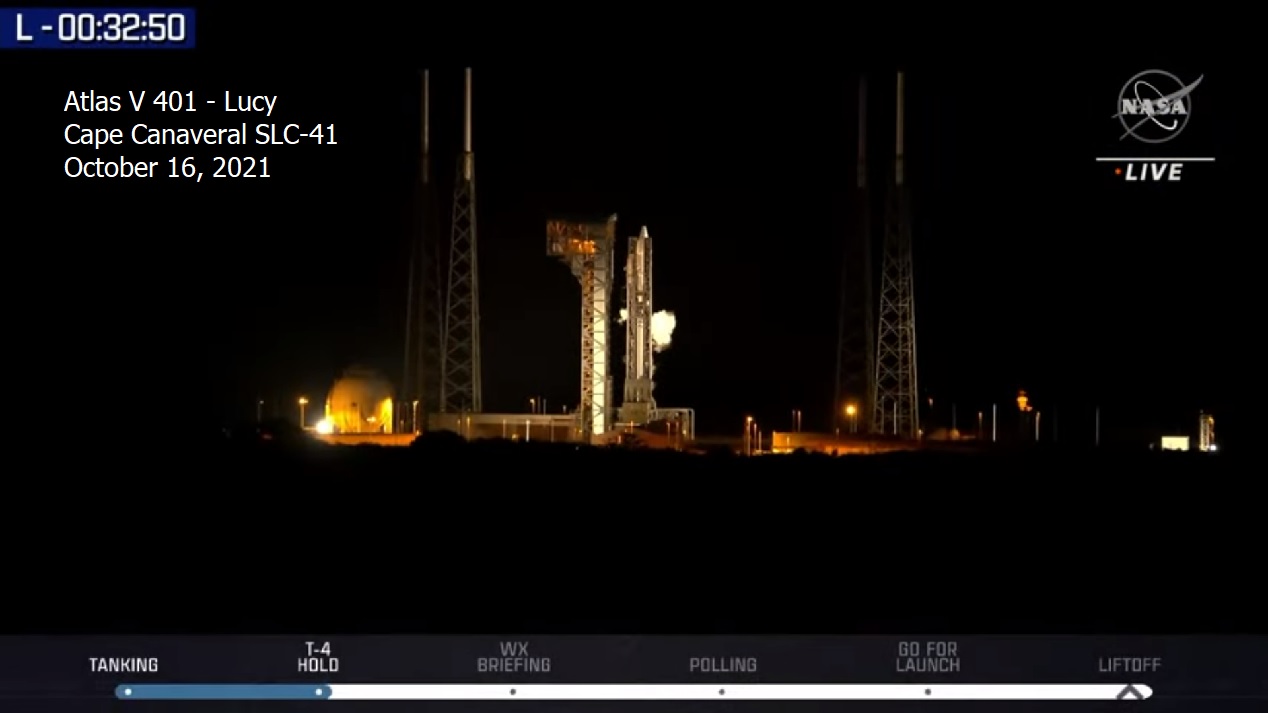
Screenshot from ULA Webcast of the Lucy launch  - It's way too early to get up. 30 more minutes

Mission Rundown: ULA - Atlas V 401 - Lucy

Written: November 25, 2022

Lift Off Time

October 16, 2021 - 05:34:00 EDT - 09:34:00 UTC

Mission Name

Lucy

Launch Provider

ULA - United Launch Alliance

Customer

NASA - National Aeronautics and Space Administration

Rocket

Atlas V 401

Launch Location

Space Launch Complex 41 - SLC-41

Cape Canaveral Space Force Base, Florida

Payloads

Lucy - Deep Space Asteroid Science Satellite

Payload ‘wet’ mass

1 550 kg ~ 3 417 pounds - Propellant ~ 729 kg

Where did the satellite go?

Heliocentric Orbit to visit seven Trojan Asteroids in front of and behind Jupiter - 1st orbit 666 km x 679 km x 98,2°

Type of launch system?

Atlas Evolved Expendable Launch Vehicle - No SRB

The first stage landing zone?

At the bottom of the Atlantic Ocean east of SLC-41

Type of second stage?

Centaur RL-10C-1-1 engine - 16m 24s burn time

Is the 2nd stage derelict?

Yes - Main engine 3rd start/cutoff was replaced by a safety venting of gasses and liquids in deep space.

Type of fairing?

4.2 meter two part metallic fairing

This will be the:

– 146th flight of all ULA rockets

– 89th flight of an Atlas V rocket - Tail no. AV-096

– 260th launch with a Centaur upper stage

– 100th launch of a rocket from SLC-41

– 37th ULA mission for NASA

– 13th mission for NASA Discovery Program

– 4th mission for ULA in 2021

Where to watch

Where to read more in depth

ULA/NASA YouTube link - Scott Manley YouTube link

Want to know or learn more go visit or see Tim Dodd


Launch debriefing

(This will happen)

Launch countdown is different from Terminal countdown. The L clock can be paused or put on hold any time

Mach One depends on air pressure which is lower at altitude

ULA shows the numbers in 1049 Miles per Hour, and altitude as 16 Miles

ULA shows max. q as 1118 Miles per Hour, and altitude as 21 Miles

L-00:34:00

Host:

L-00:07:00

T-00:04:00

T 00:00:00

T+00:01:19

T+00:01:30

T+00:04:03

T+00:04:09

T+00:04:19

T+00:04:27

T+00:13:09

T+00:40:39

-

T+00:58:00

T+01:03:02

T+01:27:44

T+01:59:20

ULA/NASA live YouTube feed at 00:48

Marie Lewis, Mic Woltman, Derrol Nail, Blair Allen,

Final Polling preparing the launch at 34:59

No release needed at -4 minute hold at 37:59

Liftoff at 41:59 - L+ clock visible - 18:12:00 UTC

Mach 1 at 43:18 - Speed Mach One 1225,5 km/h 

MaxQ at 43:26 - Maximum aerodynamic pressure

BECO at 46:03 - Atlas V booster is empty

Stage separation at 46:09 - Just losing 95% weight

MES-1 at 46:21 - Centaur RL-10C-1-1 engine start

Fairing separation at 46:29 - We’re in space now

SECO-1 at 58:33 and coasting past Madagascar

MES-2 to SECO-2 in 361 second burn will increase the velocity and transfer Lucy to the Heliocentric Orbit

ULA/NASA shows Lucy deployment at 2:02:42

Wrap up from ULA/NASA at 2:04:04

Centaur blowout of remaining gasses and fuel

No expected crash landing on Earth ever


Atlas V 531

NROL-101

Delta IV Heavy

NROL-44

Delta IV Heavy

NROL-82

Atlas V 421

SBIRS GEO-5

Atlas V 401

Landsat 9

Atlas V 401

Lucy

Atlas V 551

STP-3

Atlas V 511

USSF-8

Atlas V 541

GOES-T

Atlas V N22

OFT-2 Starliner

Let’s go look at some rocks

NASA and ULA (United Launch Alliance) launched NASA’s next asteroid exploration mission — Lucy — from Florida early Saturday morning, kickstarting the spacecraft’s 12-year journey through the solar system. Liftoff of Atlas V and Lucy occurred at 5:34 AM EDT (09:34 UTC) on Saturday, October 16, from SLC-41 (Space Launch Complex 41) at Cape Canaveral Space Force Station in Florida.

Atlas V will stand 194 feet tall (59.1 meters) and weigh 749,479 pounds (339,958 kg) at liftoff. Atlas V is ULA’s workhorse rocket, with a total of 88 launches prior to Lucy. The variant in use for this mission, the Atlas V 401, was previously launched 39 times.

Using a three-digit configuration number, the first digit denotes the diameter of the payload fairing, the second indicates the number of solid rocket motors (SRMs), and the third represents the number of RL-10 engines on the Centaur upper stage.

Atlas used the longest-available 4.2-meter fairing known as the Extra Extended Payload Fairing (XEPF), and a single RL-10 engine on the Centaur upper stage.

The LUCY Payload

Lucy, led by NASA’s Goddard Space Flight Center in Maryland, represents the thirteenth mission under NASA’s Discovery Program. The Discovery Program is a NASA solar system exploration program designed to select low-cost, deep space missions with the primary goal of researching a specific scientific area in the solar system.

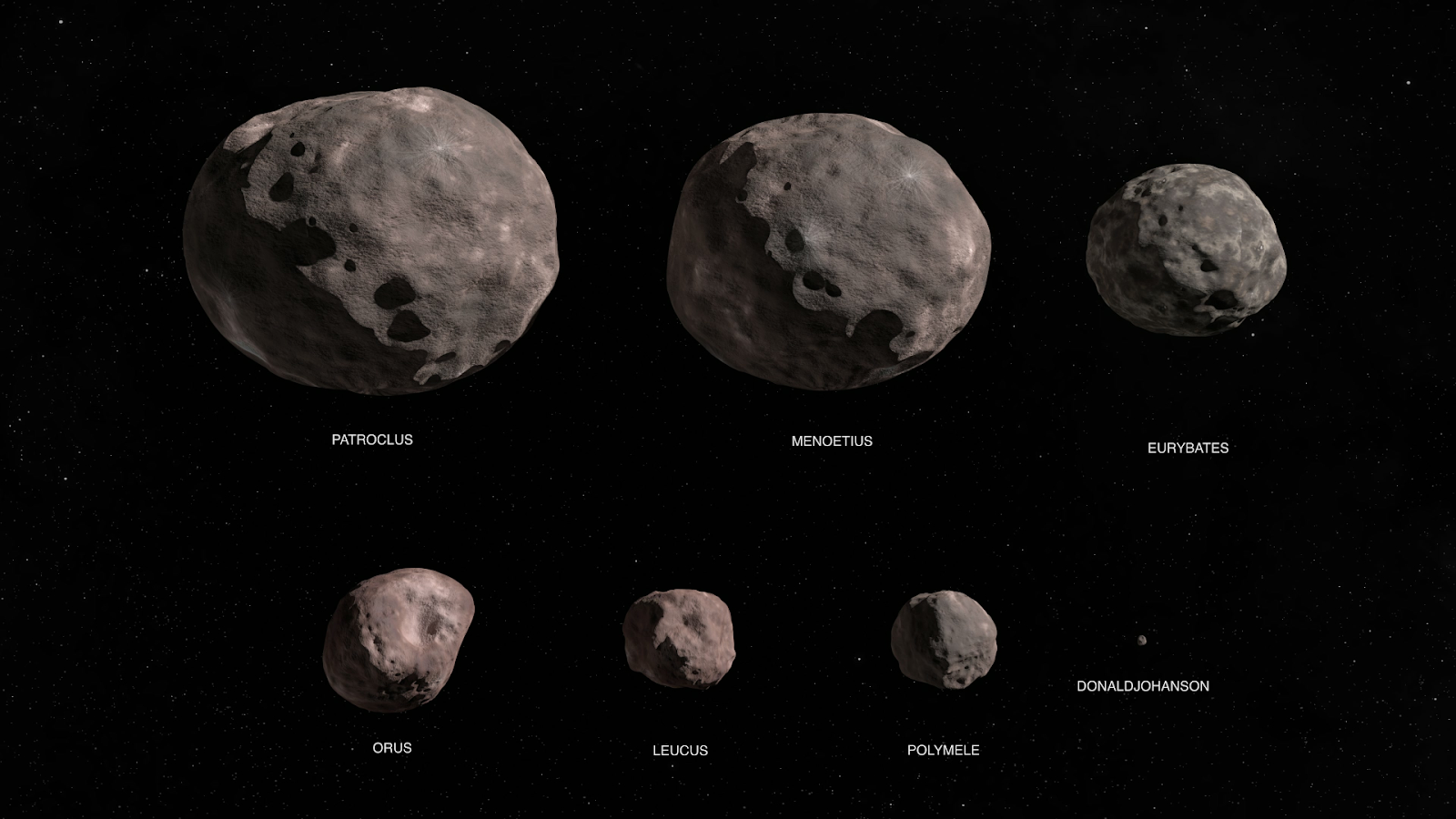
Lucy will be visiting seven Trojan Asteroids after a flyby of the Donald Johanson asteroid. NASA

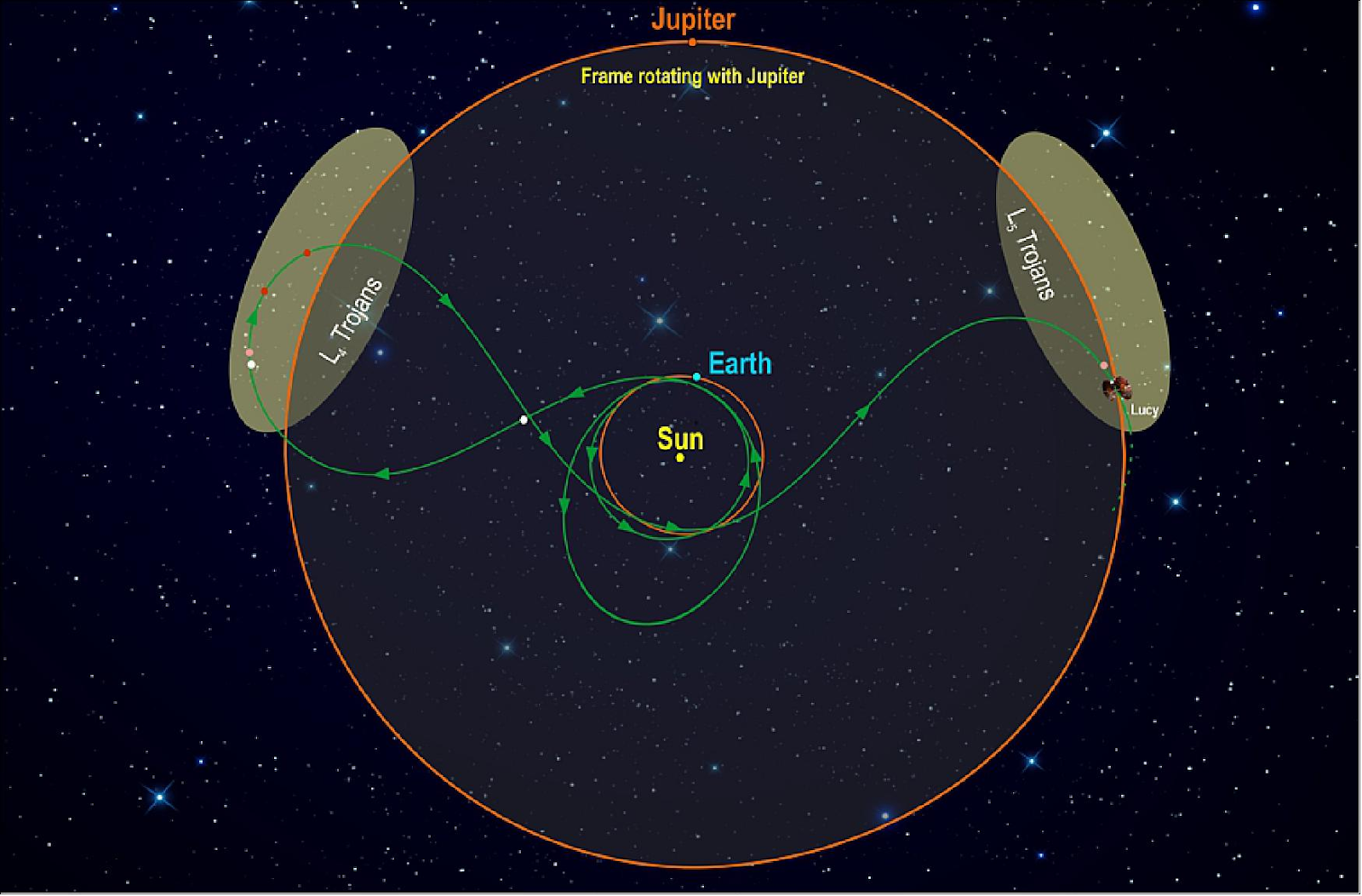
During its 12-year primary mission, Lucy will visit a total of eight asteroids. Seven of these asteroids are Trojan asteroids — unique asteroids located at Jupiter’s L4 and L5 Lagrange points, 60 degrees ahead of and 60 degrees behind Jupiter, respectively.

Lucy’s goal is to thoroughly investigate these Trojan asteroids, which, until Lucy, have never been visited by another spacecraft. These asteroids could be remnants of the very first collisions in our solar system, so investigating them with a mission like Lucy will provide incredible data on our solar system’s formation and past environment.

However, for a mission as complex as Lucy, the spacecraft itself has to feature many unique instruments and systems to help it survive the harsh environment of space for twelve years — while simultaneously collecting some of the most valuable information on planetary formation to date.

When fully deployed in space, Lucy will span a massive 15.8 meters in width,  7.2 meters in height, and 2.78 meters in depth — due to the spacecraft’s giant circular solar arrays.

Lucy’s solar arrays, once deployed, will be an impressive 7.3 meters in diameter, and will produce 504 watts of power at Lucy’s furthest distance from the Sun. Additionally, these solar arrays will make Lucy the farthest spacecraft to travel from the Sun that solely relies on solar power (all other spacecraft have used nuclear power sources).

Lucy’s dry mass, or the mass of the spacecraft when unfueled, is 821 kg. Lucy’s wet mass, or the fuelled mass of the spacecraft, is 1550 kg.

Lucy will carry four primary instruments with it to the Trojan asteroids onboard an Instrument Pointing Platform (IPP). The four main instruments Lucy is carrying are:

L’Ralph will be used as a color visible imager and an infrared imaging spectrometer. MVIC, the color visible imager, will take standard color images of the Trojans, showing each asteroid’s unique activity and surface characteristics. The infrared imaging spectrometer, known as LEISA, will allow Lucy to see absorption lines on asteroids that show different silicates, ices, and organics that are present on Trojan asteroids to determine their composition and, critically, where in the solar system they formed before they were trapped in Jupiter’s Lagrange points.

L’LORRI, is a high spatial resolution visible instrument that will take monochromatic images across the 0.35 to 0.85 micron wavelength. L’LORRI will provide scientists with incredibly detailed images of the surface of the Trojans — also revealing their sub-surface characteristics via impact craters.

L-TES is an instrument that will use an infrared thermal emission spectrometer covering wavelengths of 6 to 75 microns. Having an infrared thermal emission spectrometer will allow scientists to learn more about a Trojan asteroid’s thermal inertia, body heat retainment, and surface material structure.

Lastly, Lucy will use its high gain antenna to measure the mass of each asteroid it passes using the Doppler shift of the radio signal from the antenna.

Lucy was encapsulated in an Atlas V 4-meter payload fairing on September 29, and was transported to SLC-41 in the following days. As Lucy was undergoing final integration, testing, and preparations for launch, ULA was also preparing the Atlas V rocket at SLC-41.

On top of the Payload Adapter Fitting is the satellite release mechanism needed to deploy Lucy in its correctly planned heliocentric orbit. The PAF also carries the fairings until their release points 4 minutes into the flight of Atlas V 401 with Lucy.

Lucy will coast through near Earth space for a year before it performs the first flyby of its mission — a flyby of Earth in October 2022. The spacecraft will use Earth’s gravity to adjust its orbit, in a maneuver called a gravity assist. Lucy will perform yet another Earth gravity assist in December 2024 before making the trek to the L4 Trojan asteroids.

However, before performing its L4 asteroid flybys, Lucy will first flyby asteroid 52246 Donaldjohanson on April 20, 2025. The flyby will largely serve as a dress rehearsal for Lucy’s Trojan flybys — just as New Horizons used Jupiter as a practice target ahead of its eventual encounter with Pluto — with the spacecraft using its IPP instruments and internal systems as it would with a Trojan flyby.

Lucy will arrive at the L4 Trojan swarm in 2027 and will kick off its Trojan flybys on August 12, 2027, when Lucy flies past 3548 Eurybates and its satellite, Queta.

September 15, 2027, Lucy will fly by 15094 Polymele, the second of the seven Trojans the spacecraft will encounter. Lucy will fly past 11351 Leucus on April 18, 2028.

The last Trojan Lucy will encounter in the L4 swarm is 21900 Orus. Lucy will do a flyby on November 11, 2028, and will exit the L4 swarm in the weeks following the flyby. It is now time to transmit all the collected data back to Earth.

Lucy will then coast back to Earth for another gravity assist on December 25, 2030, slingshotting the spacecraft toward the L5 Trojan swarm.

Lucy will arrive at the L5 swarm in 2033 and will perform the final two flyby’s of the primary mission on March 3, 2033, when it flies past Patroclus and Menoetius — two, equal mass binary Trojans. Astronomers are probably planning changes to the flight plan if JWST finds an asteroid on its path back out to L5 Trojan swarm.

Lucy’s primary mission will conclude with the flyby of Patroclus and Menoetius, but future mission extensions could see Lucy flyby other L4 and L5 Trojans if spacecraft power and fuel reserves systems allow.

Lagrange Points L1 - L5

Lagrange Points are positions in space where the gravitational forces of a two body system like the Sun and in this case Jupiter produce enhanced regions of attraction and repulsion. These can be used by spacecraft to reduce fuel consumption needed to remain in their position. Lagrange points are named in honor of Italian-French mathematician Josephy-Louis Lagrange.

There are five special points where a small mass can orbit in a constant pattern with two larger masses. The Lagrange Points are positions where the gravitational pull of two large masses precisely equals the centripetal force required for a small object to move with them. Of the five Lagrange points, three are unstable Lagrange points - labeled L1, L2 and L3 - all lying along the direct line of sight connecting the two large masses.

L1 is behind Jupiter in a balance point where the drift out into outer space is canceled by the common attraction of Jupiter and the Sun. Spacecraft can orbit L1 with relative ease where it comes to propellant consumption. The James Webb Space Telescope - JWST is doing that in Earth's L1 point right now.

L2 is in the balance point between Jupiter and the Sun where a spacecraft can do exactly the same as at L1. Spacecraft can orbit L2 with relative ease where it comes to propellant consumption as well. A number of Earth satellites have done or are doing that.

L3 is behind the Sun and is used extensively by Science Fiction writers as homes for hostile aliens. If a planet Two of equal size there would be an  L6 and L 7 that was capable of capturing asteroids and holding satellites in a gravitational flux of balance.

The stable Lagrange points - labeled L4 and L5 - form the apex of two equilateral triangles that have the large masses at their vertices. L4 leads the orbit of Jupiter and L5 follows.

The L4 and L5 points are home to stable orbits so long as the mass ratio between the two large masses exceeds 24.96. Objects found orbiting at the L4 and L5 points are often called the Trojans and the Greeks after the three large asteroids Agamemnon, Achilles and Hector that orbit in the L4 and L5 points of the Jupiter-Sun system.

According to Homer, Hector was the Trojan champion slain by Achilles during King Agamemnon's siege of Troy. There are hundreds of Trojan Asteroids in the solar system. Most orbit with Jupiter, but others orbit with Mars. In addition, several of Saturn's moons have captured their own Trojan companions.

The Atlas V 401 launch

The launch countdown began with the loading of liquid oxygen onboard Atlas V. The rocket was already fueled with RP-1 kerosene two days before during the completed WDR.

Throughout the last four minutes of the countdown, ULA launch teams monitored the health of the rocket and spacecraft. 

At T – 2 seconds, the RD-180 engine ignited, and the rocket lifted off at T-0. 

At T+1:27, Atlas V experienced Max-Q, short for maximum aerodynamic pressure. Max-Q occurs when the aerodynamic loads on the vehicle are at their highest during ascent.

Following Max-Q, propellant levels in the first stage depleted, and the RD-180 engine was commanded to shut off in an event called booster engine cutoff (BECO). Spacecraft separation followed six seconds later, at T+4:09.

Lucy has a double figure eight orbit between Earth and Jupiter's Larange points 4 and 5. The first deep space encounter with an asteroid is a training run. The rest is for real. Source

Over the next 42 minutes, the Centaur upper stage ignited its RL-10 engine twice, starting with main engine start 1 (MES-1) at T+4:19. Payload fairing jettison occurred at T+4:27 just eight seconds after MES-1. MECO-2 happened at T+13:09.

Centaur shut down after 361 seconds for the final time at T+46:40 seconds and entered a 12-minute coast phase in preparation for spacecraft separation.

Lucy deployed from the Centaur upper stage at T+58:00, kicking off its 12-year mission through the solar system.

In the minutes following separation from Centaur, Lucy unfolded its massive circular solar arrays and began generating power to run its instruments and internal systems.

Lucy will be on a trajectory that will take it out of Earth’s sphere of influence in the days following launch.

The Atlas V 401 rocket

The Atlas V core in use for this mission is AV-096. It was originally delivered to Cape Canaveral to boost the Boeing Starliner on a trip to the ISS. Technical difficulties delayed that launch and AV-096 was reassigned to Lucy.

On June 28 it underwent preparations to go vertical at Mobile Service Tower (MST).

The next day, the Atlas V interstage was installed on top of the first stage followed by the Centaur upper stage installation on July 15. The lower portion of the payload fairing, the boattail, was then installed on top of the 3 meter wide Centaur, completing the majority of the Atlas rocket assembly.

On October 1, Atlas V underwent a Wet Dress Rehearsal (WDR). A WDR is one of the final major tests of all the systems on the Atlas V, which includes fueling the rocket as if it is about to launch. 25000 gallons of RP-1 kerosene was loaded and left there to lift off.

United Launch Alliance (ULA) has completed encapsulation of the payload fairing around NASA’s Lucy spacecraft inside the Astrotech Space Operations Facility in Titusville, Florida. The payload fairing secures and protects the spacecraft during launch and ascent.

The fairing halves that encapsulate the satellite went vertical for encapsulation in the Vehicle Integration Facility at the Cape Canaveral Space Force Station on October 7 where it will be “mated” with the boattail of United Launch Alliance Atlas V 401 rocket. Lucy was approved by NASA to proceed with its October 16 launch.

After receiving this approval, the satellite was stacked on top of the EFS and safely encapsulated in its 4.2-meter payload fairing. On September 15, the encapsulated payload was transported from the Integrated Processing Facility (IPF) to SLC-41 and was later integrated with the Atlas V.

The VIF is a 30-story building where the rocket stages and payload were put together for this mission aboard the Mobile Launch Platform.

The MLP will travel 400 meters to the pad with the help of undercarriage railcars and trackmobile machines that push the entire 1.4-million-pound platform and Atlas V 401 rocket along tracks up the hill to the launch pad.

The Atlas V will lift off from Space Launch Complex 41.The rocket will carry Lucy outside Earth’s atmosphere to begin the long journey to the Trojan asteroids.

Everyday Astronaut: Trevor Sesnic link

NasaSpaceFlight: Author Chris Bergin link

Coauthor/Text Retriever Johnny Nielsen

link to ULA launch list - Link to ULA Fan


ULA – Vulcan – Peregrine Lunar Lander

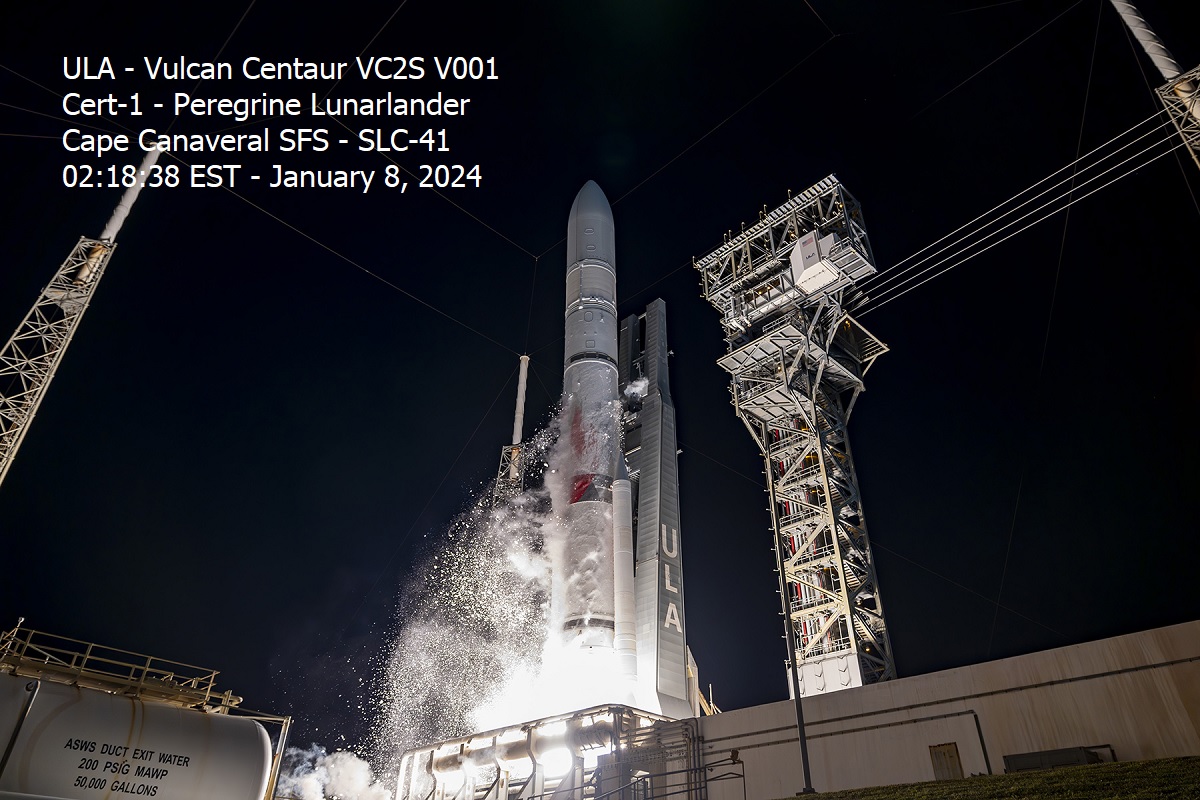
Photo from ULA of the Vulcan launch. I’ll huff. I’ll puff. And I’ll blow your pad away. Just you wait… Mission Rundown: ULA – Vulcan Centaur...