tirsdag den 1. marts 2022

ULA - Atlas V 541 - GOES-T

Screenshot from ULA Webcast of the launch of GOES-T

Mission Rundown: ULA - Atlas V 541 - GOES-T

Written: November 25, 2022

Lift Off Time

March 1, 2022 - 16:38:00 EST - 21:38:00 UTC

Mission Name

GOES-T

Launch Provider

ULA - United Launch Alliance

Customers

NOAA

NASA

Rocket

Atlas V 541

Launch Location

Space Launch Complex 41 - SLC-41

Cape Canaveral Space Force Station, Florida

Payloads

A2100 Weather Satellite are hosting six instruments

Payload mass

5 192 kg ~ 11 446 pounds

Where did the satellite go?

Geostationary Transfer Orbit targeting

8 897 km x 35 277 km x 9,42° inclination

Type of launch system?

Atlas Evolved Expendable Launch Vehicle + 4 SRB’s

The GEM-63 SRB’s fate?

In the Atlantic Ocean east of SLC-41

The first stage landing zone?

Bottom of the Atlantic ocean a lot further downrange

Type of second stage?

Centaur RL-10C-1 engine - 842 second burn time link

Is the Centaur stage derelict?

Yes - Main engine 4th start/cutoff was used to raise the orbit perigee to 38 655 km and followed by a safety venting of gasses and liquids in deep space.

Type of fairing?

5,4 meter two part composite carbon fiber fairing

This will be the:

– 149th flight of a ULA rocket

– 92nd flight of an Atlas V rocket - Tail no. AV-095

– 38th ULA mission for NASA

– 19th mission for NOAA - GOES-R Program

– 2nd mission for ULA in 2022

Where to watch

Where to read more in depth

NASA/ULA YouTube link

Want to know or learn more go visit or see Tim Dodd


Launch debriefing

(This did happen)

Centaur upper stage MES-1 to MECO-1 burn time was 446 seconds

Centaur upper stage will coast approximately for 11 minutes before its 2nd transfer burn

Centaur upper stage will coast about 3 hours to reach its geostationary 3rd insertion burn

GOES-T will spend 11 days on orbit raising into its allotted station

L-00:37:08

Hosts:

L-00:34:00

L-00:07:00

T-00:04:00

T 00:00:00

T+00:00:35

T+00:00:48

T+00:01:51

T+00:01:53

T+00:03:33

T+00:04:23

T+00:04:29

T+00:04:39

T+00:12:01

T+00:22:39

T+00:28:30

T+03:28:28

T+03:32:56

T+03:59:16

T+04:32:36

NASA/ULA live feed at 03:04

Megan Cruz, Kevin Fryar, Mic Woltman, Darryl Nail, etc.

ULA in a planned 30 minute hold at 34:00

Final Polling prior to the launch at 33:12

Release 4 minute hold at 36:12

Liftoff at 40:12 - 21:38:00 UTC

Mach 1 at 40:47 - Speed Mach One 1225,5 km/h

MaxQ at 41:00 - Maximum aerodynamic pressure

SRB burn out at 42:02 - Delayed release 2 by 2

SRB separation at 42:06 - Four GEM-63 spent

Fairing separation at 43:46 - Computer graphics on

BECO at 44:39 - Atlas V booster is empty - 263 second

Stage separation at 44:42 - Just losing 95% weight

MES-1 at 44:52 - Centaur RL-10C-1 engine start

MECO-1 at 53:14 - Coasting toward Africa

MES-2 to SECO-2 in 333 second doing a GTO burn

Wrap up from ULA at 1:09:43 - Calculated T+

MES-3 - SECO-3 in a 99 second insertion burn into GEO

ULA doesn’t show deployment of GOES-T

Centaur blowout of remaining gasses and fuel

Centaur 2nd stage becomes derelict space debris


Atlas V 401

Lucy

Atlas V 551

STP-3

Atlas V 511

USSF-8

Atlas V 541

GOES-T

Atlas V N22

OFT-2 Starliner

Atlas V 541

USSF-12

Atlas V 421

SBIRS GEO-6

Delta IV Heavy

NROL-91

Atlas V 531

SES 20 & 21

Atlas V 401

JPSS-2

Dude. It’s a weather satellite

United Launch Alliance (ULA) has launched the Geostationary Operational Environmental Satellite (GOES)-T advanced weather satellite for the US National Oceanic and Atmospheric Administration (NOAA). GOES-T launched on an Atlas V 541 from Space Launch Complex (SLC)-41 from Cape Canaveral Space Force Station (CCSFS). The launch took place on March 1, 2022, at 4:38 PM EST (21:38 UTC).
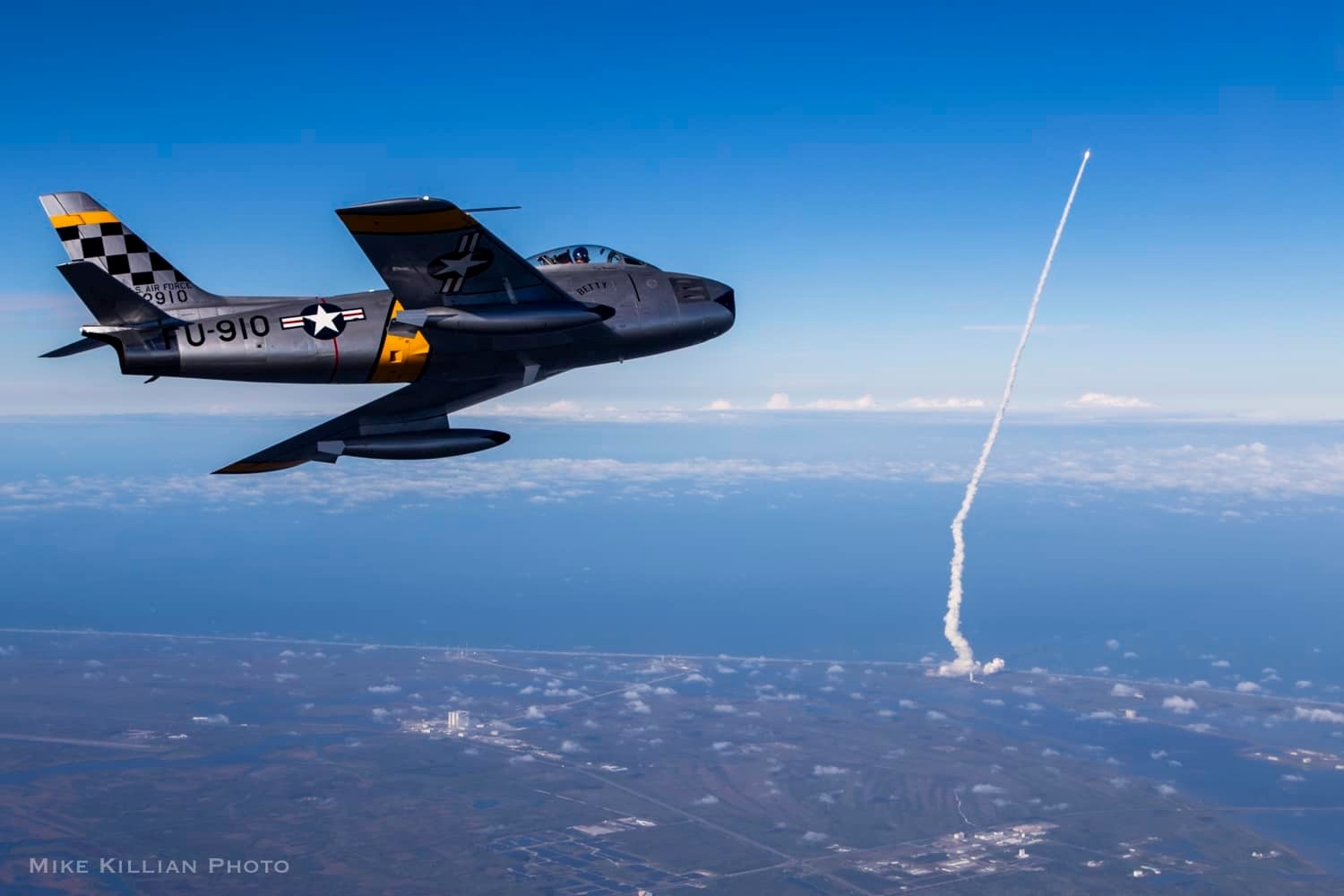
Two pilots with a restored F-86 Sabre took this photo of the GOES-T launch from SLC-41.  Squirrel

GOES-T is the third satellite in the GOES-R satellite series, the 19th overall GOES satellite, and the second Atlas V launch of 2022. Following the launch, GOES-T will become GOES-18 and will be stationed in the GOES-West position, replacing GOES-17.

The attachment of four side-mounted solid rocket boosters (SRBs) to the Atlas first stage will generate three-quarters of the energy necessary at liftoff to power the vehicle on to a complex, seven-hour flight. The core Atlas V booster will do the remaining 25%.

At T-7 minutes, the final Go/No-Go poll is conducted. Once the poll is complete and authorization to proceed received, the countdown resumes at T-4 minutes.

The RD-180 engine ignites at T-2.7 seconds. At T+1 second, the four GEM-63 boosters ignite and the Atlas V lifts off the pad. At T+5.3 seconds, the Atlas begins a pitch and roll maneuver to reach the proper flight profile while minimizing the loads on the rocket.

The four GEM-63 boosters burn out 94 seconds into the flight and are released 24 seconds later. This must be done to secure a safety distance from shore for rocket disposal.

With the rocket out of the atmosphere, payload fairing jettison occurs at T+3 minutes 30 seconds followed by Atlas engine shutdown at T+4 minutes 22 seconds. 

Six seconds later, the Atlas separates from the Centaur, and 10 seconds after that, the Centaur main RL-10C-1 engine ignites.

NOTAM hazard areas where Atlas V 541 will drop off SRB boosters, fairings and 1st stage

Just under eight minutes after Centaur’s ignition, the rocket reached its initial parking orbit. Centaur then begins an approximately 11-minute coast to a point directly over the equator.

Centaur then reignites to boost the apogee to around the GEO altitude of 36,000 km. The centaur burns for five minutes. After the burn it begins a long-duration coast phase.

After three hours, Centaur burns for a third and final time. This burn raises the perigee close to 8,900 km and lowers the inclination to 9.4 degrees. After a final two-minute coast, GOES-T separates from Centaur in 35,286 km by 8,876.7 km at a 9.4-degree inclination.

Following separation from the Centaur, GOES-T will begin an orbit-raising operation that will be completed on March 23. Once in GEO, GOES-T will be renamed GOES-18 and will be in the 89.5-degree and 136.2-degree locations for its on-orbit testing. This testing will make sure the spacecraft and instrument systems are ready for operations.

The upper stage Centaur’s RL-10C-1 engine depletes its last reserves of propellant to lift itself into a graveyard orbit some 38 655 km away from earth. The remaining gasses and fuel vapors will be vented at apogee in order to raise the perigee just a little.

The Centaur’s propellant tanks must be empty to avoid exploding like a rotting toad in the sunlight. At least three upper stage Centaur’s weren't purged and exploded in 10-15 large pieces of space debris.

The GOES-T Payload

GOES has its roots in the 1960s with the Applications Technology Satellite (ATS) program. ATS was NASA’s program to test satellites in Geostationary orbit (GEO) that could be used to observe the weather. The six satellite program was successful and led to the Synchronous Meteorological Satellite (SMS) Program.

The SMS program was NASA’s operational program having real time weather observations of the US. NOAA later became involved with the program, and it was renamed GOES. Since then, NASA and NOAA have continued to work together on the GOES program.

Despite issues seen with previous satellites while in orbit, the GOES program has successfully allowed for continuous observations for nearly 47 years.

The GOES-R program became operational with the GOES-R satellite, launched in November 2016. The GOES satellites, despite having individual letter and number designations, are also referred to by their program name, which is taken from the first GOES in that new series. GOES-R was the first of the GOES-R program, of which GOES-T is a part.

Its twin, GOES-S, was launched on an Atlas V 541 in March 2018 and successfully made it to GTO. It later moved to GEO where it began its testing. However, in May 2018, its Advanced Baseline Imager’s (ABI’s) cooling system started having performance issues due to a blockage of a coolant line.

For the whole GOES-R program, the ABI is the primary instrument for imaging Earth. The performance issues on GOES-S, now named GOES-17, did not impede its entering service. However, the GOES-T satellite was delayed for over a year to fix the issues with the ABI instrument. Reprogramming of coolant procedures.

GOES-T is the latest satellite in the GOES-R program. Like the other three in the series, the satellite is based on the Lockheed Martin A2100 satellite bus. The A2100 is Lockheed Martin’s offering for medium Earth orbit and GEO satellites. Since its introduction, the A2100 has been used for both military and commercial missions.

For the GOES-R program, the satellites have a dry mass of 2,857 kg. Fully fueled, each masses 5,192 kg and will have a lifetime of around 15 years.

The ABI instrument is mounted on the nadir, Earth-facing side of the GOES platforms. ABI is a multi-channel passive imagining radiometer designed to observe the Earth and its weather activity.

A second scientific instrument, Geostationary Lightning Mapper (GLM), is also mounted on the nadir side of GOES. GLM will monitor Earth for sudden, visual events to help build a map for lightning activity.

The second set of instruments is mounted on the satellite’s solar panel to track the Sun. The first is the Solar Ultraviolet Imager (SUVI), which operates in the extreme ultraviolet, capturing full images of the Sun to monitor eruptions, solar flares, and surface changes.

The second instrument on the solar array is the Extreme Ultraviolet and X-Ray Irradiance Sensors (EXIS) that monitor specific spectral bands in the light coming from the sun.

Two years after GOES-T’s launch, the final GOES-R satellite, GOES-U will be launched with an additional instrument, the Compact Coronagraph (CCOR) provided by the Naval Research Laboratory.

The CCOR will work with NOAA's Space Weather Follow-On-L1 (SWFO-F1) to observe the solar activity. SWFO-L1 will launch on Falcon 9 in 2025.
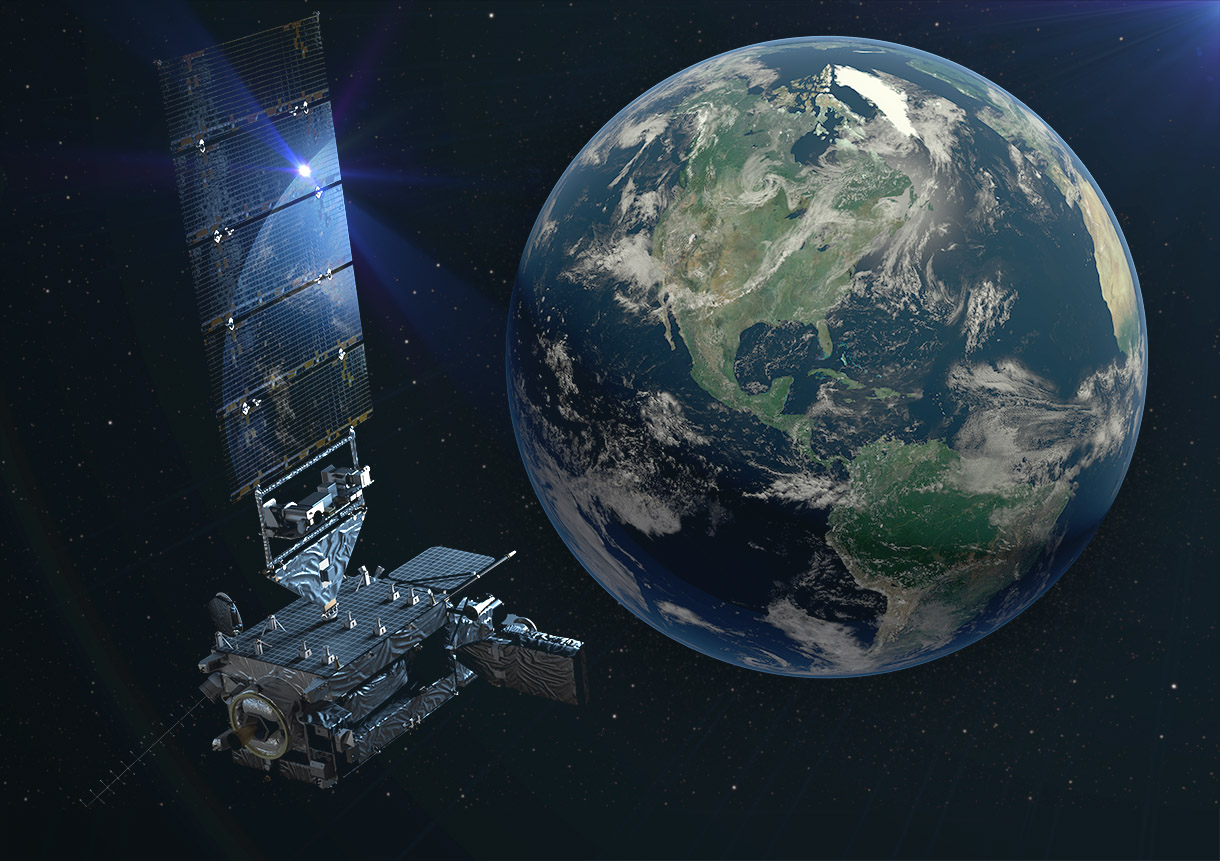
Graphic image of GOES-T keeping a keen eye on weather conditions on Earth and the Sun. Source

Joining those two are the Space Environment In-Situ Suite, consisting of four sensors that will take readings of the space environment around the satellite, and a newly upgraded magnetometer, GMAG. Built by NASA’s Goddard Space Flight Center, the magnetometer will measure magnetic field variations associated with space weather.

Testing is expected to be completed on January 3, 2023, with GOES-18 will be declared operational. Then GOES-18 will then drift to the GOES-West position with GOES-17 being transitioned to a backup satellite.
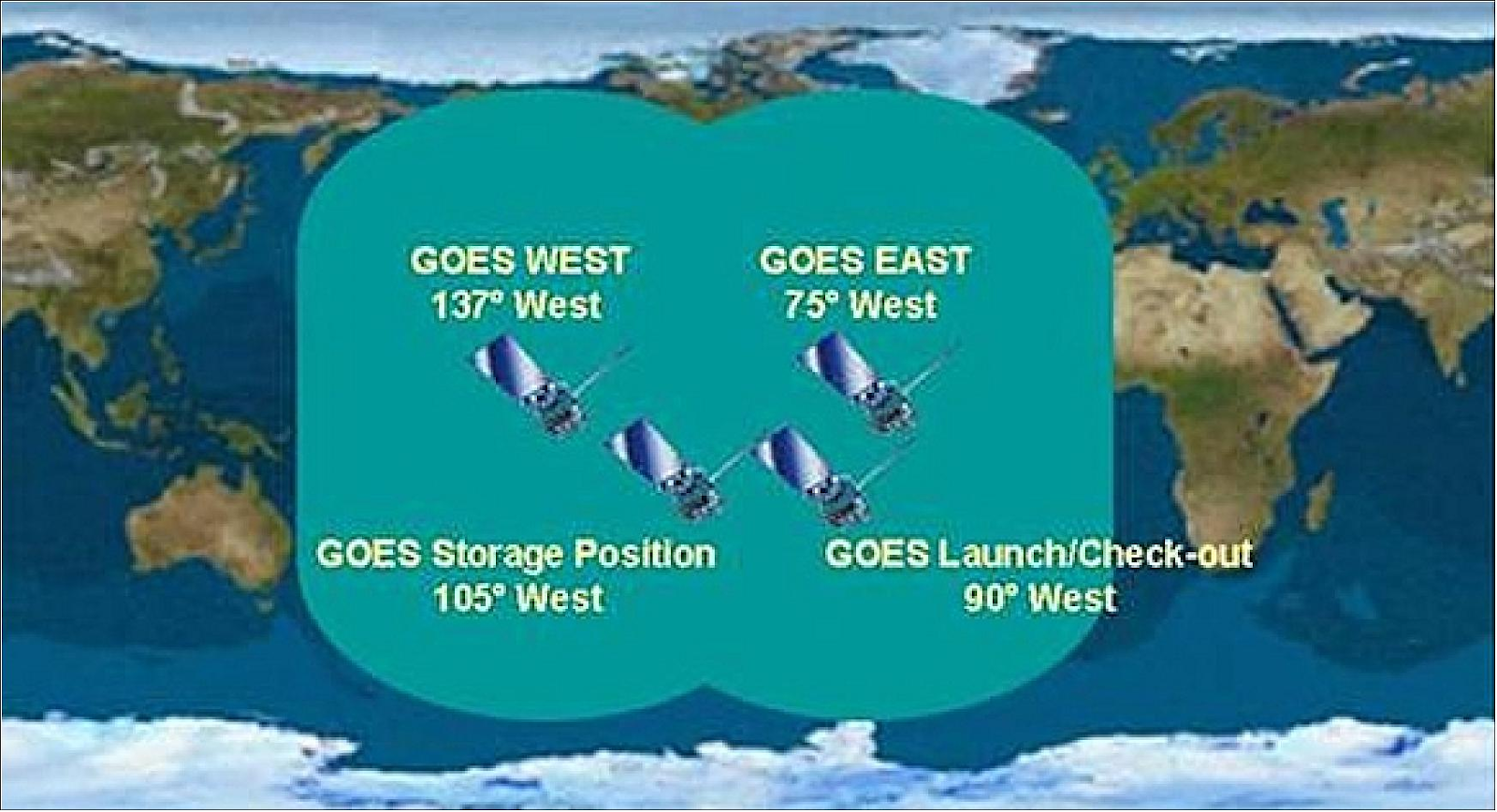
Graphic of the GOES-R series spacecraft locations. They hover over America. Not the World. link

The Atlas V rocket

The Atlas V core in use for this mission is AV-095. First launched in August 2002 on the Hotbird-6 telecommunication mission, Atlas V has since launched 91 times, with a nearly spotless record. After GOES-T, there are built 24 remaining Atlas V launches before its retirement in favor of the upcoming Vulcan rocket.

Atlas V is a two-stage liquid-fueled rocket. The first stage booster is a single-engine stage utilizing a Russian-built RD-180 engine. The RD-180 generates 3,828 kN of thrust with a specific impulse of 337 seconds. This stage is 32.5 meters in length, 3.81 meters in diameter, uses RP-1/LOX, and burns for about four minutes.

For the initial part of the flight, the first stage can support up to five GEM-63 solid rocket boosters. These boosters, first introduced on the NROL-101 mission in November 2020, are manufactured by Northrop Grumman and are smaller versions of the GEM-63XL boosters set to launch on Vulcan. Each booster generates 1,652 kN and burns for about 94 seconds. This mission will use four boosters.

The second stage is the Centaur, a hallmark of the Atlas family that was first used in 1962. Since then, the Centaur has evolved into the Common Centaur used today. To power the stage, an Aerojet Rocketdyne RL10C-1 engine is used to place its payload(s) into its final orbit. The RL10 engine is historic, having been used over several generations of rocket families and has been produced over 500 times.

The RL10C-1 uses liquid hydrogen and liquid oxygen to generate 101.8 kN of thrust with a specific impulse of 449 seconds. It has a 842 second - 14 minute burn time at full thrust. Centaur is also where the Atlas V rocket’s avionics systems are housed. Centaur is 3.05 meters in diameter and 12.6 meters in length.

Encapsulating both the Centaur upper stage and the GOES-T satellite is the payload fairing. Seen with the ULA rockets, a four or five-meter fairing can be used to better suit a customer’s needs. The five-meter fairings used on the GOES-T mission are manufactured from RUAG space.

To show what variant of the rocket is used on a given mission, ULA uses a three-digit number. The first digit denotes the diameter of the payload fairing, the second indicates the number of solid rocket motors, and the third represents the number of RL10 engines on the Centaur upper stage.

On GOES-T, the Atlas V was a 541, meaning a five-meter fairing with four GEM-63 boosters and a single RL10C-1. Using the Atlas V 541 allows ULA to put GOES-T into an optimized GTO that can place the satellite closer to its final orbit and therefore allows for less fuel consumption. This will help extend GOES-T’s operational lifetime.

Everyday Astronaut: Austin Desisto link

NasaSpaceFlight: Lee Kanayama link

Coauthor/Text Retriever Johnny Nielsen

link to ULA launch list - Link to ULA Fan


fredag den 21. januar 2022

ULA - Atlas V 511 - USSF-8

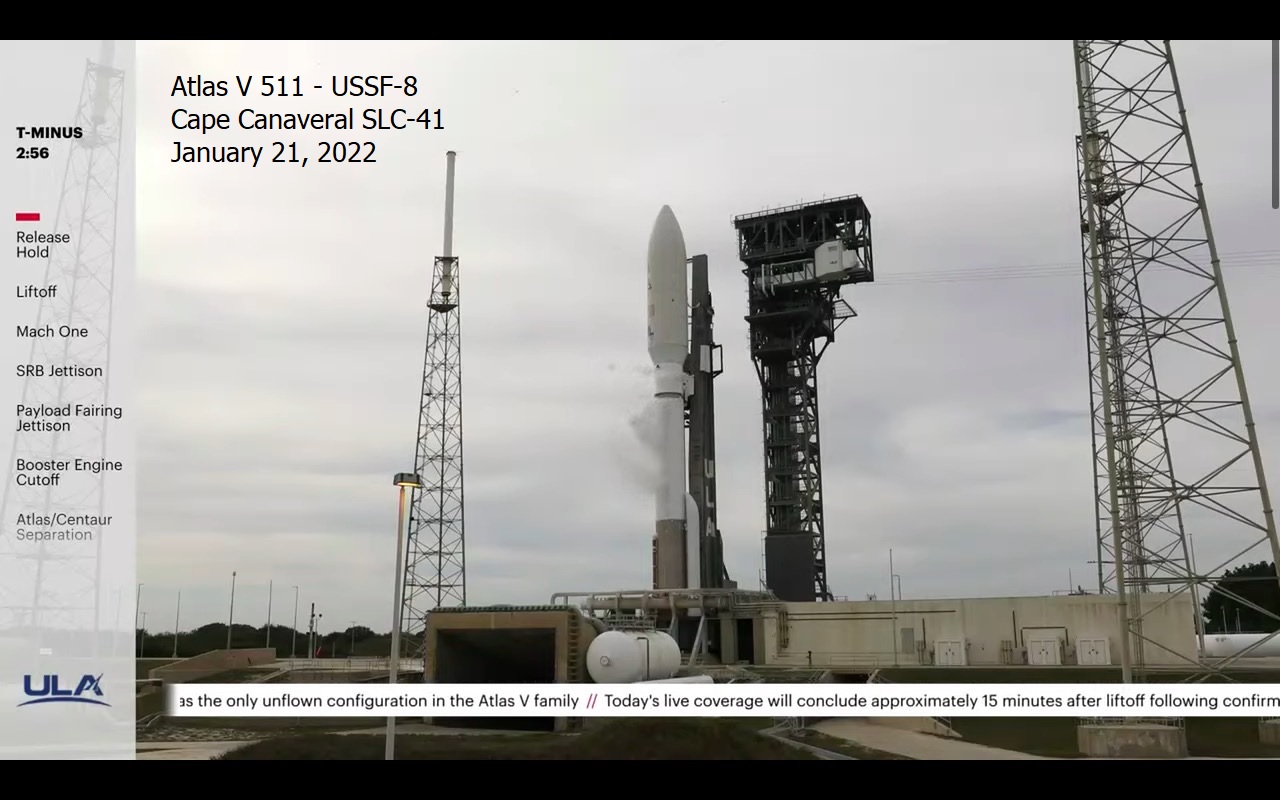
Screenshot from ULA Webcast of the launch of USSF-8. It’s clouded but it’s go for launch

Mission Rundown: ULA - Atlas V 511 - USSF-8

Written: November 26, 2022

Lift Off Time

January 21, 2022 - 14:00:00 EST - 19:00:00 UTC

Mission Name

USSF-8

Launch Provider

ULA - United Launch Alliance

Customer

United States Space Force

Rocket

Atlas V 511

Launch Location

Space Launch Complex 41 - SLC-41

Cape Canaveral Space Force Station, Florida

Payload

2 Geosynchronous Situational Space Awareness Sats

Payload mass

1 360 kg ~ 3 000 pounds

Where did the satellites go?

Near Synchronous Geostationary Orbit

Target Orbit - 36 002 km x 36 003 km x 0,01°

Type of launch system?

Atlas Evolved Expendable Launch Vehicle + 1 SRB

The GEM-63 SRB rocket fate?

In the Atlantic Ocean due east of SLC-41

The first stage landing zone?

Bottom of the Atlantic ocean a lot further downrange

Type of second stage?

Centaur RL-10C-1 engine - 842 second burn time link

Is the Centaur stage derelict?

Yes - Main engine 4th start/cutoff was replaced by a safety wenting of gasses and liquids in deep space.

Type of fairings?

5,4 meter two part carbon composite fairing

This will be the:

– 148th flight of all ULA rockets

– 91st flight of an Atlas V rocket - Tail no. AV-084

– 75th launch of a Atlas V rocket from SLC-41

– 4th mission for US Space Force

– 1st mission for ULA in 2022

Where to watch

Where to read more

ULA YouTube link

Want to know or learn more go visit or see Tim Dodd


Launch debriefing

(This will happen)

There is found a three second delay in the ULA computer graphic and the ULA YouTube video

Most likely it’s the ULA YouTube video feed that’s three seconds behind real time

MES-1 to SECO-2 burn time was 505 seconds

Centaur III have fuel for 842 second burn time and it will be missing 17 second of full burn time

This is evidence that some of the 2-3 burns wasn’t at full throttle

T-00:04:00

Host:

T-00:07:00

T-00:04:00

T 00:00:00

T+00:00:58

T+00:01:07

T+00:02:01

T+00:03:35

T+00:04:23

T+00:04:28

T+00:04:38

T+00:13:03

T+00:16:53

T+01:09:30

T+06:31:12

T+06:35:48

T+06:45:20

T+07:11:40

T+07:46:40

ULA live feed at 03:21 - In a planned 30 minute hold

Caroline Kirk, Patrick More - Flight Commentator

Final Polling preparing the launch at 15:59

Release -4 minute hold at 18:59

Liftoff at 23:00 - No T+ clock - 19:00:00 UTC

Mach 1 at 23:58 - Speed Mach One 1225,5 km/h 

MaxQ at 24:07 - Maximum aerodynamic pressure

SRB separation at 25:01 - Single GEM-63 got off

Fairing separation at 26:38 - Computer graphic delay?

BECO 27:26 - Atlas V booster is empty - 263 seconds

Stage separation at 27:31 - Just losing weight - 268 s

MES-1 at 27:41 - Centaur RL-10C-1-1 engine start

SECO-1 at 36:06 - Coasting in Low Earth Orbit

Wrap up from ULA at 39:56

MES-2 to SECO-2 in a 247 second GTO burn

MES-3 to SECO-3 in a 107 second GEO burn

GSSAP-5 deployment at 45:55

GSSAP-6 deployment at 46:45

Centaur blowout of remaining gasses and fuel

Centaur 2nd stage becomes derelict space debris


Atlas V 401

Lucy

Atlas V 551

STP-3

Atlas V 511

USSF-8

Atlas V 541

GOES-T

Atlas V N22

OFT-2 Starliner

Atlas V 541

USSF-12

Atlas V 421

SBIRS GEO-6

Delta IV Heavy

NROL-91

Atlas V 531

SES 20 & 21

Atlas V 401

JPSS-2

Two small’s for the price of one

United Launch Alliance (ULA) will, with an Atlas V 511 rocket, launch the USSF-8 mission for the U.S. Space Force. Liftoff will occur from Space Launch Complex-41 at Cape Canaveral Space Force Station, Florida on January 21, 2022 at 14:00 EST - 19:00:00 UTC.

USSF-8 will launch two identical Geosynchronous Space Situational Awareness Program (GSSAP) satellites. GSSAP-5 and GSSAP-6, directly to a near geosynchronous orbit approximately 22,300 miles (36,000 km) above the equator.

Upcoming in the Atlas V 511 stacking work, a GEM 63 solid rocket booster and the Centaur upper stage will be hoisted into place. The USSF-8 payload attachment occurs early in the new year. Liftoff on January 21st will be the 75th Atlas V launch from Cape Canaveral and ULA's 148th mission.

The tail number for USSF 8 is seen as AV-084. This mission was originally known as AFSPC 8. Link

When flying from SLC-41, Atlas rockets are assembled atop the mobile platform in the VIF (Vertical Integration Facility), which is located 550 meters south of the pad. AV-084’s Common Core Booster and Centaur arrived at Cape Canaveral aboard ULA’s RocketShip transport vessel in September 2020, with launch then slated for March 2021.

Various factors resulted in subsequent delays to this date, with the CCB finally arriving at the Vertical Integration Facility on December 18th, less than a fortnight after SLC-41 had been vacated by the previous Atlas V launch with STP-3.

The encapsulated payload in its fairings was hoisted on its launch vehicle on Monday, January 10th to begin integrated operations. Final pre-launch readiness reviews and rollout to the launch pad will happen next.

The photo of the mission patch on the fairing suggests that four ‘Owls’ are in place on their geostationary ‘perch’ after two successful launches, and this is the last launch with two ‘Owls’. The GSSAP satellites are represented as ‘Owls’ and the launches are represented as the two Gold Stars and one Silver Star. link

USSF-8 will be the one and only mission to fly on Atlas V 511 in this unique configuration that will provide just the right amount of thrust to deliver the twin spacecraft directly to near-geosynchronous orbit. It’s known as "Big Slider" named by GEO Tory Bruno because the SRB’s offset thrust will move Atlas V sideways during its launch.

ULA will launch USSF-8 on an Atlas V 511 configuration rocket, that includes a 5-meter short payload fairing and stands 196 ft. (59.7 m) tall. The Atlas booster for this mission is powered by the AMROSS RD-180 engine. Aerojet Rocketdyne provided the RL10C-1 engine for the Centaur upper stage and Northrop Grumman provided the single Graphite Epoxy Motor (GEM) 63 solid rocket booster.

1st stage AV-084’s Common Core Booster is powered by a RD-180 engine manufactured by Russia’s NPO Energomash, and is a two-chamber version of the four-chamber RD-170 developed for the Soviet Union’s Zenit and Energia rockets. See or read about it here.

Alerting observers and astro-photographers

Friday evening a fuel dump from a Centaur rocket may be visible as a bright nebula in the sky for observers in North, Central and South America. The fuel dump will occur at 18:11 PST - 21:11 EST for the planned 19:00:00 UTC launch of the Atlas V 511 rocket.

The Atlas V 511 rocket will place 2 satellites in geostationary orbit above the Galapagos Islands and after separation of the satellites the rocket stage will dump the remaining fuel. This cloud of fuel will be visible as a bright nebula, possibly as big as the Full Moon.

The cloud should be visible to the naked eye, and with binoculars or telescopes it should be possible to see the cloud grow and change shape. See Marco Langbroek's blog.

https://sattrackcam.blogspot.com/2016/06/muos-5-gto-insertion-and-centaur-fuel.html

With binoculars and telescopes, it may also be possible to see the exhaust plume of the rocket burn that circularizes the elliptical transfer orbit at geostationary altitude, as well as plumes while the rocket maneuvers to deploy the satellites before it moves away to begin dumping its remaining propellant reserves and emptying its gaseous residues.

The circularization burn is scheduled for 6h31m after launch, with separation of the satellites at 6h36m and 6h45m after launch. Check the ULA mission overview for more information. https://ulalaunch.com/missions/next-launch/atlas-v-ussf-8

In 2016, two similar satellites were placed in a similar orbit and @coastal8049 link managed to capture the circularization burn, maneuvering plumes and fuel dump in this video. The burn starts at the 8 second mark on the right hand side.

For Friday's Atlas V 511 launch, the timing is perfect as the Sun has set for North, Central and South America, with the events occurring some 36 000 km above the Galapagos Islands with the rocket still lit by the Sun.

The GSSAP Payload

The GSSAP (Geosynchronous Space Situational Awareness Program) is a US Space Force project using small satellites to inspect other spacecraft operating in geostationary orbit. Friday’s launch, which is designated USSF-8 (US Space Force 8), is carrying the fifth and sixth satellites in this series. Links to GSSAP launch one and two.

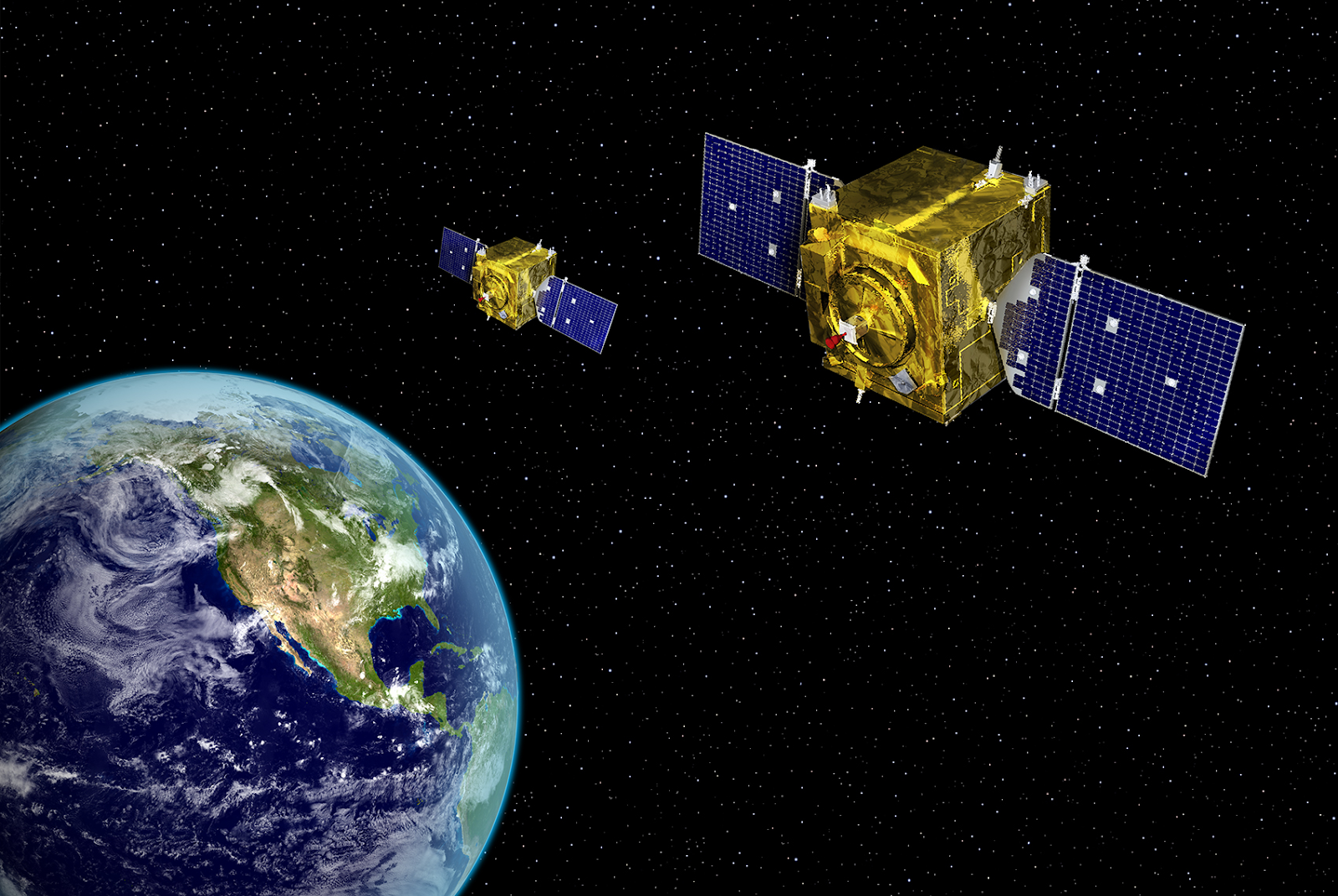
Graphic with two GSSAP satellites with a small red hydrazine thruster and solar wings unfolded

The six GSSAP spacecraft operate in near-geosynchronous orbits, which means they are slower or faster depending on their altitude allowing observations of other spacecraft from above and below. This means strutting with camera’s and a lot of antennas.

GSSAP satellites are manufactured by Northrop Grumman, formerly Orbital ATK, and are based on the lightweight GeoStar-1 bus. This is a three-axis stabilized platform incorporating the systems that enable the satellite to carry out its mission. Each satellite is powered by a pair of deployable solar arrays and are capable of maneuvering on-orbit to set up inspection passes of other spacecraft.

Each GSSAP spacecraft must have a mass of less than 1,000 kilograms (2,204 pounds) in order for the selected rocket configuration to be able to deliver them directly into a near geosynchronous orbit.

The USSF-8 launch comes shortly after the retirement of the first two GSSAP satellites, with GSSAP-1 being decommissioned and moved to a “graveyard” orbit above the geostationary belt around the start of last February. GSSAP-2 retired in October.

It would be logical for the US Space Force to use Hall Effect plasma thrusters in order to conserve propellant in orbit. The GSSAP satellites are too small to extend their service life beyond 5-10 years. Extensive orbit maneuvering going from satellite to satellite in deep space is time and propellant consuming.

The arrival of GSSAP-5 and 6 will restore the constellation to four satellites, although it is not clear for how much longer GSSAP-3 and 4 will be able to remain in service as they are only one year younger than GSSAP-1 and 2 was when they were withdrawn.

In addition to their own names and their launch designations, all military spacecraft in orbit have also been assigned numbers under the series of USA designations.

The first pair was designated USA-253 and 254, while the second pair was designated USA-270 and 271. USA designations are assigned sequentially, and the most recently announced example was USA-319, given to the GPS-III-05 satellite launched last June.

Assuming no unannounced numbers have been assigned in the meantime, this means that GSSAP-5 and 6 will most likely be given the designations USA-320 and USA-321.

Everyday Astronaut: Mariia Kisseleva link

Everyday Astronaut: Austin Desisto link

NasaSpaceFlight: William Graham link

Coauthor/Text Retriever Johnny Nielsen

link to ULA launch list - Link to ULA Fan


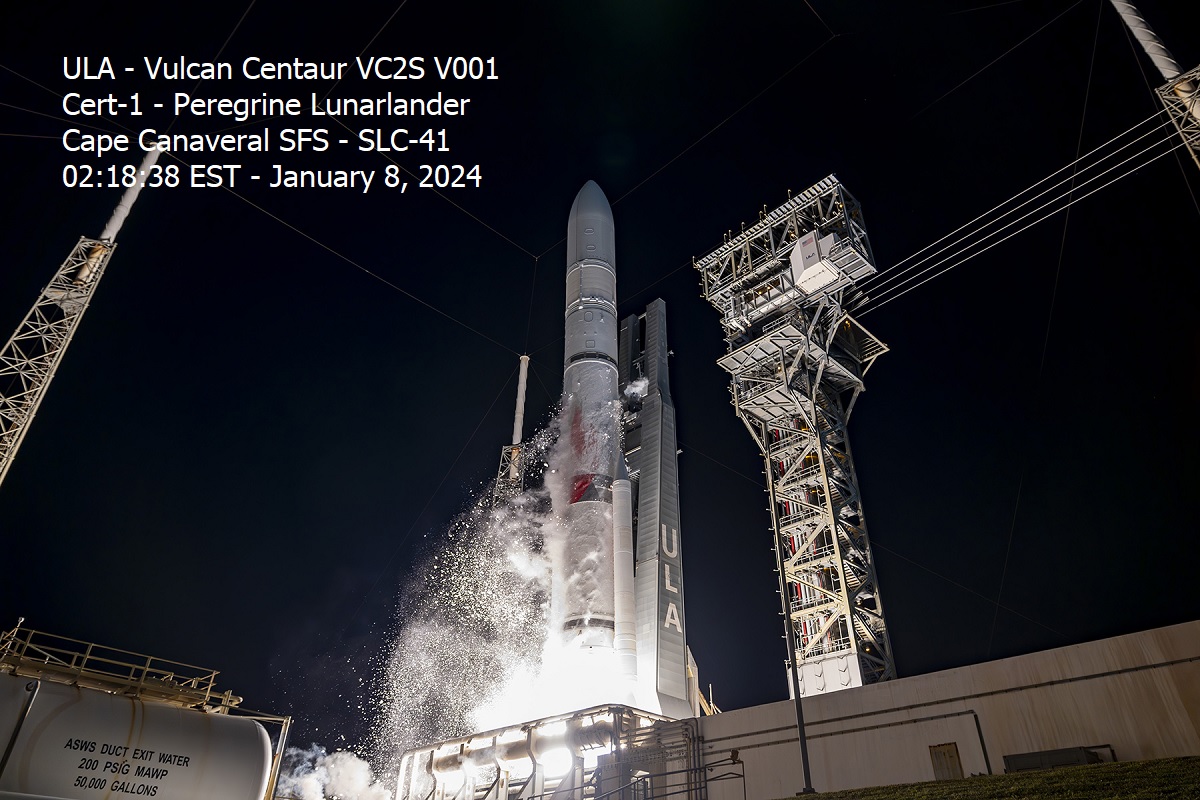
ULA – Vulcan – Peregrine Lunar Lander

Photo from ULA of the Vulcan launch. I’ll huff. I’ll puff. And I’ll blow your pad away. Just you wait… Mission Rundown: ULA – Vulcan Centaur...