lørdag den 24. september 2022

ULA - Delta IV Heavy - NROL-91

Screenshot from ULA Webcast of NROL-91. Mikey. Close the Shed when you're done with the Torch

Mission Rundown: ULA - Delta IV Heavy - NROL-91

Written: December 7, 2022

Lift Off Time

September 24, 2022 - 15:25:30 PDT - 22:25:30 UTC

Mission Name

NROL-91

Launch Provider

ULA - United Launch Alliance

Customer

NRO - National Reconnaissance Office

Rocket

Delta IV Heavy ~ ‘Delta 387’

Launch Location

Space Launch Complex 6 - SLC-6

Vandenberg Space Force Base, California

Payload

Blok 5 KH-11 Kennen 18/Chrystal Satellite ~ USA-338

Payload mass

19 000 kg ~ 41 800 pound

Where are the satellites going?

Low Earth Semi-Polar Orbit - 364 x 414 km x 73,58°

Type of launch system?

Delta Evolved Expendable Launch Vehicle - 3 Core’s

The side boosters landing zone?

Bottom of the Pacific Ocean near Baja California

The center core's landing site?

Bottom of the Pacific Ocean further downrange

Type of second stage?

DCSS - 16m 24s burn time

Is the DCSS derelict?

No - DCSS engine 2nd start/cutoff was a braking burn

New orbit is -30 km x 414 km x 74.17° 

Type of fairing?

5.1 meter two part carbon composite fairing

This will be the:

– 153rd flight of all ULA rockets

– 387th launch of Delta rocket

– 14th flight of a Delta IV Heavy rocket

– 96th mission for the U.S. National Security

– 32nd mission for NRO - 10th on Delta IV Heavy

– 6th mission for ULA in 2022

Where to watch

Where to read more

ULA YouTube link

Want to know or learn more go visit or see Tim Dodd


Launch debriefing

(This did happen)

DCSS is a acronym for Delta Cryogenic Second Stage and is a 5 meter wide extension of the Delta IV core booster

The last four times given is pure guesswork

L-00:53:34

Host:

L-00:45:25

L-00:07:00

T-00:04:00

T 00:00:00

T+00:01:21

T+00:01:23

T+00:03:47

T+00:03:58

T+00:05:36

T+00:05:44

T+00:06:00

T+00:06:09

T+00:06:40

T+00:18:05

T+00:42:42

T+00:47:47

T+00:50:50

T+01:19:27

ULA live feed inside a planned hold at 01:17

Caroline Kirk, Rob Kesserman as flight director

Extended hold with a new T0 at 05:00

Final Polling preparing the launch at 46:25

Release -4 minute hold at 49:25

Liftoff at 53:25 - No T+ clock - 22:25:30.144 UTC

MaxQ at 54:46 - Maximum aerodynamic pressure

Mach 1 at 54:48 - Speed Mach One 1225,5 km/h

Side booster throttling down at 57:12 - On fumes now

Side booster separation at 57:23 - Double drop off

BECO 59:01 - Delta IV Common Core Booster is empty

Stage separation 59:09 - Just losing 93% weight

MES-1 at 59:25 - DCSS RL-10B-2 engine start up

Fairing separation at 59:34 - Seeing ice breaking off

Wrap up from ULA at 1:00:05 - Calculated T+

MECO-1 at 53:14 - Coasting toward South Chile

ULA doesn’t show deployment of NROL-91

MES-2 to SECO-2 in xx seconds doing a deorbit burn

DCSS blowout of remaining gasses and fuel

DCSS becomes the property of Davy Jones Locker


Atlas V 541

USSF-12

Atlas V 421

SBIRS GEO-6

Delta IV Heavy

NROL-91

Atlas V 531

SES 20 & 21

Atlas V 401

JPSS-2

-TBD-

Mission 

not 

chosen 

yet

Last one closes the giant shed

United Launch Alliance’s (ULA) Delta IV Heavy rocket made its last West Coast launch on Saturday, carrying out a mission for the National Reconnaissance Office, as Delta IV Heavy moves one flight closer to retirement. Liftoff of the NRO Launch 91 (NROL-91) mission from Space Launch Complex 6 — at the Vandenberg Space Force Base in California — took place at 3:25:30 PM PDT - 22:25:30 UTC.
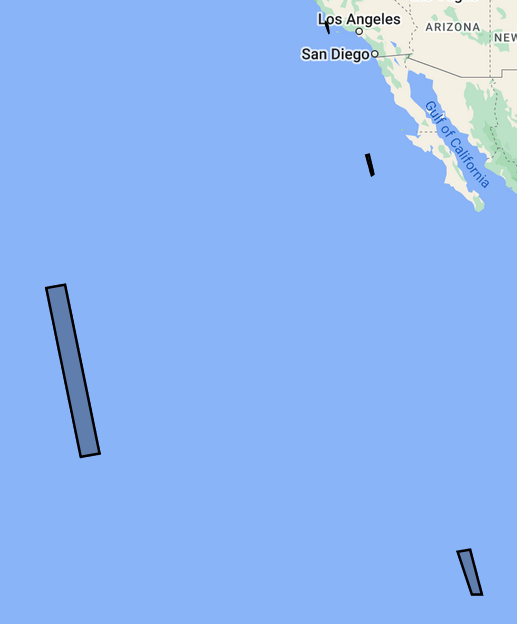
NOTAM with three splashdown areas. Nearest is launch failure. Second is Delta side boosters. Third is the Delta core booster and fairing parts. DCSS splashdown area is the largest area

This was the 14th launch of a Delta IV Heavy from SLC-6 on September 24, 2022.

Saturday’s mission, NROL-91, is the final Delta IV launch from California’s Vandenberg Space Force Base, with the Delta IV Heavy’s remaining two missions to be executed from the East Coast at SLC-37 on Cape Canaveral Space Force Base.

The NROL-91 Payload

Due to the NRO being a government agency, there is no publicly available information regarding the parameters and function of the NROL-91 satellite. It is also difficult to speculate on the purposes, size, mass, and function of the satellite. The NRO has chosen ULA because of their successful and highly accurate launches for all customers.

Graphic speculation on what a KH-11 KENNEN spy satellite looks like. A small Huble telescope

Because of the chosen orbit, which is similar to the NROL-71 mission 3 years earlier, it’s speculated that NROL-91 is a Blok 5 KH-11 Kennen/Chrystal satellite now designated USA-338. With both NROL-91 and NROL-71 in similar orbits, it is speculated they are ‘sisterships’ who might be replacing an aging USA-xxx satellite launched on a previous NROL mission ten years earlier.

While the National Reconnaissance Office (NRO) keeps details of its satellites classified, the use of a Delta IV Heavy and the fact the launch is taking place from Vandenberg speak volumes. Delta IV Heavy missions carry satellites that have too great a mass for the most powerful Atlas V configurations to place into their destined orbits, indicating the satellite is very heavy, bound for a high orbit, or both.

From its location on the West Coast, Vandenberg is an ideal launch site for low Earth orbit (LEO) reconnaissance satellites operating in polar and near-polar orbits, as well as some signals intelligence satellites in elliptical orbits.

The Delta IV Heavy Launch

Saturday’s countdown saw the Delta IV rocket filled with cryogenic propellants while critical systems are powered up and tested as the count proceeds toward liftoff. The ignition sequence for the three RS-68A engines began seven seconds before liftoff with the starboard booster before the port and center cores ignited two seconds later. This staggered start helps mitigate the effects of hydrogen build-up around the base of the vehicle, which has scorched the rocket or set fire to insulation on previous missions.

Liftoff occurred at T0. After Delta IV cleared the tower, it began a series of pitch and yaw maneuvers to attain its planned orbit, with the first of these beginning about 10 seconds after liftoff. Flying downrange, Delta 387 throttled down its center core to its partial thrust setting. It passed through the area of maximum dynamic pressure, or Max-Q, 89.6 seconds into the mission and reached Mach 1, the speed of sound, about 1.4 seconds later.

With the side boosters firing at full thrust and the center core operating in partial thrust mode, the port and starboard cores depleted their propellant first. As they approached burnout, they began to throttle back before shutting down at the three-minute and 56.3-second mark in the mission. The spent boosters separated 2.2 seconds later, falling away from the center core as it throttled up to full thrust.

Booster Engine Cutoff (BECO), the end of first-stage flight, occurs five minutes and 37 seconds after liftoff. Six and a half seconds after BECO, the first stage separates and the DCSS begins preparations to ignite its RL10C-2-1 engine, including deployment of the extendible nozzle. RL10 ignition occurs under 13 seconds after stage separation. 10 seconds into the burn, Delta IV payload fairing separates, and the NROL-91 payload is exposed to space for the first time.

With fairing separation complete, NRO missions tend to enter a news blackout, with further mission details remaining classified other than a brief press release to confirm the successful deployment of the satellite.

The DCSS can be expected to continue firing its engine for about 12 minutes as it inserts the satellite directly into orbit. Spacecraft separation will occur shortly afterward, before the DCSS restarts its engine for a deorbit burn. DCSS will crash into the Pacific Ocean after less than one orbit. A short but sweet life of the Delta Cryogenic Second Stage.

The Delta IV Heavy rocket
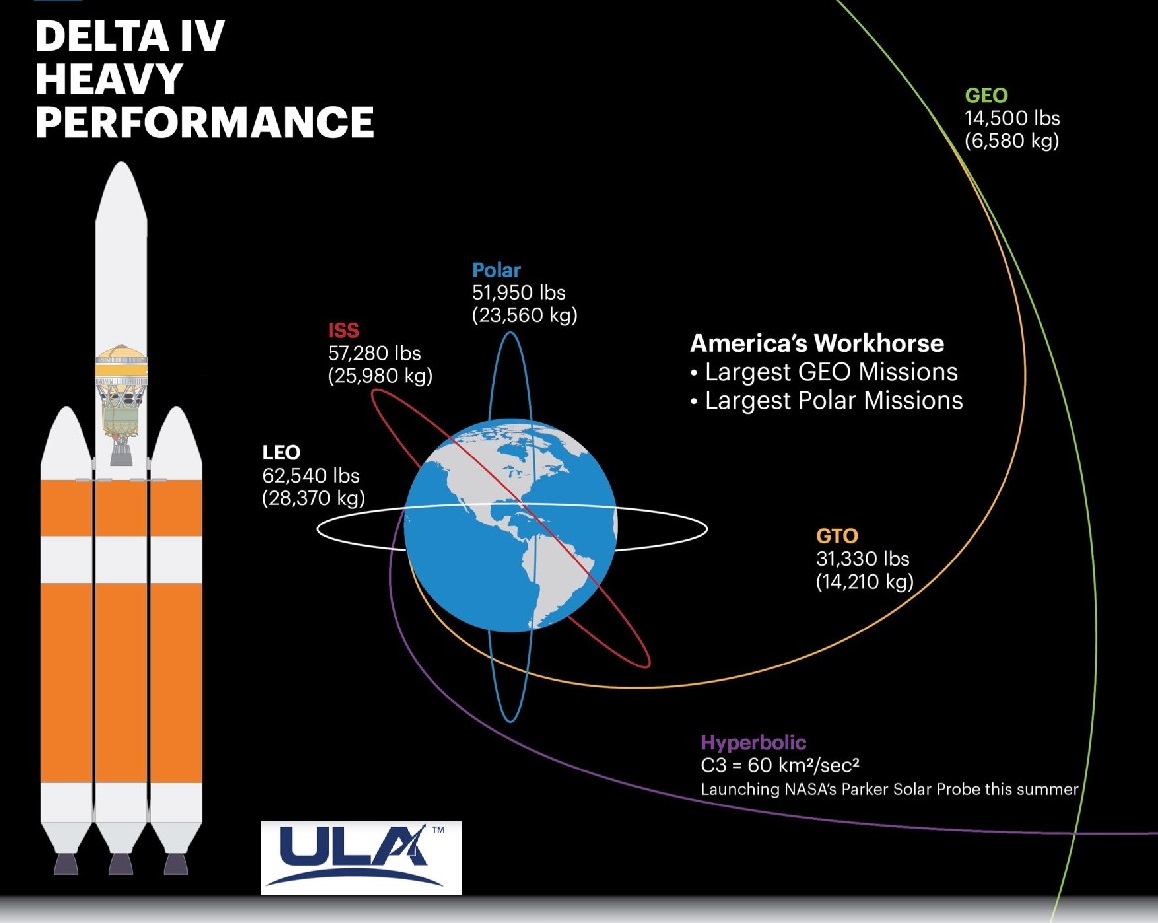
Graphic showing ULA rocket Delta IV Heavy’s capacity to loft various payloads to different orbits

The Delta IV Heavy is a 725,7 ton reliable heavy lift launch vehicle, meaning that it can take bigger and heavier payloads into orbit. It can launch up to 28,000 kg (61,000 lbs) to a 90 degree - meaning compass course - inclination into Low Earth Orbit (LEO) and 14,000 kg (30,000 lbs) to a geostationary transfer orbit (GTO).

To accommodate payloads of all sizes, ULA offers two different payload fairing types with three heights both at 5 m (16 ft) in diameter. A 14 meter (47 ft) tall fairing and a 19.1 m (62.7 ft) tall fairing. As types go it's a three part fairing and a two part fairing.

The Delta IV Heavy first stage consists of three nearly identical 40.8 meter - 170 foot boosters strapped together. The Hydrogen and Oxygen tanks hold together 470 000 gallon of liquid propellant in 6 tanks measuring about 1 792 m3 in needed tank volume.

Each booster has one RS-68A engine also manufactured by Aerojet Rocketdyne. Together with DCSS and fairing they stand 71,6 meters - 235 feet tall on the launch pad.

The Hydrogen tanks hold 330 000 gallon of liquid Hydrogen chilled to -252,8 0C Celsius or -423 0F Fahrenheit in 3 tanks measuring about 1 254 m3 in estimated tank volume. The three Hydrogen tanks each hold at least 418 m3 cubic meter liquid Hydrogen.

The Oxygen tanks hold 120 000 gallon of liquid Oxygen chilled to below -182,96 0C Celsius or -297,33 0F Fahrenheit in 3 tanks measuring about 454,2 m3 in estimated tank volume. The three Oxygen tanks each hold at least 151,4 m3 cubic meter liquid Oxygen.

NROL-82 states that 120 000 gallons of liquid Oxygen is loaded. NROL-44 gave me these numbers. Second source found. Is it 470 000 gallon of liquid propellant with DCSS?

Using a calculator dividing 33 with 15 gets you a ratio of 2,75 in hydrogen to oxygen. Doing the same with DCSS gets you a ratio of 1,33. 13,750 gallon LH2 divided with 5,000 gallon LOX gives you the same ratio of 2,75. Ergo 10,000 gallon LH2 and 6,000 gallon LOX are both wrong numbers. That is if the limit to DCSS volume is 20,000 gallon liquid propellant.

The first stage is infamously known for lighting itself on fire just before launch to burn off extra hydrogen. It does this because it needs to get rid of any hydrogen so it does not explode unintentionally during liftoff.

The hydrogen comes from the purging or chilling of the engines prior to ignition. The engine can’t handle the freezing chock of liquid Hydrogen and Oxygen and will split itself apart especially in the turbopump bearings. They will become brittle and shatter.

Each RS-68A engine has the capability to produce 3,160 kN (705,000 lbf) of thrust for a combined 9,420 kN of total thrust. The RS-68A engine has a specific impulse of 362 seconds and uses a combination of liquid hydrogen (LH2) and liquid oxygen (LOx).

During the flight, the center booster burned at a slightly slower throttle setting - 80% - than the two side boosters. This is because the Delta IV Heavy needs all three boosters in order to get enough velocity to pass through the thick parts of the atmosphere. However, after that, they are expended and jettisoned as to not carry any extra weight.

As the vacuum optimized Delta second stage is very efficient, but not very powerful, the Delta IV Heavy burns its center booster longer than other rockets so the second stage will be able to put its payload into orbit.

Continuing up the rocket comes the second stage. The Delta Cryogenic Second Stage (DCSS) is powered by a single, vacuum optimized RL10B-2 engine. For its fuel, the DCSS too uses liquid hydrogen (LH2) and for the oxidizer, liquid oxygen (LOX).

The LH2 tank - volume of 38 m3 holding 10 000 gallon LH2 - being on top, it has the job of supporting the payload and the payload fairing and is structurally separated from the other ‘half’ of DCSS. The clearly smaller LOX tank - volume of 23 m3 holding 6 000 gallon LOX - is suspended below it and is responsible for structurally supporting the RL10B-2 engine.

The LH2 tank - volume of 52.0 m3 holding 13 750 gallon LH2 - being on top, it has the job of supporting the payload and the payload fairing and is structurally separated from the other ‘half’ of DCSS. The clearly smaller LOX tank - volume of 18.9 m3 holding 5 000 gallon LOX - is suspended below it and is responsible for structurally supporting the RL10B-2 engine.

With 20,000 gallons of liquid propellant reserved for the DCSS there should be room for 1,250 gallons of Hydrazine and pressurized Helium gas for orbit maneuvers and back filling of the empty propellant tanks.

The numbers of DCSS are found to be wrong. It must be double checked first.

The RL10B-2 was originally built by Aerojet Rocketdyne and first flew in 1998. It has the capability to produce 110 kN (24,700 lbf) of thrust in a vacuum and has a specific impulse of 462 seconds. It will light up at least four times with 18 minutes 15 seconds of burn time and an unknown throttle setting during the mission.

In order to save costs and weight, the gimbal system uses electromagnetic actuators over normal hydraulics; this also increases reliability.

Facts on this Delta IV Heavy launch vehicle

Height of Delta IV Heavy: 233 feet (71 meters)

Fuel onboard: 470,000 gallons of cryogenic liquid propellant

3 x Core stage Delta IV Heavy: 110,000 gallon LH2 - 40,000 gallon LOX

Second Stage 5 meter DCSS: 10,000 gallon LH2 - 6,000 gallon LOX

150 kg (340 lb) of Hydrazine is stored - Unknown so far

Helium storage tanks: Unknown so far

Mass at liftoff: 1,6 million pounds (725,750 kg)

Thrust at liftoff: 2.1 million pounds (9.4 mega-Newtons)

Orbit: Low Earth Semi-Polar Orbit - 226 x 257 miles (364 x 414 km)

Everyday Astronaut: Trevor Sesnic link

NasaSpaceFlight: William Graham link

Coauthor/Text Retriever Johnny Nielsen

link to ULA launch list - Link to ULA Fan


torsdag den 4. august 2022

ULA - Atlas V 421 - SBIRS GEO-6

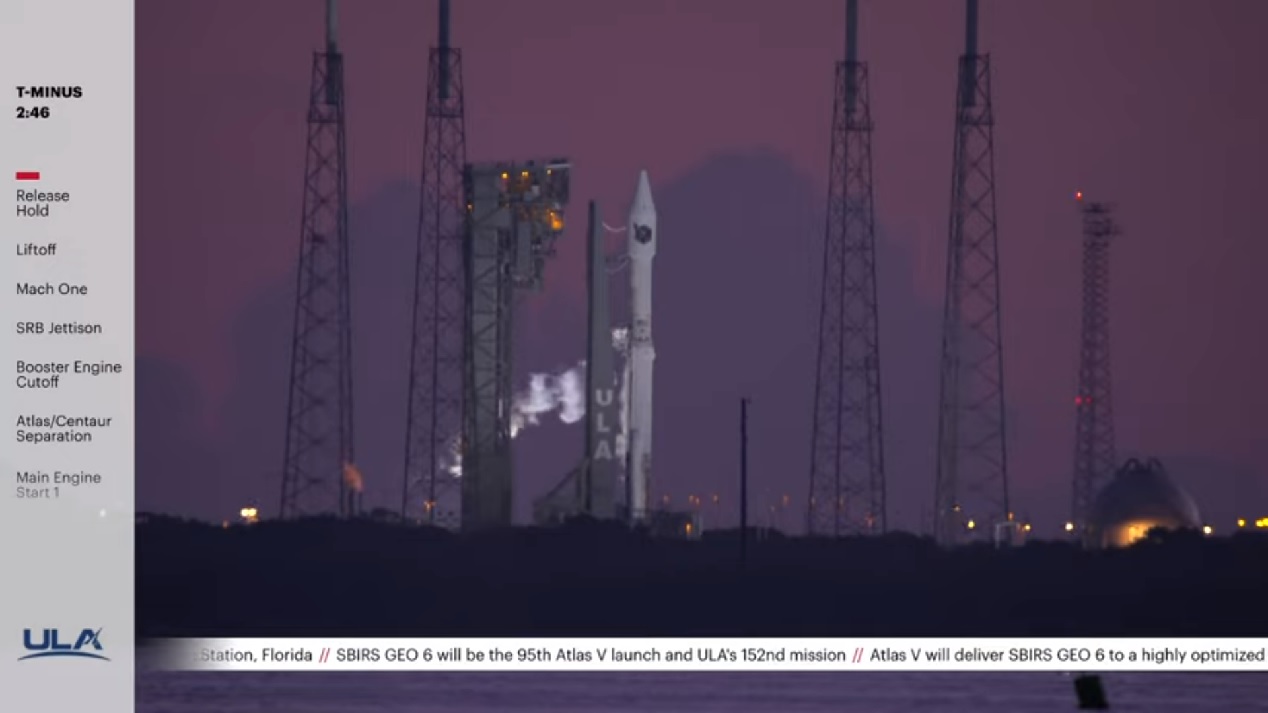
Screenshot from ULA Webcast of the launch of SBIRS GEO-6. Morning is breaking in purple colors

Mission Rundown: ULA - Atlas V 421 - SBIRS GEO-6

Written: December 7, 2022

Lift Off Time

August 4, 2022 - 06:29:00 EDT - 10:29:00 UTC

Mission Name

SBIRS GEO-6

Launch Provider

ULA - United Launch Alliance

Customer

U.S. Space Force

Rocket

Atlas V 421

Launch Location

Space Launch Complex 41 - SLC-41

Cape Canaveral Space Force Station, Florida

Payload

Infrared Surveillance Satellite - LM 2100M Combat Bus

Payload mass

4 500 kg ~ 10 000 pounds

Where did the satellite go?

Geostationary Transfer Orbit

5 218 km x 35 536 km x 17,63°

Type of launch system?

Atlas Evolved Expendable Launch Vehicle + 2 SRB’s

The GEM-63 SRBs' fate?

In the Atlantic Ocean due east of SLC-41

The first stage landing zone?

Bottom of the Atlantic Ocean further downrange

Type of second stage?

Centaur RL-10C-1-1 engine - 16m 24s burn time

Is the 2nd stage derelict?

Yes - Main engine 3rd start/cutoff expanded the orbit

New orbit is 5 256 km x 35 350 km x 16.50° 

Type of fairing?

4.2 meter two part metallic fairing

This will be the:

– 152nd flight of all ULA rockets

– 95th flight of an Atlas V rocket - Tail no. AV-097

– 677th launch of all types of Atlas rockets since 1957

– 6th launch for US Space Force - USA-336

– 5th mission for ULA in 2022

Where to watch

Where to read more

ULA YouTube link

Want to know or learn more go visit or see Tim Dodd


Launch debriefing

(This did happen)

At 28:54 pay attention to the two SRB’s who are in the frame glinting and trailing smoke as the both fall into the ocean

It will take Centaur about 25000 years to fall back to earth. Can you wait?

T-00:04:38

Host:

T-00:04:00

T-00:07:00

T-00:04:00

T 00:00:00

T+00:00:49

T+00:00:52

T+00:01:29

T+00:02:25

T+00:04:15

T+00:04:21

T+00:04:32

T+00:04:39

T+00:12:52

T+00:13:34

T+xx:xx:xx

T+00:22:54

T+02:57:40

T+03:01:27

T+03:31:27

T+03:59:27

ULA live feed at 05:40

Noah Curry, Jesse Gonzales flight commentator

Planned 15 minute hold at 05:18

Final Polling preparing the launch at 18:18

Release -4 minute hold at 21:18

Liftoff at 25:19 - No T+ clock - 10:29:00.202 UTC

Mach 1 at 26:08 - Speed Mach One 1225,5 km/h

MaxQ at 26:11 - Maximum aerodynamic pressure

SRB burn out at 26:48 - Still coughing up thrusts

SRB separation at 27:34 - Two GEM-63 spent

BECO at 29:34 - Atlas V booster is empty - 255 second

Stage separation at 29:40 - Just losing 93% weight

MES-1 at 29:51 - Centaur RL-10C-1-1 engine start

Fairing separation at 29:58 - Computer graphics on

MECO-1 at 38:11 - Coasting - Burn time 500 seconds

Wrap up from ULA at 38:53 - Calculated T+

Deployment of EZIO 5 & EZIO 6 - Canceled - No ticket

MES-2 to SECO-2 in 329 second doing a GTO burn

MES-3 - SECO-3 in a 146 second insertion burn to GEO

ULA doesn’t show deployment of SBIRS GEO-6

Centaur blowout of remaining gasses and fuel

Centaur 2nd stage becomes derelict space debris


Atlas V 541

USSF-12

Atlas V 421

SBIRS GEO-6

Delta IV Heavy

NROL-91

Atlas V 531

SES 20 & 21

Atlas V 401

JPSS-2

-TBD-

Mission 

not 

chosen 

yet


Sixth ‘redeye’ taking to the sky

ULA launched the SBIRS GEO-6 satellite on an Atlas V rocket in the 421 configuration for the United States Space Force’s Space Systems Command (SSC).

Liftoff of the SBIRS GEO 6 mission from Space Launch Complex-41 at Cape Canaveral Space Force Station occurred at the opening of a 40-minute window at 6:29 AM EDT (10:29 UTC) on August 4, 2022.

The Space-Based Infrared System, or SBIRS, plays a key role in defending the United States and its allies from missile attacks. Combining dedicated satellites in geosynchronous orbit and sensors hosted on other spacecraft in inclined elliptical orbits, it keeps a constant watch for the signs of rocket and missile launches around the world.

SBIRS satellites are equipped with infrared sensors to detect launched missiles by the heat signatures of their exhaust plumes.

Thursday’s launch deployed the constellation’s sixth geosynchronous satellite. SBIRS GEO 6 is also expected to be the last SBIRS satellite to launch before a next-generation missile detection system begins deployment in the coming years.

The SBIRS GEO-6 Payload

The SBIRS GEO 5 and 6 spacecraft are of an upgraded design, based around Lockheed Martin’s modernized LM 2100M satellite bus. GEO 5 launched in May 2021, with Thursday’s launch of GEO 6 completing the constellation.

Two additional satellites had been planned but were canceled in the Air Force’s 2019 budget to free up resources for the successor program, Next-Generation Persistent Overhead Infrared (NG-OPIR). DSP, SBIRS, and NG-OPIR were all transferred from the Air Force to Space Force upon Space Force’s formation in 2019, with Space Delta 4 responsible for the projects.

NG-OPIR will use satellites in both geosynchronous and Molniya orbits. The first NG-OPIR GEO satellite is currently slated for launch in 2025, while the first launch of the NG-OPIR Polar series – the Molniya orbit spacecraft – is expected no earlier than 2027.

A pathfinder satellite, Wide Field of View (WFOV) Testbed, was launched as part of the US Space Force 12 (USSF-12) mission on the previous Atlas V launch.

The Rocket Launch

Atlas rolled out to the launch pad on Tuesday atop the MLP. Departing the VIF at 10:00 a.m. local time (14:00 UTC), the launch platform was “hard down” at the pad one hour and 22 minutes later. Fuelling of the first stage propellant tanks with RP-1 – rocket-grade kerosene – was completed on Tuesday evening.

Loading of the second stage’s liquid hydrogen (LH2) fuel and the liquid oxygen (LOX) oxidizer for both stages takes place on launch day as these propellants boil off at ambient temperatures. One way of keeping cryogenic propellants chilled is using liquid Helium as gas bubbles or liquid Nitrogen in pipes as heat exchangers.

The first stage is powered by a single RD-180 engine with two combustion chambers. At the T-2.7 second mark in Thursday’s countdown, the RD-180 ignited, with the twin GEM-63 motors also lighting shortly afterward.

At T+1.1 seconds the thrust produced by the rocket exceeded its weight, so it lifted off and began its climb toward space. Six seconds into the flight, Atlas initiated its first pitch and yaw maneuver to put it on the right track - azimuth - for its destination orbit.

Atlas flew east from Cape Canaveral, out over the Atlantic Ocean. It took 48.9 seconds for the rocket to reach Mach 1, the speed of sound. Three and a half seconds later Atlas V passed through Max-Q, the area of maximum dynamic pressure.

The GEM-63 solids burned for about 98 seconds before depleting their propellant. After burnout, the spent casings remain attached to Atlas until conditions are right to ensure a clean separation with no risk of recontact between the spent motor casings and the Atlas vehicle. The SRMs were jettisoned at two minutes, 13.3 seconds mission elapsed time.

With the GEM-63s gone, the RD-180 engine continued to fire alone. It burned for the first four minutes and 12.4 seconds of the mission, with its shutdown being a mission milestone designated Booster Engine Cutoff (BECO).

Six seconds after BECO the Centaur upper stage separated from the booster and began its prestart sequence. Ignition of Centaur’s RL10C-1-1 engine took place 10 seconds after stage separation. Eight seconds after Centaur ignites, the rocket’s payload fairing separated, exposing SBIRS GEO 6 to space.

The SBIRS GEO 6 mission marks the second flight of the RL10C-1-1 engine, in place of the RL10C-1 that has been used on most of Atlas V’s recent missions. This new version of the veteran RL10 engine was first flown on the SBIRS GEO 5 launch last year and incorporates an extended nozzle for increased thrust, and improved manufacturing techniques.

Despite performing nominally during its first flight and successfully delivering the payload into orbit, the engine nozzle - bell - was observed to be vibrating far more than had been expected, so engineers have taken their time to review data from that mission before allowing the new engine to fly again.

For Thursday’s launch, the engine flew without deploying its full nozzle extension, leaving it about the same length as the RL10C-1.

Although the RL10C-1-1 is being introduced on Atlas V, it is expected to go on to power a new version of Centaur under development for ULA’s next-generation rocket, Vulcan.

Thursday’s mission called for Centaur to make three burns of its RL10C engine. The first burn was the longest, lasting eight minutes and 27 seconds to place Centaur and SBIRS GEO 6 into an initial parking orbit.

After a ten-minute coast phase, Centaur made another four-minute, 44-second burn to raise itself into an elliptical transfer orbit. This burn is followed by an extended coast as the upper stage and its payload gain altitude.

During this coast phase two small satellites, named EZIO-5 and 6, are expected to be deployed from Centaur’s Aft Bulkhead Carrier. These are likely similar to the EZ-3 and EZ-4 satellites deployed during the first coast of the SBIRS GEO 5 mission, which were 12U CubeSats flown as part of Space Systems Command’s Technology Demonstration Orbiter (TDO) program.

Two and a half hours after the second burn concludes Centaur fired again for 58 seconds to further raise the orbit.

SBIRS GEO 6 separated two minutes and 49 seconds after the end of the third burn.

Centaur then performs a blowdown and passivation before the official end of the launch mission at T+3 hours, 59 minutes, and 27 seconds mission elapsed time.

The Atlas V rocket

The Atlas V that carried out Thursday’s mission has the unique tail number AV-097. The vehicle is in the 421 configuration, which incorporates a four-meter-diameter payload fairing, a pair of solid rocket boosters to augment the thrust of the first stage, and a single-engine Centaur upper stage. AV-097 lifted off from Space Launch Complex 41 (SLC-41) at the Cape Canaveral Space Force Station in Florida.

Atlas V is a two-stage rocket. Its Common Core Booster (CCB) first stage powers the early stages of flight as the rocket climbs through Earth’s atmosphere. Centaur, a highly-efficient cryogenic fuel upper stage, then takes over to deliver the payload into its prescribed orbit.

Thursday’s launch targeted a geosynchronous transfer orbit with a raised perigee – the point of the orbit closest to the Earth’s surface – of 5,218 kilometers (3,243 miles, 2,818 nautical miles), an apogee of 35,335 km (21,956 mi, 19,079 nautical miles), a inclination of 17.63 degrees.

Facts on the Atlas V launch vehicle

Height of Atlas V 421: 194 feet (59.1 meters)

Fuel onboard: 91,000 gallons of liquid propellant

First stage Atlas: 25,000 gallon RP-1 - 48,800 gallon LOX

Second Stage Centaur: 13,050 gallon LH2 - 4,150 gallon LOX

LOX+LH2 = 66,000 gallon of cryogenic liquid propellant

150 kg (340 lb) of Hydrazine is stored in a pair of bladder tanks

Helium storage tanks: Unknown so far

2 GEM-63 SRB: 200,000 pounds of solid fuel

Mass at liftoff: 969,500 pounds (439,758 kg)

Thrust at liftoff: 1.6 million pounds (7.1 mega-Newtons)

Orbit: Geosynchronous Transfer Orbit - 3,243 x 22,000 miles (5,218 x 35,500 km)

Graphic of Atlas V 421 split in its major pieces. The 12 U ‘toolbox’ sized EZIO 5 and 6 leaves first

Everyday Astronaut: Claire Percival link

NasaSpaceFlight: William Graham link

Coauthor/Text Retriever Johnny Nielsen

link to ULA launch list - Link to ULA Fan


ULA – Vulcan – Peregrine Lunar Lander

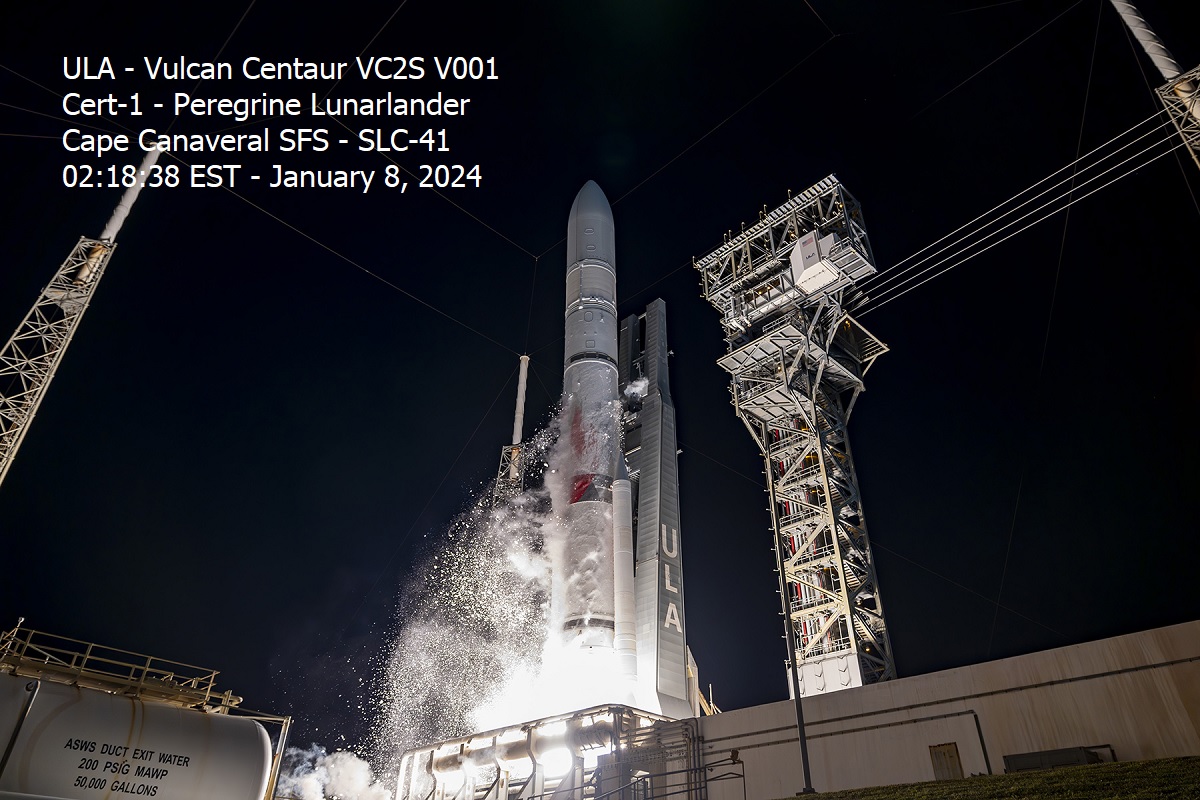
Photo from ULA of the Vulcan launch. I’ll huff. I’ll puff. And I’ll blow your pad away. Just you wait… Mission Rundown: ULA – Vulcan Centaur...