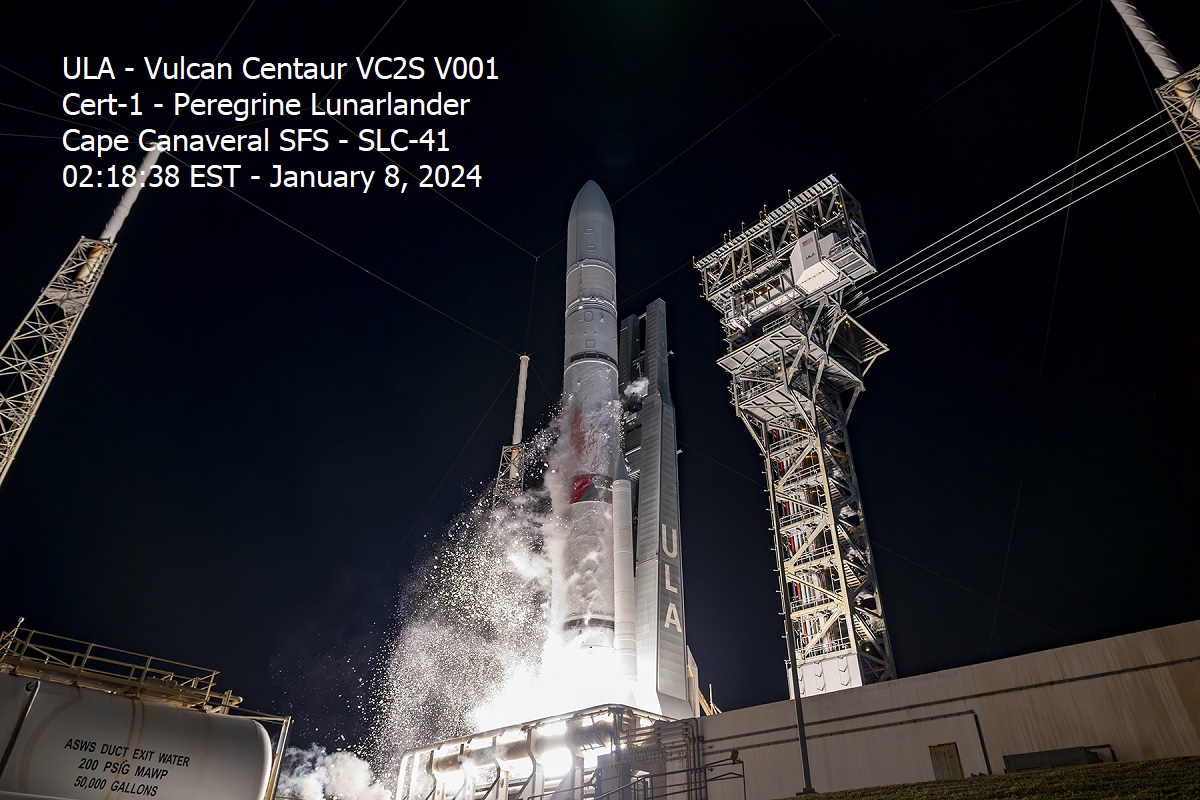
Screenshot from ULA Webcast of the NROL-39 launch. Standing here in the spotlight feeling lonely
Mission Rundown: ULA - Atlas V 501 - NROL-39
Written: February 6, 2023
Lift Off Time | December 5, 2013 – 23:14:30 PST December 6, 2013 – 07:14:30 UTC |
Mission Name | NROL-39 |
Launch Provider | ULA - United Launch Alliance |
Customer | NRO - National Reconnaissance Office |
Rocket | Atlas V 501 |
Launch Location | Space Launch Complex 3E - SLC-3E Vandenberg Air Force Base, California |
Payload | Topaz-3 Radar Reconnaissance Satellite - USA-247 GEMSat - ELaNa II with 12 CubeSats |
Payload mass | 6 420 kg ~ 14 154 pounds - Max. mass capacity |
Where did the satellites go? | Retrograde Polar Orbit - 1 069 km x 1 091 km x 122,99° Retrograde Polar Orbit - 467 km x 883 km x 120,01° |
Type of launch system? | Atlas Evolved Expendable Launch Vehicle No SRB |
The first stage landing zone? | Bottom of the Pacific Ocean 2 500 km downrange |
Type of second stage? | Centaur RL-10A-4-2 engine - 14m 50s burn time |
Is the 2nd stage derelict? | Yes - Main engine 4th start/cutoff wasn’t evident Graveyard orbit is 488 km x 890 km x 120.45° |
Type of fairing? | 5.4 meter two part carbon composite fairing |
This will be the: | – 77th flight of all ULA rockets – 42th flight of an Atlas V rocket - Tail no. AV-042 – 16th ULA mission for NRO – 11th mission for ULA in 2013 |
Where to watch Where to read more in detail | ULA YouTube link provided by Matthew Travis Want to know or learn more go visit or see Tim Dodd |
Launch debriefing (This did happen) Sound is very low and choppy at best - some launch details are not heard clearly All time stamps after wrap up is guesses and marked with an end on 27 seconds | L-00:20:28 Host: L-00:07:00 T-00:04:00 T 00:00:00 T+00:01:24 T+00:01:32 T+00:03:38 T+00:04:29 T+00:04:24 T+00:04:29 T+00:04:39 T+00:14:27 T+00:18:27 T+00:21:27 T+00:42:27 T+02:52:30 T+03:32:30 T+03:49:27 T+03:59:27 | ULA live feed at 04:37 Matt Donovan, Marty Malinowski Final Polling preparing the launch at 13:28 Release -4 minute hold at 16:28 Liftoff at 20:28 - No T+ clock - 07:14:30 UTC Mach 1 at 21:52 - Speed Mach One 1225,5 km/h MaxQ at 22:00 - Maximum aerodynamic pressure Fairing separation at 24:06 - Seen from ground camera Wrap up from ULA at 25:57 - Calculated T+ BECO at 25:39 - Atlas V booster is empty - 264 second Stage separation at 25:42 - Just losing 95% weight MES-1 at 25:52 - Centaur RL-10A-4-2 engine start MECO-1 at 53:14 - Coasting toward Antarctica ice shelf MES-2 to SECO-2 doing a 29 second insertion burn ULA doesn’t show deployment of NROL-39 MES-3 - SECO-3 in a 29 second deorbit burn to LEO Deployment start of CubeSats scheduled at 10:06 UTC Deployment of CubeSats ends at 10:46 UTC DCSS Centaur blowout of remaining gasses and fuel DCSS Centaur 2nd stage becomes derelict space debris |
Will you bring the ‘kids’ with you?
The United Launch Alliance (ULA) have launched their Atlas V rocket on the NROL-39 mission for the National Reconnaissance Office. Liftoff from Vandenberg Air Force Base in California on December 5, 2013 was on schedule at the opening of its launch window at 23:13 Pacific standard time Thursday (07:13 UTC on Friday).

NOTAM of NROL-39 flight path shows it’s flying southeast from Vandenberg heading for a very retrograde orbit. Debris fields are marked for impact from fairing parts and the core booster
The primary payload for Thursday’s launch was a classified payload for the National Reconnaissance Office, NROL-39, whose launch was contracted in 2003 as part of the second block-purchase of Evolved Expendable Launch Vehicle (EELV) launches; Buy 2.
The Atlas V rocket was also carrying the Government Experimental Multi-Satellite payload, or GEMSat; a Naval Postgraduate School CubeSat Launcher (NPSCUL) which will deploy twelve nanosatellites.
Like most of the NRO’s satellites, the NROL-39 spacecraft and its mission are classified; however due to the nature of satellite programs it is hard to keep many details secret.
The NROL-39 payload
Notices to Airmen, or NOTAMS, issued for the L-39 launch showed that the rocket will follow the same trajectory used for the NROL-41 launch – leaving the satellite in an orbit only typically used for the NRO’s radar imaging satellites.
Because of this, it can be inferred that NROL-39 is the third satellite in the NRO’s current-generation radar reconnaissance fleet. It follows the Atlas V 501 launch of the NROL-41 mission, or USA-215, launched in September 2010, and NROL-25 (USA-234) which was launched by a Delta IV in April 2012.
The radar imaging program is believed to be a remnant of the NRO’s Future Imagery Architecture (FIA) program, which was intended to produce new-generation optical and radar-imaging surveillance satellites, replacing the earlier KH-11 and Onyx radar imaging spacecraft.
NROL-39 is the third mission to launch out of the four in the 2002 document, following NROL-25 and NROL-41 which were also Topaz satellites.
The last spacecraft of the group, NROL-45, is also slated to use an Atlas V 501 flying from Vandenberg, and as such is almost certain to be a fourth Topaz satellite.
Topaz launches have so far used a single inclination – 123 degrees – which corresponds to a retrograde analogue of the 57 degree plane. The two operational Topaz satellites’ orbits are separated by 180 degrees in terms of the longitude of their ascending nodes, with NROL-39’s launch window suggesting that its orbital plane will be halfway between them. Their orbits cross the Equator from south on opposite sides of the Earth.
GEMSat, which shared NROL-39’s journey into orbit, marks the second time excess capacity on an NRO launch has been used to carry CubeSats – the first being OUTSat which was carried aboard the NROL-36 mission last year.
Both OUTSat and GEMSat are Naval Postgraduate School CubeSat Launchers (NPSCULs), which consist of eight Poly Picosatellite Orbital Deployers (PPODs) each with capacity equivalent to three single-unit CubeSats.
The NROL-39 payload consists of twelve CubeSats, seven for the US military and five for various educational institutions. The educational satellites were flown as part of NASA’s Educational Launch of Nanosatellites (ELaNa) program and are designated ELaNa II.
ELaNa II is a NASA program to provide launch opportunities for educational CubeSat missions. Consisting of two 3U PPODs, ELaNa II was a revived ‘canceled’ launch number of the program started in 2011. The most recent mission was ELaNa IV, launched as part of the ORS-3 mission aboard a Minotaur I rocket last month.
Therefore the current ELaNa batch isn't ELaNa ‘five’ that’s catching a ride with NROL-39.
The Atlas V 501 launch
The specifics of AV-042 Belle’s launch profile are classified, however the mission began, like all Atlas V flights, with ignition of the ‘russian derived’ RD-180 engine 2.7 seconds in advance of the planned T-0.
At approximately T+1.1 seconds Belle lifted off from the pad, beginning her ascent into orbit. The vehicle rolled to the proper launch azimuth, flying southwest out over the Pacific. Pitch and yaw maneuvers were then used to attain the proper attitude for the journey to low Earth orbit. The rocket's azimuth is equivalent to its compass heading.
The flight computer onboard AV-042 switched to closed-loop control around 50 seconds after launch, shortly afterwards completing its roll sequence.
Approximately 146 seconds into the flight AV-042 Belle passed through Mach 1, followed shortly by the area of maximum dynamic pressure, or max-Q.
In preparation for payload fairing separation, the RD-180 was throttled down at 175 seconds into the flight. Fairing separation occurred a little over 40 seconds later.
The forward load reactor, a device used to keep the fairing rigid which attaches near the front of the Centaur, was jettisoned five or six seconds after the fairing.
Fairing separation must occur before staging since the Centaur is encapsulated. Depletion of the first stage occurred about four minutes and 20 seconds after liftoff, with the spent stage separating six seconds later.
Ten seconds after first stage separation, the Centaur’s RL10A-4-2 engine was scheduled to ignite for its first burn.
The Centaur will either make a long burn followed by a short burn, or one longer burn, prior to the separation of the primary payload.
Based on its launch azimuth and previous Topaz launches, amateur observers expect to find NROL-39’s payload in a 1,067 by 1,080 kilometer (663 by 671 statute miles, 576 by 583 nautical miles) orbit with 123 degrees inclination and an orbital period of approximately 106.7 minutes.
The Firebird satellites are expected to be placed into a 465 by 972 kilometer elliptical orbit (289 by 604 miles, 251 by 525 nautical miles) at the same inclination; the Centaur is likely to make an additional burn after spacecraft separation to attain this, rather than dropping the satellites off in a parking orbit.
All of the CubeSats will be deployed in the same orbit. Since no NOTAMS have been issued from FAA as evidence for the Centaur to be deorbited, it will presumably remain in orbit after CubeSat separation, in a similar orbit to the CubeSats.
The NRO’s use of retrograde orbits for its Topaz radar satellites is believed to improve the performance of the imaging payload, due to the increased velocity of the satellite relative to the surface of the Earth. The doppler shift in the radar return signal becomes stronger.
The Atlas V 501 rocket
The NROL-39 mission made use of United Launch Alliance’s Atlas V rocket. Named Belle, and with the tail number AV-042, the Atlas flew in the 501 configuration with a five-meter RUAG payload fairing, no solid rocket motors and a single-engine Centaur upper stage.
AV-042 stands 196 feet tall. Weighs 76000 pounds empty and 750000 pounds fueled.
AV-042 was the forty-second Atlas V to fly, and the fifth to use the 501 configuration. In addition to NROL-41, previous Atlas V 501 launches have deployed the three flights of the X-37B spacecraft, the most recent of which is still in orbit having launched last December.
The first stage of the Atlas rocket is a Common Core Booster (CCB), which is fuelled with RP-1 propellant oxidized by liquid oxygen. Its RD-180 engine was developed by NPO Energomash of Russia, and is derived from the RD-170 series developed for the Russian or rather Soviet Zenit and Energia program.
The ‘engine’ consists of one cryogenic propellant turbopump, that feeds propellant to two burn chambers with two engine bells - nozzles - below them, capable of producing up to 4.15 meganewtons (930,000 pounds-force) of thrust.
The second stage, a single-engine Centaur (SEC), is mounted atop the first stage and encapsulated within the rocket’s payload fairing along with the payload. AV-042 is using a medium-length five meter fairing, developed by RUAG of Switzerland, with a diameter of 5.4 meters (17.7 feet) and a length of 23.4 meters (77 feet).
The Centaur is powered by one RL10A-4-2 engine burning liquid hydrogen and liquid oxygen. While the Atlas V is designed to use single or dual-engine Centaur stages, only the single-engine variant has been flown.
A dual-engine Centaur is currently under development to support commercial manned spaceflight missions, such as the Dream Chaser and Boeing’s CST-100 capsule.
The Atlas V launch complex at Vandenberg Air Force Base is Space Launch Complex 3E. That was converted from launching Atlas II to accommodate the Atlas V, a process which included increasing the height of the pad’s mobile service tower.
The first Atlas V launch from Vandenberg occurred in March 2008, with the USA-200 (NROL-28) satellite, and AV-042 is the seventh Atlas V vehicle to use the pad.
NasaSpaceFlight: William Graham link Gunter’s Space Page: Details Atlas link | Coauthor/Text Retriever Johnny Nielsen link to ULA launch list - Link to ULA Fan |