onsdag den 2. juli 2014

ULA - Delta II 7320-10C - OCO-2

Screenshot from ULA Webcast of the OCO-2 launch. Standing in the spotlight waiting for the fog

Mission Rundown: ULA - Delta II 7320-10C - OCO-2

Written: January 26, 2023 

Lift Off Time

January 29, 2014 – 02:56:23 EDT | 09:56:23 UTC

Mission Name

OCO-2

Launch Provider

ULA - United Launch Alliance

Customer

NASA

Rocket

Delta II 7320-10C

Launch Location

Space Launch Complex 2W - SLC-2W

Vandenberg Air Force Base, California

Payload

Orbiting Carbon Observatory - LEOStar-2 Science Satellite

Payload mass

454 kg ~ 998.8 pounds

Where did the satellite go?

Sun-Synchronous Polar Orbit - 700 km x 710 km x 98,21°

Type of launch system?

Delta II Evolved Expendable Launch Vehicle + 3 SRB’s

The SRB rocket’s fate?

In the Pacific Ocean 150 km south of SLC-2W

The first stage landing zone?

Bottom of the Pacific Ocean 2 300 km downrange

Type of second stage?

Delta AJ-10-118K engine - 8m 20s burn time ish…

Is the 2nd stage derelict?

Yes - Main engine 5th start/cutoff wasn’t evident

New orbit is 2 380 km x 10 336 km x 98.2° 

Type of fairing?

3.05 meter - 10 feet two part carbon composite fairing

This will be the:

– 84th flight of all ULA rockets

– 27th flight of a Delta IV rocket - D367

– 18th ULA mission for NASA

– 7th mission for ULA in 2014

Where to watch

Where to read more in depth

ULA YouTube link provided by Matthew Travis

Want to know or learn more go visit or see Tim Dodd


Launch debriefing

(This did happen)

Audio at 4:54 - Go for cryogenic tanking

4 clocks on the wall tells us the T0 time, the L count with all holds, the T count to launch, the day of year counting clock read from left to right

For some unknown reason the second stage Delta K isn’t deorbited but is raised to a much higher elliptical orbit

L-01:55:08

Host:

L-00:07:00

T-00:04:00

T 00:00:00

T+00:00:36

T+00:00:50

T+00:01:09

T+00:01:39

T+00:04:24

T+00:04:32

T+00:04:38

T+00:05:01

T+00:10:20

T+00:14:38

T+00:50:50

T+00:56:15

T+01:25:00

T+01:56:40

T+02:09:27

T+02:19:27

T+02:29:27

NASA/ULA live feed at 00:00

George Diller, Tim Dunn, Steve Agid

Final Polling preparing the launch at 1:48:08

Release -4 minute hold at 1:51:08

Liftoff at 1:55:08 - No T+ clock - 09:56:23 UTC

Mach 1 at 1:55:44 - Speed Mach One 1225,5 km/h

MaxQ at 1:55:58 - Maximum aerodynamic pressure

SRB burn out at 1:56:17 - Delayed release of the SRB’s

SRB separation at 1:56:48 - Three GEM-40 spent

BECO at 1:59:32 - Delta II booster is empty - 263 second

Stage separation at 1:59:40 - Just losing 95% weight

MES-1 at 1:59:46 - Delta AJ-10-118K engine start

Fairing separation at 2:00:09 - Computer graphics on

MECO-1 at 2:05:28 - Coasting toward Antarctica

Wrap up from ULA at 2:09:46 - Calculated T+

MES-2 to SECO-2 doing a 62 second orbit insertion burn

ULA doesn’t show deployment of OCO-2

MES-3 - SECO-3 in a 38 second higher transfer burn

MES-4 - SECO-4 doing a 51 second orbit insertion burn

Possible deployment of unknown secondary payload

Delta K blowout of remaining gasses and fuel

Delta K 2nd stage becomes derelict space debris


Atlas V 541

NROL-67

Delta IV M+4,2

GPS IIF-6

Atlas V 401

NROL-33

Delta II 7320-10

OCO-2

Delta IV M+4,2

AFSPC-4

Atlas V 401

GPS IIF-7

Atlas V 401

WorldView-3

Atlas V 401

CLIO

Atlas V 401

GPS IIF-8

Delta IV Heavy

Orion EFT-1


A sigh is just a sigh - Not anymore

NASA’s Orbiting Carbon Observatory completed its ride to orbit on Wednesday morning, launched atop a United Launch Alliance Delta II rocket, following a 24 hour turnaround.

A defective solenoid valve that prevented water flow into the sound suppression system caused the scrub seconds ahead of yesterday's launch attempt.

Liftoff took place from Space Launch Complex 2 West at the Vandenberg Air Force Base in California was right on schedule Wednesday July 2, 2014 at 02:56 PDT - 09:56 UTC.

The OCO-2 Payload

Orbiting Carbon Observatory 2, or OCO-2, is a near-identical replacement for its ill-fated predecessor. Constructed by Orbital Sciences Corporation around the LEOStar-2 bus, the satellite has a mass of 454 kilograms (999 lb). Of this 45 kilograms (99 lb) is propellant.

OCO-2 Satellite (Graphic image credit: NASA JPL)

The small satellite is designed for a two-year mission, however NASA hopes to be able to operate it for longer. End of mission is September 2023 over nine years later.

OCO-2 uses a three axis stabilized LeoStar-2 bus, consisting of a 2.12 m long hexagonal column 0.94 m wide, with a launch mass of 449 kg. The bus contains the ACS (Attitude Control Subsystem) module, consisting of four reaction wheels, star trackers, a MIMU (Miniature Inertial Measurement Unit), 13 sun sensors and a magnetometer.

The LeoStar-2 bus also carries a 96 Gigabit solid state recorder for onboard data storage, both science and housekeeping data is downlinked using an L3 Communications X-band transmitter and a body-mounted X-band patch antenna, at a data rate of 150 Mbit/s.

Two ~900 Watt GaAs solar panels will be used to generate electricity to power the single Eagle Picher 35 Ah NiH (Nickel-Hydrogen) battery in the spacecraft.

Destined for a sun-synchronous orbit, OCO-2 will join the A-Train, or Afternoon Train, a constellation of Earth-observing satellites which fly in formation to complement each other’s observations. The “Train” consists of the Earth Science Satellites Aqua, Aura, CALIPSO, CloudSat and Shizuku (GCOM-W1).

The primary objective of the OCO-2 mission is to study the absorption of sunlight by carbon dioxide atoms in the atmosphere. To this end, the satellite is equipped with a single scientific instrument which will use three spectrometers to study the near-infrared spectra of light reflected from the surface of the Earth.

Absorption lines in the spectral images produced by the instrument can be used to determine areas of carbon dioxide and molecular oxygen in the regions studied.

Each of the three spectrometers is optimized for a particular wavelength of light. One will observe a region around 2.06 micrometers (microns) for a strong absorption band associated with atmospheric carbon dioxide.

The second will study a region of the spectrum around 1.61 micrometers in order to search for a weaker absorption band associated with carbon dioxide surface sources.

The third spectrometer is keyed to a wavelength of 0.765 micrometers, looking for absorption due to oxygen molecules which will be used to calibrate the results for the carbon dioxide data.

The OCO-2 satellite was originally manifested to fly atop a Taurus rocket, in the same configuration that its predecessor had used. Orbital Sciences attempted to resolve the issue which had led to the loss of OCO-1, and in March 2011 the rocket carried NASA’s Glory satellite on its return-to-flight mission.

After suffering the same fairing anomaly as befell OCO-1, NASA lost confidence in the Taurus requiring that it be recertified before entrusting further payloads to it.

NASA meanwhile re-awarded the OCO-2 contract to United Launch Alliance, using the proven Delta II rocket. Statistically the most reliable rocket currently in service, the Delta II last suffered a launch failure in early 1997 and has achieved 96 consecutive successful missions since.

The Delta II 7320-10C launch

The launch took place from Space Launch Complex 2 West (SLC-2W) at the Vandenberg Air Force Base in California. Built in the late 1950s, SLC-2W was originally part of the much larger Launch Complex 75.

The rocket that launched OCO-2 was Delta 367. Its first stage, the Extra-Extended Long Tank Thor, was powered by a single RS-27A engine with two vector adjustable Vernier motors to provide roll control. It uses RP-1 propellant with liquid oxygen as an oxidiser.

Ignition of the RS-27 occurred three seconds before the planned launch. At T-0, the three solid rocket motors ignited and Delta 367 began its ascent towards space. The rocket reached the speed of sound, Mach 1, in 35.7 seconds, passing through the area of maximum dynamic pressure – Max-Q – fourteen seconds later at 50 seconds.

A minute and four seconds into its flight, the Delta’s solid rocket motors burned out, having consumed their supply of propellant. Separation of the spent boosters did not occur for another thirty five seconds as the rocket first needed to clear an offshore oil field in order to ensure the jettisoned SRMs didn't fall on the oil rigs located there.

The first stage ended its burn with Main Engine Cutoff, or MECO, four minutes and 24.2 seconds after launch. Vernier Engine Cutoff, or VECO, followed shortly afterwards, with the spent stage separating eight seconds after burnout. Ignition of the second stage engine took place five and a half seconds after staging.

The second stage of Delta 367 is a Delta-K, which is powered by an AJ10-118K engine, burning Aerozine-50 propellant oxidized by dinitrogen tetroxide. The stage can be restarted, allowing multiple burns to ensure accurate orbital insertion.

On this mission two burns were conducted prior to spacecraft separation. The first lasted five minutes and 42.8 seconds, before a fifty-minute and 28.5 second coast phase began. Separation of the payload fairing occurred 23.3 seconds into the first burn.

The second burn lasted just twelve seconds, circularizing the vehicle’s trajectory for spacecraft separation.

The planned sun-synchronous deployment orbit is near-circular, with an altitude of 686 by 698 kilometers (426 x 434 miles or 370 x 377 nautical miles).

It will be inclined at 98.2 degrees, with a semimajor axis of 7,071 kilometers (4,394 miles, 3818 nautical miles), eccentricity of 0.0013 and an argument of perigee of 69.1 degrees. Spacecraft separation took place over the Indian Ocean off the East coast of Africa and close to the equator, at fifty-six minutes and fifteen seconds mission elapsed time; five minutes and 12.6 seconds after the end of powered flight.

Following spacecraft separation, the upper stage will perform two further burns to remove itself from the spacecraft’s operational orbit. The first of these will begin twenty eight and three-quarter minutes after separation and last 38.5 seconds.

The second, thirty-one minutes and 1.5 seconds later will be for about 50.9 seconds. As a result of these burns, the second stage is expected to end up in a 2,380 by 10,336 kilometer (1,478 by 6,423 statute miles or 1,285 by 5,581 nautical miles) orbit.

The reason why the second stage Delta K didn’t deorbit itself remains unclear, there must have been a second clandestine payload, an unknown mission objective or test program included in this NASA rocket launch.

The Delta II 7320-10C rocket

The launch will overall be the 152nd launch of the Delta II and the 129th flight for the 7000-series configuration, but not including the six Delta II Heavy missions.

The Delta II Heavy, or 7920H/7925H which appends an H to the designation to indicate the use of the more powerful GEM-46 solid rocket motors. Fittings and release mechanism at the base and sides of the Core are welded in to attach the GEM-46 strap-on motors.

The 7000 rocket to be used for today's launch was originally built as a Delta II Heavy core, but was converted back to a standard Delta II configuration to meet payload and launch site requirements. Some refitting, welding and assembly required.

Delta II split in its major parts. This is a 7420-10C configuration used in the ICESat-2 mission

For Delta II rockets the four digit number after the rocket’s name denotes the configuration it will fly in; for the launch it is a Delta II 7320. The first digit gives the type of first stage and booster rockets being employed, in this case an Extra-Extended Long Tank Thor augmented by three GEM-40 strap-on motors.

The second digit of the designation gives the number of solid rocket motors. For the Delta II this is either three, four or nine GEM-40 strap-on motors.

The third digit denotes the type of second stage being flown – for the Delta II this is always a Delta-K, denoted by the digit 2.

Finally, the fourth number is the type of third stage being flown; 0 for no third stage, 5 for a Star-48B or 6 for a Star-37FM. The OCO-2 launch will fly with three solid rocket motors and no third stage.

The payload fairing which encapsulates the OCO-2 satellite was a three-meter (10-foot) composite structure. The largest fairing used by the Delta II, its presence is denoted by adding “-10C” to the rocket’s configuration number.

The full classification of today's launch of Delta 367 is Delta II 7320-10C.

Delta II 7320-10C stands 58.90 meters - 127.6 feet tall. - Diameter 2.44 meter - 8 feet

Delta II 7320-10C weighs 151 700 kilo - 334400 pounds fully fueled and loaded

Delta II 7320-10C first stage weighs less than 20 000 kilo - 44 000 pounds when empty

Thor first stage RS-27 engine provides 3 020 kilonewton - 678 920 lbf of thrust

ATK GEM-40 height 12.96 meter - 42.51 feet - Diameter 1.02 meter - 3.34 feet

ATK GEM-40 weighs 13 064 kilo - 28 801 pounds at launch

ATK GEM-40 weighs 1 361 kilo - 3 000 pounds at jettison - 63 second burn time

ATK GEM-40 provides 499.2 kilonewton 112 225 lbf of thrust if ignited at altitude

ATK GEM-40 provides 446.0 kilonewton 100 264 lbf of thrust at sea level

NasaSpaceFlight: William Graham link

Gunter’s Space Page: Details Delta link

Coauthor/Text Retriever Johnny Nielsen

link to ULA launch list - Link to ULA Fan


torsdag den 22. maj 2014

ULA - Atlas V 401 - NROL-33

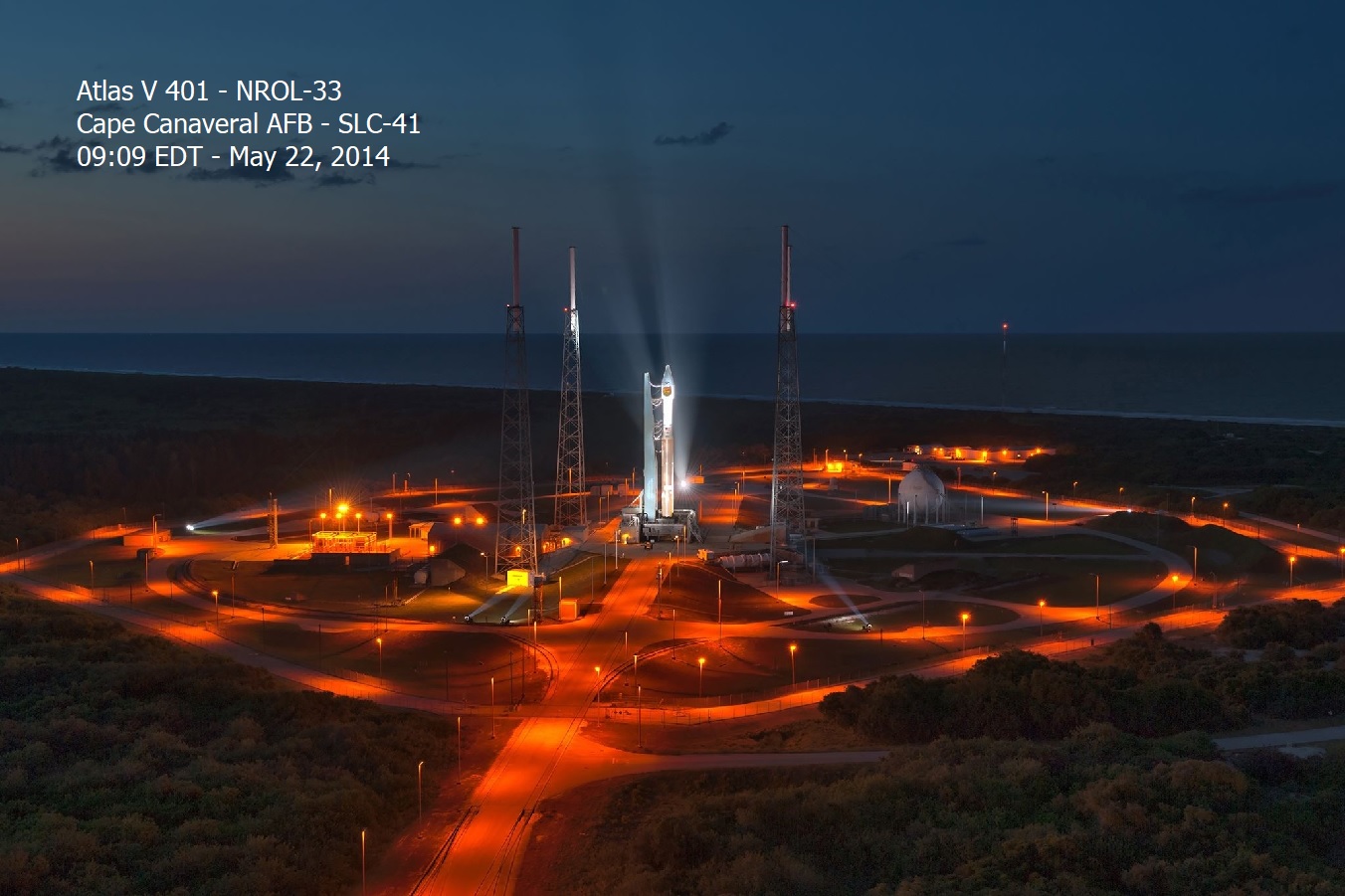
Photo from ULA of the NROL-33 launch. It was the night before dawn. One stood there yawning

Mission Rundown: ULA - Atlas V 401 - NROL-33

Written: January 27, 2023

Lift Off Time

May 22, 2014 – 09:09:00 EDT | 13:09:00 UTC

Mission Name

NROL-33

Launch Provider

ULA - United Launch Alliance

Customer

NRO

Rocket

Atlas V 401

Launch Location

Space Launch Complex 41 - SLC-41

Cape Canaveral Air Force Station, Florida

Payload

Quasar - Military Data Relay Satellite - USA-252

Payload mass

4 950 kg ~ 10 890 pounds - Maximum mass to GTO

Where did the satellite go?

Geostationary Transfer Orbit 

Deployment - 4 516 km x 35 536 km x 20,69°

Type of launch system?

Atlas Evolved Expendable Launch Vehicle - No SRB’s

The first stage landing zone?

Bottom of the Atlantic Ocean 2 500 km downrange

Type of second stage?

Centaur RL-10A-4-2 engine - 14m 50s burn time

Is the 2nd stage derelict?

No - Main engine 3rd start/cutoff was 58 seconds

Last orbit was -180 km x 34 520 km x 20.17° 

Type of fairing?

4.2 meter two part metallic fairing

This will be the:

– 83rd flight of all ULA rockets

– 46th flight of an Atlas V rocket - Tail no. AV-046

– 18th ULA mission for NRO

– 6th mission for ULA in 2014

Where to watch

Where to read more in depth

ULA YouTube link provided by dxrts

Want to know or learn more go visit or see Tim Dodd


Launch debriefing

(This did happen)

L-00:24:38

Host:

L-00:07:00

T-00:04:00

T 00:00:00

T+00:01:20

T+00:01:32

T+00:04:04

T+00:04:08

T+00:04:20

T+00:04:28

T+00:04:46

T+00:15:27

T+00:25:27

T+05:42:27

T+05:49:27

T+10:19:27

T+10:29:27

ULA live feed at 0:26 before a planned 10 minute hold

Dillon Rice, Marty Malinowski

Final Polling preparing the launch at 17:26

Release -4 minute hold at 20:26

Liftoff at 24:26 - No T+ clock - 13:09:00 UTC

Mach 1 at 25:46 - Speed Mach One 1225,5 km/h

MaxQ at 25:58 - Maximum aerodynamic pressure

BECO at 28:30 - Atlas V booster is empty - 263 second

Stage separation at 28:34 - Just losing 95% weight

MES-1 at 28:46 - Centaur RL-10A-4-2 engine start

Fairing separation at 28:54 - Computer graphics on

Wrap up from ULA at 29:12 - Calculated T+

MECO-1 at 53:14 - Coasting toward Africa

MES-2 to SECO-2 doing a 269 second GTO burn

ULA doesn’t show deployment of NROL-33

MES-3 - SECO-3 doing a 58 second deorbit burn

Centaur blowout of remaining gasses and fuel

Centaur doing a 44g dive into South Pacific Ocean


Atlas V 541

NROL-67

Delta IV M+4,2

GPS IIF-6

Atlas V 401

NROL-33

Delta II 7320-10

OCO-2

Delta IV M+4,2

AFSPC-4

Atlas V 401

GPS IIF-7

Atlas V 401

WorldView-3

Atlas V 401

CLIO

Atlas V 401

GPS IIF-8

Delta IV Heavy

Orion EFT-1

When might isn’t right, should we fight?

A National Reconnaissance Office (NRO) military payload rode into orbit atop the United Launch Alliance (ULA) Atlas V rocket on Thursday.

Liftoff of the NROL-33 mission from Cape Canaveral occurred on May 22, 2014 at 09:09 EDT local time - 13:09 UTC from Space Launch Complex -41 - SLC-41.

Thursday’s mission made use of the 401 configuration. Designated AV-046, the Atlas consists of two stages; a Common Core Booster powered by an RD-180 engine, with an RL10A-4-2-powered Centaur atop it.

The first stage’s RD-180 engine has recently been at the center of a political dispute. Produced by Russia, the engine was developed from the RD-170 series on the Zenit rocket.

This has attracted criticism due to the United States placing economic sanctions on Russia over its recent intervention in Ukraine. Although a license to produce RD-180s in the United States does exist, at present all engines are imported from Russia.

The NROL-33 payload

Like most missions for the National Reconnaissance Office, many details of Thursday’s launch – for instance the type of satellite being deployed and the rocket’s flight plan – were classified.

Launch hazard warnings and notices to airmen show that the rocket was to head East after liftoff, flying over the Atlantic. This suggests the Atlas will be targeting a geosynchronous transfer orbit, as this is the only low-inclination orbit regime typically used for NRO payloads of this size.

NOTAM warning of hazardous rocket operations at the red zones. 1st stage crash site is shown

The most likely identity of the NROL-33 payload is a Quasar communications satellite. Used to relay data from other NRO satellites to ground stations, Quasar is also known as the Satellite Data System (SDS).

Speculation that the NROL-33 payload is part of the Satellite Data System is reinforced by the patches created to commemorate the launch. The payload patch features a pack of three wolves – before it was edited down for release – and a winged warrior emitting five beams of light from her outstretched hand, against the backdrop of a setting sun.

The wolves most likely denote the three newest satellites in the Quasar fleet, all of which operate in geosynchronous orbit. Five earlier satellites – two geosynchronous and three in elliptical Molniya orbits – have been identified as part of the same generation of satellites – these are presumably denoted by the beams.

A setting sun is usually employed to symbolize the final launch of a particular satellite, so presumably L-33 will be the last third-generation SDS.

The launch patch, meanwhile, features a flying squirrel along with the motto “Defendi nostrae opes”, literally “to defend our resources”. The meaning of this is not entirely clear, however it could be related to the fact that NROL-33 is intended to support the NRO’s reconnaissance fleet, and provide it with resources to return images for analysis.

Europe is prominently featured on the insignia, which suggests the spacecraft is intended for use over that part of the world.

The patch also features eight stars, arranged in two banks of four on either side. While its meaning remains unclear, this symbol has appeared on several past Quasar patches.

The NROL-27 and NROL-38 missions of 2011 and 2012 replaced the two earlier geosynchronous satellites.

Since both geosynchronous satellites have been replaced in the last few years, it is unlikely that L-33 will replace an existing satellite.

It remains unclear whether it will serve as an on-orbit spare, or be used to open a new orbital slot for the constellation. It also remains to be seen whether the geosynchronous element of the constellation has now completely replaced the Molniya component, or whether these planes will be replenished in due course.

The Atlas V 401 launch

Thursday’s launch used the four meter Long Payload Fairing (LPF), which at a length of 12.2 meters (40 feet) is the smallest of those available for the Atlas V. The LPF’s somewhat confusing name comes from its earlier use on the Atlas I, where it provided a longer alternative to the smaller and now long-discontinued Medium Payload Fairing.

While the precise flight plan for AV-046 is classified, it is likely to resemble past Atlas missions to geosynchronous transfer orbits.

All Atlas V missions begin with RD-180 ignition at T-2.7 seconds, with the engine building up thrust before lifting off at T+1.1 seconds.

Shortly after liftoff, AV-046 performed a roll maneuver to align itself along the required azimuth to achieve the necessary low-inclination orbit. Around eighty seconds into the mission, Atlas passed through the speed of sound, Mach 1, followed by the area of maximum dynamic pressure or Max-Q.

First stage flight concluded around four minutes and three seconds after liftoff, with the RD-180 being throttled back during the last few seconds of powered flight in order to keep the rocket’s acceleration at levels slightly negative which would ‘stretch’ the rocket stack easing the separation and reduce damage done to the Centaur stage and its payload.

Six seconds after cutoff, the spent Common Core Booster separated and the Centaur with a small forward momentum pulled away and began its pre-start sequence. RL10 ignition came ten seconds after the spent stage was jettisoned.

Around ten to twenty seconds into the second stage burn, the payload fairing separated from around AV-046’s payload. This marks a media black out and transmission ends.

The Centaur will likely make two burns, with their lengths dependent upon whether the standard or high-perigee transfer orbit is required. For a standard geosynchronous transfer orbit, the first burn will last around eleven minutes, with a ten minute coast phase before a four-minute second transfer burn is initiated near the Equator.

Missions to a higher-perigee orbit would see the first burn extended by two minutes, with the second being cut to about 80 seconds after a much longer coast of around an hour and a half. Based on past Quasar launches, the standard profile is more likely.

Following spacecraft separation, NROL-33 will be given a USA designation – most likely USA-252 – and will maneuver to geosynchronous orbit under its own power.

The Centaur will make a further 58 second deorbit burn some time after separation. The length of this burn depends on available propellants left in the Centaur tanks.

Reentry is expected to occur after 9-10 hours of mission elapsed time - MET between 22:06 to 23:10 UTC over the Pacific, near Kwajalein in the Marshall Islands.

The Atlas V 401 rocket

The Atlas V is an expendable medium lift launch system and member of the Atlas rocket family. The rocket is one of the most reliable in the world, having more than 45 launches with no complete failures.

The Atlas V 401 rocket, tail no. AV-046 is standing 57.31 meters - 188 feet tall on SLC-41.

The Atlas V, tail number AV-046, consists of a Common Core Booster (CCB), which is powered by an RD-180 engine with two bells and burns kerosene (RP-1) and liquid oxygen (LOX). This is accompanied by up to five strap-on solid rocket boosters. The second stage is the Centaur upper stage, which is powered by one RL10C-1 engine and is burning liquid hydrogen (LH2) with liquid oxygen (LOX).

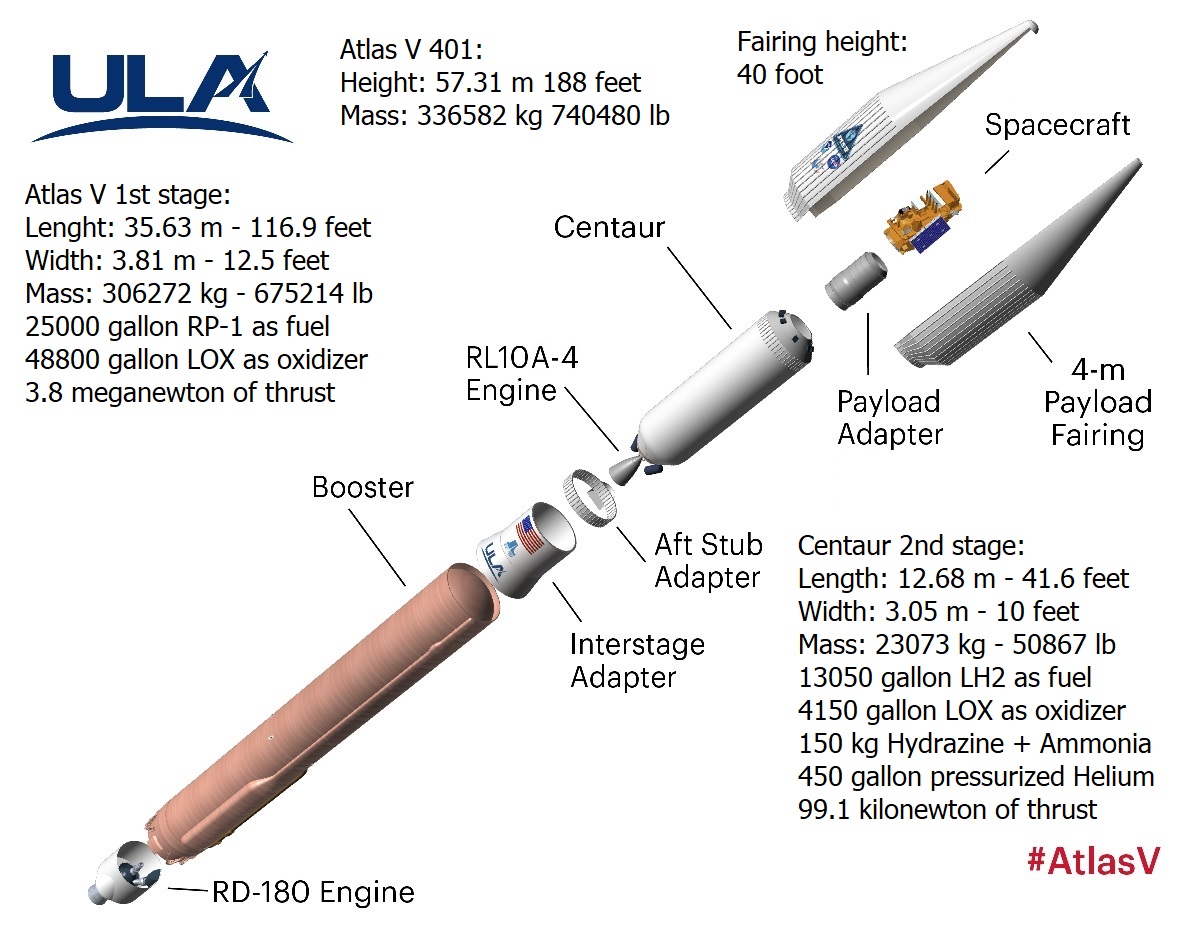
Atlas V 401 split in its major parts. This is a generic non mission specific graphic configuration

Facts on the Atlas V 401 launch vehicle

Height of Atlas V 401: 188 feet (57.31 meters)

Mass at liftoff: 336,582 kilograms - 740,480 pounds

Thrust at liftoff: 3.8 mega-Newtons - 0.86 million lbf

Fuel onboard: 91,000 gallons of liquid propellant

LOX+LH2 = 66,000 gallon of cryogenic liquid propellant in three tanks

Core stage Atlas: 25,000 gallon RP-1 or 94,64 m3 - 48,800 gallon LOX or 184,73 m3 

Core stage weighs fully fueled 306,271.7 kilograms - 675,213.5 pounds

Core stage measures 35.63 meters - 116,9 feet tall and 3.81 meters - 12,5 feet wide

Core stage RD-180 main engine produces 3,826.9 kilonewtons - 860,321.35 pounds of thrust at sea level while the thrust level increases to 933,406.73 pounds in space

Upper Stage Centaur: 13,050 gallon LH2 or 48,07 m3 - 4,150 gallon LOX or 15,71 m3 

Upper Stage Centaur weighs fully fueled 23,073 kilograms - 50,867.3 pounds

Upper Stage Centaur measures 12.68 meters - 41,6 feet tall - 3.05 meters - 10 feet wide

RL-10A-4-2 engine is optimized for vacuum usage with a big nozzle - engine bell, so it only produces 99.1 kilonewtons - 22,300 pounds in space

Centaur has 150 kg (340 lb) of Hydrazine + Ammonia is stored in two diaphragm tanks

Centaur has 2-3 Helium 100-150 gallon pressure vessel storage tanks

Atlas V 401 XEPF 4.2 meter fairings weigh 2,487.0 kilograms - 5,482.9 pounds

Atlas V 401 LPF Payload Fairing measures 12.2 meter - 40 feet in length

NROL-33 payload weighs 4 950 kg ~ 10 890 pounds - Maximum for a GTO mission

HAZ GAS operations are completed when the hydrazine is loaded. The RCS thrusters on the Centaur stage are using hydrazine as a monopropellant during orbit insertion.

The reaction control system (RCS) includes the ullage gas pressure thrust from the tanks and consists of twenty hydrazine monopropellant engines located around the stage in two 27 newton twin-thruster pods and four 40 newton quad-thruster pods.

For propellant, 150 kg (340 lb) of Hydrazine and Ammonia is stored in a pair of diaphragm tanks and fed to the RCS engines aided by pressurized helium gas, which is also used to accomplish some of the Centaur RL-10A-4-2 engine start up functions.

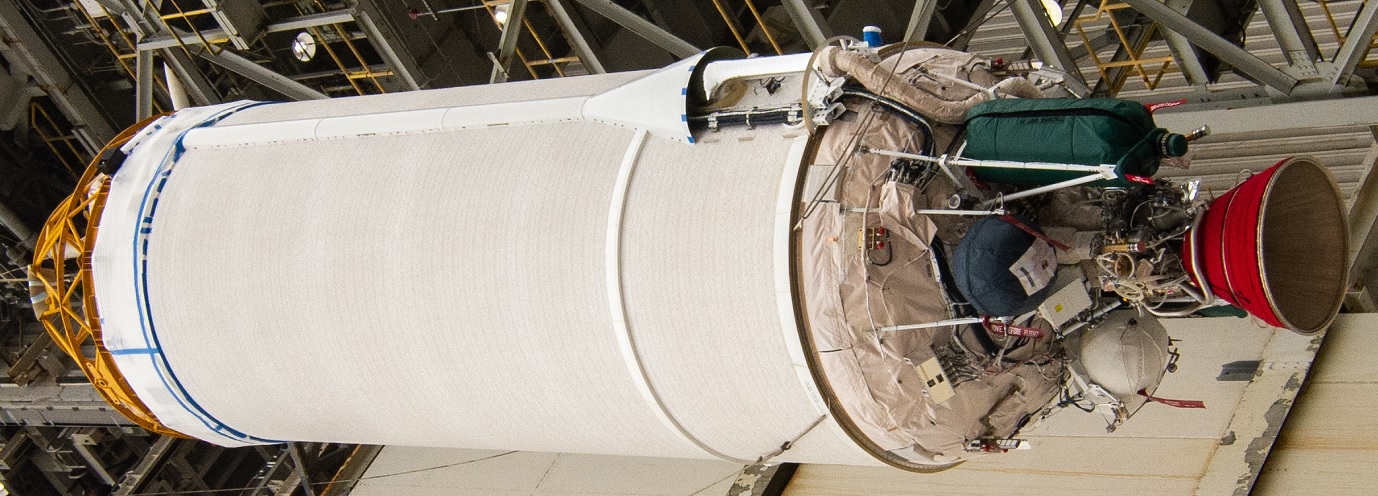
The Centaur 2nd stage with a RL-10A-4-2 engine is hanging here in the Vertical Integration Facility

This photo of the Centaur with the RL-10A-4-2 vacuum engine depicts two insulated green pressure vessels - one behind the engine - a white insulated Ammonia sphere and a blue insulated Hydrazine sphere with propellant used to feed the thrusters in the Attitude slash Reaction Control System RCS.

The propellant is visibly divided in a large Hydrogen tank forward and a smaller Oxygen tank below it supporting the engine mount. The RL-10A-4-2 vacuum engine's red nozzle will get a longer nozzle cone extension mounted.

In the 401 configuration, the Atlas V is capable of carrying a structural maximum of 9,050 kg to Low Earth Orbit - LEO, 8,200 kg to the International Space Station - ISS and 4,950 kg to Geostationary Transfer Orbit - GTO.

The Common Core Booster contains a total of 284,089 kilograms - 626,309 pounds of RP-1 kerosene and liquid oxygen, weighs 306,271.7 kilograms - 675,213.5 pounds fully fueled, and is 35.63 meters - 116,9 feet tall and 3.81 meters - 12,5 feet wide.

The Centaur III upper stage contains 20,830 kilograms - 45,922.3 pounds of liquid hydrogen and liquid oxygen, weighs 23,073 kilograms - 50,867.3 pounds fully fueled, and is 12.68 meters - 41,6 feet tall & 3.05 meters - 10 feet wide.

The NROL-33 spacecraft weigh 4,950.0 kilograms - 10,890 pounds on its own, that’s with the fairings weight excluded.

The Atlas V 401 XEPF fairings weigh 2,487.0 kilograms - 5,482.9 pounds. The weight of a 6 foot fairing extension is estimated to be a small part of the LPF fairing. 200 kg at most.

Doing the math: 306272 kg + 23073 kg + 4950 kg NROL-33 + 2287 kg = 336582 kg.

The Atlas V 401 rocket has a three number configuration code.

The first number represents the fairing diameter size in 4 or 5 meters, so in this instance there is a 4 meter fairing. This launch will use the 12.2 meter long (40 ft) LPF.

The standard four-meter fairing, named the Long Payload Fairing (LPF), measures 12.2 meter (40 feet) in length and was first introduced as a larger fairing for the Atlas I rocket that was used as a launch vehicle in 1990.

One or two 90-centimeter (3-foot) cylindrical segments can be added to the fairing to form an Extended Payload Fairing (EPF) 13.1 meters (43 feet) or Extra-Extended Payload Fairing (XEPF) 14.0 meters (46 feet) respectively for payloads that require the additional space.

The second number denotes the number of solid rocket boosters (SRBs), which attach to the base of the rocket. The number of SRBs for a 5 meter fairing can range from 0 – 5.

The third number shows the number of engines on the Centaur Upper Stage, which is 1 in this configuration. So this means that this rocket will have a 4 meter fairing, no solid rocket boosters, and 1 engine bell on the Centaur Upper Stage.

NasaSpaceFlight: William Graham link

Gunter’s Space Page: Details link Atlas link

Coauthor/Text Retriever Johnny Nielsen

link to ULA launch list - Link to ULA Fan


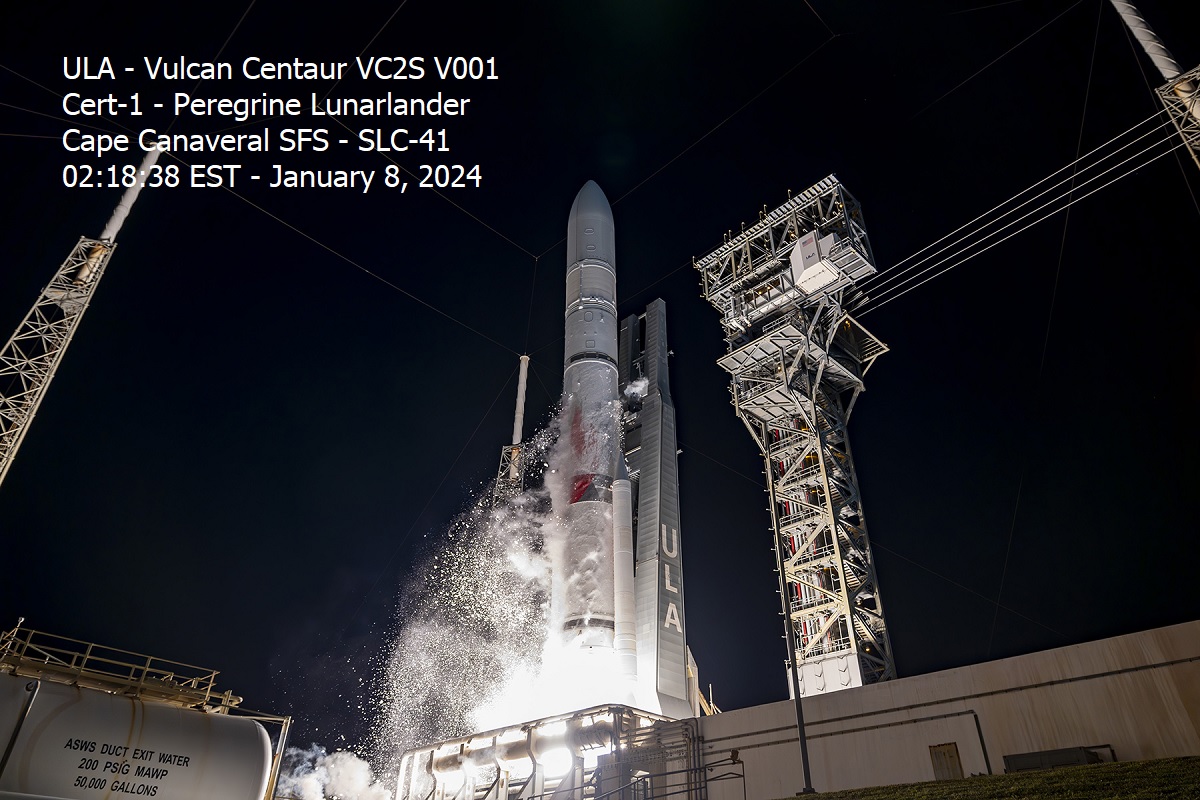
ULA – Vulcan – Peregrine Lunar Lander

Photo from ULA of the Vulcan launch. I’ll huff. I’ll puff. And I’ll blow your pad away. Just you wait… Mission Rundown: ULA – Vulcan Centaur...