torsdag den 18. august 2016

ULA - Delta IV M+4,2 - AFSPC-6

Screenshot from ULA Webcast of the launch of AFSPC-6. Looking like a real rocket for a change

Mission Rundown: ULA - Delta IV M+4,2 - AFSPC-6

Written: December 30, 2022

Lift Off Time

August 19, 2016 - 00:52:00 EDT - 04:52:00 UTC

Mission Name

AFSPC-6

Launch Provider

ULA - United Launch Alliance

Customer

US Air Force

Rocket

Delta IV M+4,2

Launch Location

Launch Complex 37B - LC-37B

Cape Canaveral Air Force Station, Florida

Payload

2 GSSAP Aquilla Surveillance Satellites - Geostar 1 Bus

Payload mass

1 360 kg ~ 3 000 pounds - 3 850 kg payload total

Where did the satellites go?

Geostationary Orbit - 35 516 km x 35 536 km x 0,01°

Type of launch system?

Delta Evolved Expendable Launch Vehicle + 2 SRB’s

The GEM-60 SRB’s fate?

In the Atlantic Ocean due east of SLC-37B

The first stage landing zone?

Bottom of the Atlantic Ocean 2 500 km downrange

Type of second stage?

4 m DCSS RL-10B-2 engine - 19m 24s burn time

Is the 2nd stage derelict?

Yes - Main engine 3rd - 5th start/cutoff was evident

New orbit is sub geostationary 34 520 km x 0.17° ?

Type of fairing?

4.2 meter two part carbon composite fairing

This will be the:

– 110th flight of all ULA rockets

– 14th flight as a Delta IV M+4,2 rocket

– 33rd flight of a Delta IV rocket - D-375

– 44th mission for US Air Force

– 7th mission for ULA in 2016

Where to watch

Where to read more in detail

ULA YouTube link

Want to know or learn more go visit or see Tim Dodd


Launch debriefing

(This did happen)

Fairing max.temp. was reached at 28:26 - so its a hot ascent at speeds exceeding mach 8 even at 96.5 km altitude

Computer graphic is 4 seconds late compared to the video timeline

DCSS flight path after end of transmission from ULA is unknown but times noted is a calculated guess

T-00:14:45

Host:

T-00:04:00

L-00:07:00

T-00:04:00

T 00:00:00

T+00:00:44

T+00:00:57

T+00:01:34

T+00:01:40

T+00:03:58

T+00:04:05

T+00:04:19

T+00:04:30

T+00:04:50

T+00:10:47

T+01:10:27

T+06:10:27

T+06:15:27

T+06:20:41

T+07:19:27

ULA live feed at 00:54

Andrea Lehnhoff, Steve Agid

Planned 10 minute hold at 11:40

Final Polling preparing the launch at 18:40

Release -4 minute hold at 21:40

Liftoff at 25:40 - No T+ clock - 04:52:00 UTC

Mach 1 at 26:24 - Speed Mach One 1225,5 km/h

MaxQ at 26:37 - Maximum aerodynamic pressure

SRB burn out at 27:14 - Delayed release of them

SRB separation at 27:20 - Two GEM-60 spent

BECO at 29:38 - Atlas V booster is empty - 238 second

Stage separation at 29:45 - Just losing 95% weight

MES-1 at 29:59 - DCSS RL-10B-2 engine start

Fairing separation at 30:10 - Computer graphics on

Wrap up from ULA at 30:40 - Calculated T+

MECO-1 at xx:xx - Coasting toward Africa

MES-2 to SECO-2 doing a 329 second GTO burn

MES-3 - SECO-3 doing a 106 second GEO insertion burn 

ULA doesn’t show deployment of AFSPC-6

DCSS blowout of gasses - fuel seen at 11:12:41 UTC

DCSS becomes geostationary derelict space debris


Atlas V 401

OA-6 Cygnus

Delta IV Heavy

NROL-37

Atlas V 551

MUOS-5

Atlas V 421

NROL-61

Delta IV M+4,2

AFSPC-6

Atlas V 411

Osiris-REx

Atlas V 401

WorldView-4

Atlas V 541

GOES-R

Delta IV M+5,4

WGS-8

Atlas V 431

Echostar-19

Second to last Delta IV M+4,2

United Launch Alliance (ULA) successfully launched a Delta IV rocket in the early hours of Friday morning, carrying out the AFSPC-6 mission for the US Air Force. The launch, which took place from Cape Canaveral, occurred slightly after the opening of a 65-minute window, with T-0 at 00:52 local time (04:52 UTC).

Delta IV launches at Cape Canaveral took place at Space Launch Complex 37, consisting of a single active launch pad – SLC-37B – and surrounding processing facilities.

Friday’s mission, Air Force Space Command 6, or AFSPC-6, saw a second pair of satellites for the Geosynchronous Space Situational Awareness Program (GSSAP) being deployed directly into near-geosynchronous orbits.

GSSAP is a four-satellite constellation deployed by the Air Force to monitor satellites in the geosynchronous belt. Therefore USA-270 and USA-271 joins the constellation.

The AFSPC-6 Payload

The GSSAP spacecraft were constructed by Orbital ATK and are based around the GeoStar-1 satellite bus – also known as Aquila.

The GeoStar-1 platform was previously used for the MiTEx-A satellite, USA-187, which formed Orbital’s contribution to DARPA’s Microsatellite Technology Experiment (MiTEx) along with the Lockheed Martin-built MiTEx-B, or USA-188.

The two MiTEx satellites were launched together atop a Delta II rocket in 2006, conducting an experimental geosynchronous satellite inspection mission; a precursor to GSSAP.

The GSSAP spacecraft operate in near-geosynchronous orbits, allowing observations of other spacecraft from above and below.

There is speculation that a GSSAP spacecraft is equipped with Lidar and Radar to enable the US Air Force Space Command to scan foreign or enemy satellites for - shall we say - ‘nasty surprises’ that can be used to disable allied satellites.

The ESPA ring observed on the Delta Cryogenic Second Stage - DCSS indicates a secret delivery system from where seven CubeSats will be deployed. When and where these seven ‘Dwarfs’ will be deployed is unknown since the ULA broadcast ends with fairing jettison per usual.

NRO is the most likely source of funding for these seven test CubeSats.

Computer graphic of the 4 meter DCSS inserting 2 GSSAP Aquilla Surveillance Satellites into orbit

The Delta IV M+4,2 Launch

The Delta IV RS-68A engine ignites five seconds before liftoff, with the solid rocket motors lighting up once the countdown reaches zero; a point the rocket is committed to launch.

Delta 375 began to climb away from its launch pad, initiating a series of pitch and yaw maneuvers eight seconds into its flight to attain the proper trajectory for its ascent to orbit.

Flying on an easterly azimuth over the Atlantic Ocean, the rocket reached Mach 1, the speed of sound, 43.8 seconds after liftoff, passing through the area of maximum dynamic pressure, or Max-Q, 12.8 seconds later.

The GEM-60 motors burned for 93.8 seconds, providing additional thrust as the Delta climbed through the thick lower layers of Earth’s atmosphere.

Once their propellant was depleted, the boosters remained attached for 6.3 seconds to ensure optimal conditions before their jettison 100.1 seconds into the mission.

The Common Booster Core provided thrust for the first three minutes and 57.7 seconds of the launch, after which time it shut down, a point in the flight designated Booster Engine Cutoff, or BECO.

The spent stage was jettisoned 7.4 seconds after cutoff, falling back to Earth to burn up in the atmosphere or fall into the ocean.

After separation, the second stage’s RL10 engine deployed its extendable nozzle and began a pre-start sequence, igniting fourteen and a half seconds after stage separation. Ten and a half seconds later the payload fairing separated from the nose of the rocket.

Timings for mission events after fairing separation have not been announced, and all official coverage of the mission – other than an announcement of successful spacecraft separation – ended at this point.

In order to achieve a geosynchronous orbit, the Delta Cryogenic Second Stage (DCSS) will be called upon to make three burns over a period of at least six hours. Its first burn will last around eight minutes, to establish the vehicle in an initial low Earth parking orbit.

Once the burn concludes the mission will enter a coast phase. Assuming the second burn occurs on the orbit’s first ascending node – the first time the rocket crosses the equator from the southern hemisphere into the northern hemisphere, this coast will last around an hour.

The DCSS’ second burn will be shorter in duration than the first; raising the orbit’s apogee close to geostationary altitude.

After its completion the mission will enter a second coast phase, this time lasting about five hours.

At its conclusion, the stage will restart for a third and final burn – shorter still – to raise the perigee, circularizing the orbit.

About six and a half hours after launch the GSSAP spacecraft will separate from their carrier rocket. ULA confirmed this milestone on Friday.

About six minutes after spacecraft separation the DCSS will perform a collision avoidance maneuver; shortly afterwards it will vent its remaining propellant to mitigate the risks of exploding in orbit. During the AFSPC-4 launch, the plume from the second stage venting was visible to the naked eye over the continental United States.

The Delta IV M+4,2 rocket

United Launch Alliance used a Delta IV rocket to conduct the AFSPC-6 mission, with the rocket flying in the Medium+(4,2) configuration.

This consists of a Common Booster Core first stage with an RS-68A engine, augmented by two GEM-60 solid rocket motors, and a four-meter Delta Cryogenic Second Stage powered by an RL10B-2. The rocket uses cryogenic propellant – liquid hydrogen oxidized by liquid oxygen – in both liquid-fuelled stages.

The Medium+(4,2), or M+(4,2) is the second-smallest of the five Delta IV configurations to have flown; however the smallest, the Delta IV Medium, has not been used since 2006 and is not expected to fly again. The M+(4,2) is the most-flown version of the Delta IV; Friday’s mission will be its fourteenth launch and the thirty-third Delta IV overall.

Last Delta IV M+4,2 to fly split in its major parts. Tank sizes were converted from gallons

The AFSPC-6 launch was the first to use an upgraded version of the Delta IV M+(4,2), with the RS-68A engine replacing the original, less powerful, RS-68 which had been used since the first launch in 2002. This upgrade has already been introduced with all of the other configurations that are still flying; the Medium+(5,2) and (5,4) and the Delta IV Heavy.

With the Delta IV intermediate configurations being phased out, Friday’s launch is expected to be the penultimate flight of the Delta IV Medium+(4,2), and with it the four-meter second stage. The configuration’s final launch is expected to carry the first Block III GPS satellite, and is currently scheduled for 2017.

The Delta IV was integrated in the pad’s Horizontal Integration Building before being transported to the launch pad and raised to vertical. The GSSAP satellites, already encapsulated within their payload fairing, were mounted atop the rocket at the pad.

The rocket that conducted Friday’s launch was numbered Delta 375, indicating that it was making the 375th launch of a Delta-family rocket; derived from the Thor-Delta vehicles first launched in the 1960s consisting of a first stage derived from the Thor missile and a second stage derived from the AJ-10-powered Delta.

NasaSpaceFlight: William Graham link

Gunter’s Space Page: Details Delta link

Coauthor/Text Retriever Johnny Nielsen

link to ULA launch list - Link to ULA Fan


onsdag den 27. juli 2016

ULA - Atlas V 421 - NROL-61

Photo from ULA of NROL-61 ready to launch. The Sun is rising. What did I promise Tory to do?

Mission Rundown: ULA - Atlas V 421 - NROL-61

Written: December 31, 2022 

Lift Off Time

July 27, 2016 - 08:37:00 EDT - 12:37:00 UTC

Mission Name

NROL-61

Launch Provider

ULA - United Launch Alliance

Customer

NRO

Rocket

Atlas V 421

Launch Location

Space Launch Complex 41 - SLC-41

Cape Canaveral Air Force Station, Florida

Payload

Quasar Data Signal Communication Satellite - BSS-702SP

Payload mass

4 900 kg ~ 10 803 pounds - Estimated guess

Where did the satellites go?

Geostationary Transfer Orbit

Target - 834 km x 35 739 km x 18,9°

Type of launch system?

Atlas Evolved Expendable Launch Vehicle + 2 SRB’s

The AJ-60A SRB’s fate?

In the Atlantic Ocean due east of SLC-41

The first stage landing zone?

Bottom of the Atlantic Ocean 2 500 km downrange

Type of second stage?

Centaur RL-10C-1 engine - 16m 24s burn time

Is the 2nd stage derelict?

No - Main engine 3rd start/cutoff was 13 seconds

Last orbit was -252 km x 28 014 km x 13.91° 

Type of fairing?

4.2 meter wide two part metallic fairing

This will be the:

– 109th flight of all ULA rockets

– 64th flight of an Atlas V rocket - Tail no. AV-065

– 23rd ULA mission for NRO

– 6th mission for ULA in 2016

Where to watch

Where to read more

ULA YouTube link

Want to know or learn more go visit or see Tim Dodd


Launch debriefing

(This did happen)

T-00:04:46

Host:

T-00:04:00

T-00:07:00

T-00:04:00

T 00:00:00

T+00:00:49

T+00:00:52

T+00:01:29

T+00:02:10

T+00:04:14

T+00:04:20

T+00:04:30

T+00:04:35

T+00:05:06

T+00:15:39

T+00:25:29

T+00:31:05

T+00:42:47

T+00:43:20

T+08:19:27

ULA live feed at 01:15

Mike Donovan, Marty Malinowski

Planned 15 minute hold at 02:01

Final Polling preparing the launch at 14:01

Release -4 minute hold at 17:01

Liftoff at 21:01 - No T+ clock - 12:37:00 UTC

Mach 1 at 21:50 - Speed Mach One 1225,5 km/h

MaxQ at 21:53 - Maximum aerodynamic pressure

SRB burn out at 22:30 - Delayed release

SRB separation at 23:11 - Two AJ-60A spent

BECO at 25:15 - Core booster is empty - 254 second

Stage separation at 25:21 - Just losing 95% weight

MES-1 at 25:31 - Centaur RL-10C-1 engine start

Fairing separation at 25:36 - Computer graphics on

Wrap up from ULA at 26:07 - Calculated T+

MECO-1 at 53:14 - Coasting toward Africa

MES-2 to SECO-2 doing a 329 second GTO burn

ULA doesn’t show deployment of NROL-61

MES-3 - SECO-3 doing a 58 second deorbit burn

Centaur blowout of remaining gasses and fuel

Centaur doing a 44g dive 750 km south of Hawaii


Atlas V 401

OA-6 Cygnus

Delta IV Heavy

NROL-37

Atlas V 551

MUOS-5

Atlas V 421

NROL-61

Delta IV M+4,2

AFSPC-6

Atlas V 411

Osiris-REx

Atlas V 401

WorldView-4

Atlas V 541

GOES-R

Delta IV M+5,4

WGS-8

Atlas V 431

Echostar-19

Firing with one or two barrels?

United Launch Alliance successfully launched one or ‘two’ satellites for the US National Reconnaissance Office Thursday aboard an Atlas V rocket.

Liftoff for the mission designated NRO Launch 61, or NROL-61, occurred from Cape Canaveral’s Space Launch Complex 41 - SLC-41 at the start of the launch window that opened at 08:37 local time (12:37 UTC).

Thursday’s mission was United Launch Alliance’s (ULA) twenty-third in support of the National Reconnaissance Office – as well as the thirteenth Atlas V launch for the agency.

The National Reconnaissance Office (NRO) is responsible for the fleet of satellites used by US intelligence agencies for surveillance, as well as in supporting roles such as research and development or communications.

With the exception of a few demonstration missions, details of the NRO’s spacecraft and operations are kept classified, with spacecraft only being identified publicly by means of their launch number and a public designation assigned after launch consisting of the letters USA, followed by a number.

Since 2007 the USA designations have been assigned sequentially, so once in orbit, the single satellite payload of Sunday’s launch is expected to become USA-269.

The NROL-61 Payload

NROL-61 could be a fourth-generation Quasar; the use of a larger rocket to deploy it would suggest a larger and more powerful spacecraft than its predecessors.

Quasar, also known as the Satellite Data System, is a constellation of communications satellites operated by the NRO to support its other intelligence-gathering activities; relaying data from other satellites to the ground in real-time, without having to wait for the intelligence-gathering satellites to pass over ground stations on friendly territory.

Thursday’s launch was the sixth flight of an Atlas V 421 and the fifth to geostationary transfer orbit. The previous geostationary satellites launched by this configuration were two Wideband Global Satcom spacecraft, which used Extended Payload Fairings, and the commercial ICO G1 and Morelos 3 communications satellites which both used the Extra-Extended fairing.

The ICO satellite, since renamed EchoStar G1, was based on Space Systems Loral’s LS-1300 bus, while Morelos – also known as MEXSAT-2 – was based on Boeing’s BSS-702HP-GEM bus. Both carried large reflector antennas to facilitate communications via mobile communication devices. It is, therefore, possible that a fourth-generation Quasar may carry a similar antenna.

An alternative explanation would be that the fourth-generation satellites are smaller than their predecessors, but will now launch in pairs. NRO budget documents published by the Washington Post in 2013 show combined line items for Quasars 17 and 18, 20 and 21 and 22 and 23, while Quasar 19 was procured separately and may have been the satellite launched in 2014, with 17 and 18 having previously launched separately.

It is possible that two Quasars could be among the three contracts awarded by the US Government to Boeing in early 2013 for BSS-702SP satellites, a modified version of the Boeing 702 platform optimized for dual launch, to be launched together by a single Atlas.

SpaceX has already conducted two dual-launch missions of BSS-702SP satellites for commercial operators Eutelsat and Asia Broadcast Satellite using its Falcon 9 rocket.

NRO could have asked ULA to prepare a launch vehicle capable of launching two Quasar satellites based on the Boeing platform BSS-702SP optimized for dual launch.

The Atlas V 421 Launch

Following a nominal countdown, the Common Core Booster’s RD-180 main engine ignited at the 2.7-second mark in the countdown, reaching liftoff thrust at zero.

Ignition of the solid rocket motors and liftoff of the vehicle occurred 1.1 seconds later, with the Atlas departing from Cape Canaveral’s SLC-41 and ascending towards orbit.

A few seconds into flight the Atlas V rocket began maneuvers to attain its planned launch trajectory, with an azimuth of 99 degrees taking it Eastward over the Atlantic Ocean.

AV-065 reached Mach 1, the speed of sound, 47 seconds into its flight, passing through the area of maximum dynamic pressure, or Max-Q, five seconds later. A little over ninety seconds after liftoff the solid motors burnt out; however, these remained attached until 129 seconds mission elapsed time.

1st stage flight ended with Booster Engine Cut-Off, or BECO, 4 minutes and 10 seconds after launch; the Common Core Booster engine having depleted its propellant.

The spent stage was jettisoned six seconds later, with ignition of the Centaur’s RL10C-1 engine occurring ten seconds later.

The final event before the mission entered a news blackout was the separation of the payload fairing at four minutes and thirty-four seconds after liftoff.

Third-generation Quasar satellites were launched into low-perigee geostationary transfer orbits; assuming NROL-61 targeted a similar orbit this would have called for two burns of the Centaur’s engine prior to spacecraft separation.

The first of these would have lasted around eleven minutes, followed by a ten-minute coast and a four-minute second burn. An alternative profile, to achieve a higher-perigee orbit, would call for a longer first burn and shorter second burn, separated by a coast phase of more than ninety minutes.

ULA did release the confirmation the mission was successful.

A hazard warning announced for the Pacific Ocean between 20:59 and 22:00 UTC suggests the Centaur will be deorbited at the end of its mission, eight or nine hours after an on-time liftoff. It will crash land about 750 km south of Hawaii.

This suggests that the stage will complete one revolution in geostationary transfer orbit, with a deorbit burn following spacecraft separation.

Ted Molczan, a leading member of the amateur satellite observing community, speculated that from the orientation of the disposal hazard area that the Centaur second stage is likely to perform a maneuver that will reduce the orbital inclination of the deployment orbit to around 13.4 degrees from its original 28.5 degrees.

The Centaur second stage will perform an orbit insertion burn, a geostationary transfer orbit burn and a short deorbit burn lowering the perigee of the transfer orbit to a low or negative number. Aiming below the Karmen 100 km line or Earth surface will suffice.

Both the payload, cataloged as USA 269 [41724/16047A], and the Centaur upper stage were observed from Australia shortly after the Centaur deorbit burn.

USA 269 was in a 843 km x 35739 km x 18.9 degree orbit

Centaur had a terminal -252 km x 28014 km x 18.9 degree orbit

If the 3rd burn is a geostationary insertion burn using all of the Centaur propellant reserves then it won’t come back to Earth and remain in a graveyard orbit below the geostationary orbit. It will use the blowout valves to depressurize itself while breaking its orbit speed just enough to avoid colliding with other space vehicles or derelict space debris.

The Atlas V 421 rocket

The Atlas V that carried out the NROL-61 mission had the tail number AV-065.

Its 421 configuration is that the vehicle consists of a single Common Core Booster (CCB) first stage augmented at liftoff by two Aerojet AJ-60A solid rocket motors, a single-engine Centaur upper stage and a four-meter - 13 foot payload fairing to encapsulate the NROL-61 spacecraft, protecting the payload during the ascent through Earth’s atmosphere.

The spacecraft itself was encapsulated within an Extra-Extended Payload Fairing (XEPF) – at 14 meter (46 feet) in height the tallest of three available four-meter (13-foot) diameter fairings – which has also never before been used for an NRO mission.

Atlas V 421 split in its major parts. Known details about Atlas V and Centaur are noted

Ted Molczan states in his analysis of the performance of the Atlas V 421 that it could deliver about 590 kg more to a 13.4 degree inclination GTO than the 401 to a 20.7 degree GTO, which tends to support the hypothesis that the spacecraft is a new model.

Another clue is the use of a longer payload fairing than one NROL-33 and NROL-38 used, as reported by Spaceflight Now.

Reducing the GTO inclination from 20.7 deg to 13.4 deg would reduce the payload's delta-V to reach the expected approximately 4.9 deg inclined GEO orbit by about 122 m/s.

This would reduce the payload's fuel expenditure to reach GEO, enabling a greater mass to reach GEO, resulting in some combination of greater payload mass and greater fuel mass for station-keeping and other orbit maneuvers.

The latter would tend to increase the useful life of the spacecraft.

Ted Molczan analysis of the data in the Atlas V Launch Services User's Guide, Revision 11, Table 2.6.2-1: Atlas V 401-431 Geo-transfer Orbit Performance, revealed the following relevant performance data.

Atlas V 401 - 20.7 inclination degree - maximum payload ~ 4324 kg ± 100 kg

Atlas V 411 - 13.4 inclination degree - maximum payload ~ 4205 kg ± 100 kg

Atlas V 421 - 13.4 inclination degree - maximum payload ~ 4914 kg ± 100 kg

NROL-61 payload is with this information set at 4900 kg until other data is found.

Facts on the Atlas V 421 launch vehicle

Height of Atlas V 421: 194 feet (59.1 meters)

Fuel onboard: 91,000 gallons of liquid propellant

First stage Atlas: 25,000 gallon RP-1 - 48,800 gallon LOX

Second Stage Centaur: 13,050 gallon LH2 - 4,150 gallon LOX

LOX+LH2 = 66,000 gallon of cryogenic liquid propellant in three tanks

150 kg (340 lb) of Hydrazine - N2H4 is stored in a pair of bladder tanks

Helium - He pressure vessel storage tanks: Unknown so far

Nitrogen - N2 pressure vessel storage tanks: Unknown so far

2 GEM-63 SRB: 200,000 pounds of solid fuel

Mass at liftoff: 969,500 pounds (439,758 kg)

Thrust at liftoff: 1.6 million pounds (7.1 mega-Newtons)

A: Geosynchronous Transfer Orbit - 3,243 x 22,000 miles (834 x 35,739 km x 18.9 deg)

B: Geosynchronous Transfer Orbit - 3,243 x 22,000 miles (5,218 x 35,500 km x 17.6 deg)

Flight plan A includes a 58 second deorbit burn. Centaur second stage is scuttled. 

Flight plan B includes a 58 second perigee raise burn. Centaur is derelict space debris.

NasaSpaceFlight: William Graham link

Gunter’s Space Page: Details Atlas link

Coauthor/Text Retriever Johnny Nielsen

link to ULA launch list - Link to ULA Fan


ULA – Vulcan – Peregrine Lunar Lander

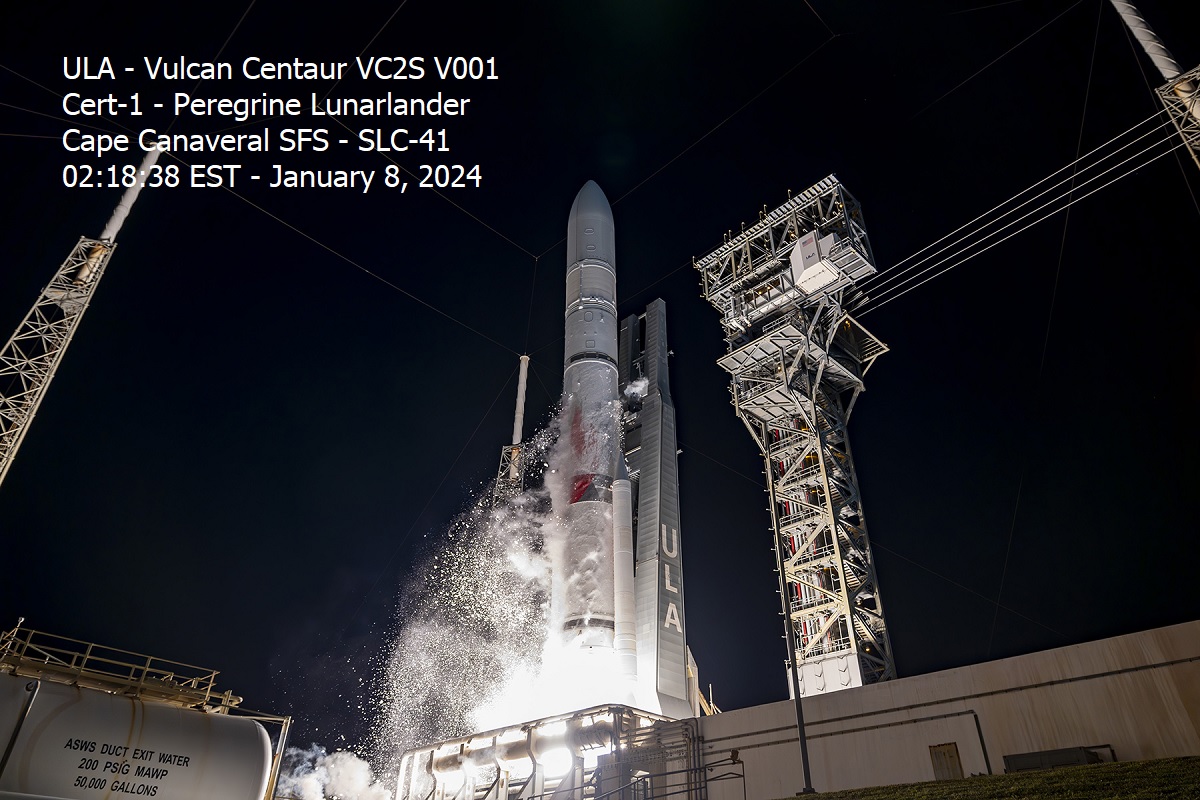
Photo from ULA of the Vulcan launch. I’ll huff. I’ll puff. And I’ll blow your pad away. Just you wait… Mission Rundown: ULA – Vulcan Centaur...