søndag den 9. februar 2020

ULA - Atlas V 411 - Solar Orbiter

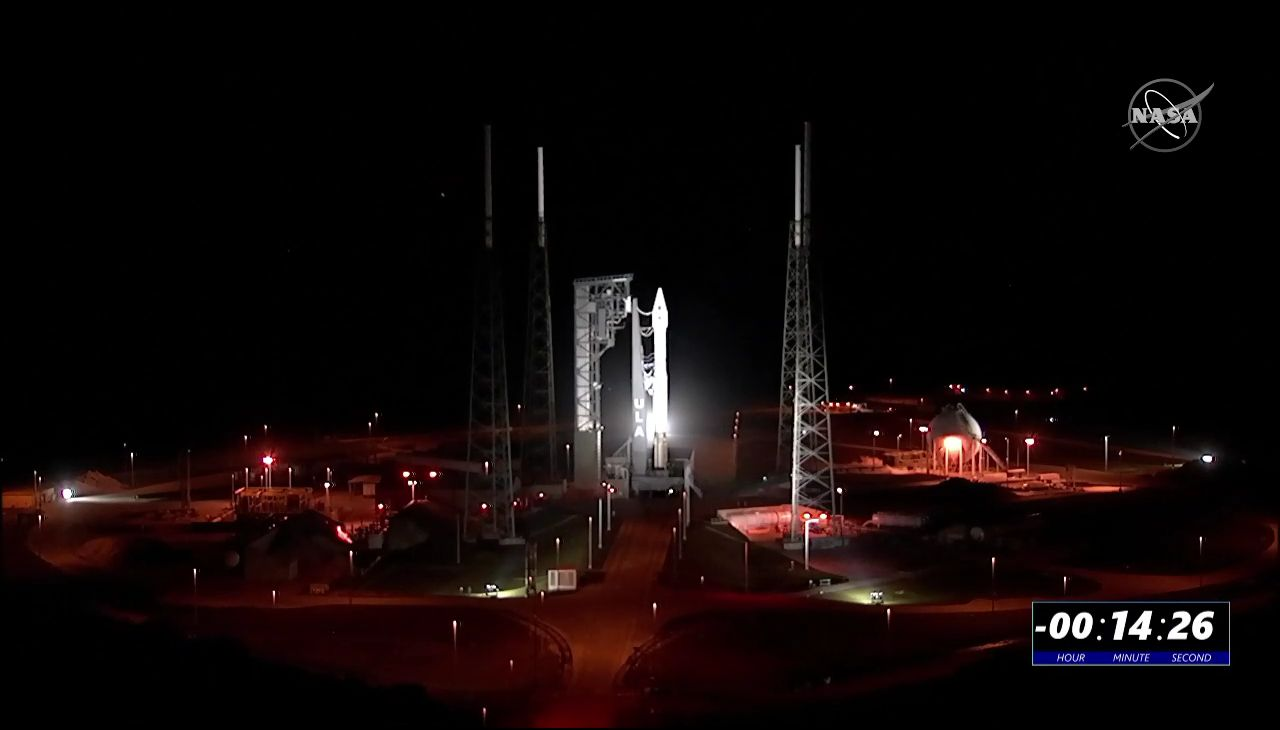
Screenshot from NASA Webcast of the launch of Solar Orbiter. NASA had a clock on screen then

Mission Rundown: ULA - Atlas V 411 - Solar Orbiter

Written: September 10, 2021 - Edit: November 28, 2022

Lift Off Time

February 9, 2020 - 23:03:00 EST

February 10, 2020 - 04:03:00 UTC

Mission Name

Solar Orbiter

Launch Provider

ULA - United Launch Alliance

Customer

ESA - European Space Agency

Rocket

Atlas V 411

Launch Location

Space Launch Complex 41 - SLC-41

Cape Canaveral Space Force Station, Florida

Payload

Helios Science Satellite - Sun observation 

Payload mass

1 800 kg ~ 4 000 pounds

Where did the satellite go?

Solar Orbit - 0.28 AU x 1.2 AU - Earth to Sun = 1 AU

Type of launch system?

Atlas Evolved Expendable Launch Vehicle + 1 SRB

The AJ-60A SRB’s fate?

In the Atlantic Ocean northeast of SLC-41

The first stage landing zone?

In the Atlantic Ocean some 2 500 km downrange

Type of second stage?

Centaur RL10A-4-2 engine - 945 second burn time

Is the Centaur stage derelict?

Yes - Main engine 2nd start/cutoff was 473 seconds - New hyperbolic orbit is -68 km x -38 456 km x 33.8° headed to a solar orbit - 0.508 AU x 0.989 AU x 2.0° off solar equator

Type of fairing?

4,2 meter two part metallic fairing

This will be the:

– 137th flight of all ULA rockets

– 82nd flight of an Atlas V rocket - Tail no. AV-087

– 1st ULA mission for ESA

– 1st mission for ULA in 2020

Where to watch

Where to read more in depth

ULA/NASA YouTube link - Scott Manley got videos too

Want to know or learn more visit or see Tim Dodd live


Launch debriefing

(This did happen)

The second burn gave the Solar Orbiter a boost from 7,35 m/s in Earth orbit to 10,87 m/s in the bigger Sun orbit

T-00:14:28

Hosts:

T-00:04:00

L-00:07:00

T-00:04:00

T 00:00:00

T+00:00:58

T+00:01:11

T+00:01:36

T+00:02:20

T+00:04:03

T+00:04:09

T+00:04:19

T+00:04:27

T+00:12:11

T+00:43:05

-

T+00:52:51

T+00:43:20

T+01:19:00

T+01:54:00

ULA/NASA live feed at 00:00 - L-00:45:28

Mic Woltmann, Derrol Nail, Joshua S, Laura A, Blair Allen

Into the 15 minute hold at 11:18

Final Polling preparing the launch at 22:27

Release -4 minute hold at 25:27

Liftoff at 29:28 - No T+ clock - 04:03:00 UTC

Mach 1 at 30:26 - Speed Mach One 1225,5 km/h 

MaxQ at 30:39 - Maximum aerodynamic pressure

SRB burn out at 31:04 - Still coughing up thrusts

SRB separation at 31:48 - One AJ-60A spent

BECO at 33:45 - I got nothing more left in me

Stage separation at 33:51- Time to lose some weight

MES-1 at 34:01 - Computer graphic program delay?

Fairing separation at 34:09

SECO-1 at 41:52 and coasting - 7m52s burn

MES-2 to SECO-2 in 473 seconds gave a velocity boost from 26 477 km/h to 39 136 km/h at 1:12:47 - 7m53s

ULA shows deployment at 1:22:33

ULA wrap up from 1:22:50 - ESA/NASA continues

Centaur blowout of remaining gasses and fuel

Centaur 2nd stage becomes derelict space debris


Atlas V N22

OFT Starliner

Atlas V 411

Solar Orbiter

Atlas V 551

AEHF-6

Atlas V 501

OTV-6

Atlas V 541

Mars 2020

Atlas V 531

NROL-101

Delta IV Heavy

NROL-44

Delta IV Heavy

NROL-82

Atlas V 421

SBIRS GEO-5

Atlas V 401

Landsat 9

Let’s go catch some rays

ESA's Solar Orbiter spacecraft was launched on 10 February 2020 (04:03 GMT) by a NASA-provided Atlas-V 411 vehicle of ULA, designated AV-87, from KSC (Kennedy Space Center) SLC-41 (Space Launch Complex), Cape Canaveral, FL, USA.

During the two-hour launch window, there were 25 instantaneous opportunities — a single second launch every 5 minutes — in which Atlas V could launch with a new azimuth owing to the ever-changing trajectories needed to insert Solar Orbiter into an interplanetary transfer heliocentric orbit to Venus.

We are going back to our star!! Solar Orbiter is a spacecraft built by the European Space Agency, ESA to study the inner heliosphere and its overall effects on solar radiation. Solar Orbiter is on a 3.5 year journey to the Sun.

Atlas V 411’s first number/letter shows the fairing diameter size in meters. The number 4 obviously means a 4,2 meter fairing. The second number determines the number of strap on solid rocket boosters (SRBs). It can range from 0 to 5, and in this case, there is only one on the side of the center core. The third and final number refers to the number of engines on the Centaur Upper Stage, which can be either one or two.

What goes up must come down. In about 4 minutes the Atlas V delivers a mighty kick to the main Centaur second stage, and after stage separation it will coast 2100 km further downrange. link

In this case there will be one engine ‘Bell or Nozzle’. The only time that there have been two engines on an Atlas V was on Starliner’s OFT-1. Technically it was on the Centaur.

The diagram above shows a detailed simulation of just how far this booster ‘ 1st stage’ will travel before crashing down into the Atlantic Ocean after Main Engine Cut-Off (MECO) and the Centaur upper stage ignites on its way to orbit. Thanks to Declan from FlightClub for doing this specially for this article!

Here it’s evident that Atlas V kicks the full weight of Centaur upper stage, the fairings and the payload about 120 km skyward and 300 km downrange before accepting its faith as a suborbital rocket under command of gravity. Maybe ULA should sell seats on the Atlas V interstage. That's one hell of a ride. Extra SRB’s and spacesuits should do it.

Initial parking orbit for this mission is 203 x 236 km. This is the orbit Centaur will initially inject into for its ~30 minute coast until Centaur re-ignition for the injection to heliocentric orbit bound for Venus.

The Solar Orbiter

Photo of Solar Orbiter on its service mount. Note the angle and rotation. By Jacques Van Oene

The Solar Orbiter will use Venus gravity assists to obtain the high inclinations reaching 35º with respect to the sun's equator (inclined elliptical orbit) at the end of the cruise phase mission (the cruise phase will last about 3.4 years).

Using SEPM (Solar Electric Propulsion Module) in conjunction with multiple planetary swing-by maneuvers, it will take the Solar Orbiter only two years to reach a perihelion of 45 solar radii with an orbital period of 149 days.

Within the nominal 5 year mission phase, the Solar Orbiter will perform several swing-by maneuvers at Venus, in order to increase the inclination of the orbital plane to 30º with respect to the solar equator. During an extended mission phase of about two years, the inclination will be further increased to 38º.

During the initial cruise phase, which lasts until November 2021, Solar Orbiter will perform two gravity-assist maneuvers around Venus and one around Earth to alter the spacecraft's trajectory, guiding it towards the innermost regions of the Solar System. At the same time, Solar Orbiter will acquire in situ data and characterize and calibrate its remote-sensing instruments. The first close solar pass will take place in 2022 at around a third of Earth's distance from the Sun.

Solar Orbiter carries ten science instruments

 – nine are led by ESA Member States and one by NASA – all working together in close collaboration to provide unprecedented insight into how our local star ‘works'. Some are remote-sensing instruments that look at the Sun, while others are in-situ instruments that monitor the conditions around the spacecraft, enabling scientists to ‘join the dots' from what they see happening at the Sun, to what Solar Orbiter ‘feels' at its location in the solar wind millions of kilometers away.

During some sections of its orbit, it will be able to work in cooperation with NASA’s Parker Solar Probe currently in orbit around our sun. There are four main questions that Solar Orbiter is trying to answer:

  1. What drives the solar wind and where does the coronal magnetic field originate from?

  2. How do solar transients drive heliospheric variability?

  3. How do solar eruptions produce energetic particle radiation that fills the heliosphere?

  4. How does the solar dynamo work and drive connections between the Sun and the heliosphere?

It will be able to do this with a multitude of onboard instruments. Some of the in-situ instruments include a Magnetometer (MAG), a Radio and Plasma Waves detector (RPW), a Solar Wind plasma Analyser SWA, and an Energetic Particle Detector (EPD).

Another set of instruments in the group are remote sensing. These include:

STIX: X-ray Spectrometer/Telescope

SPICE: Spectral Imaging of the Coronal Environment

SoloHI: Heliospheric Imager, PHI: Polarimetric and Helioseismic Imager

METIS: Coronagraph

EUI: Extreme Ultraviolet Imager

ESA Solar Orbiter link to instruments. Solar Orbiter's instruments can talk to each other.  If one sees something interesting, it can flag the other instruments to go look at the same thing in real time.

Like Parker Solar Probe, Solar Orbiter's instruments 'hide' behind the heat shield to protect them.  But there are doors on the heat shield that will open during perihelion passes to allowed direct photos and readings.

This Atlas V 411 configuration vehicle includes a 4,2 meter large payload fairing (PLF) and stands 189 feet - 57,6 meter tall. The Atlas booster for this mission is powered by the RD AMROSS RD-180 engine. Aerojet Rocketdyne provided the one AJ-60A SRB and RL10A-4-2 engine for the Centaur upper stage.

With only one SRB and the low payload weight, Atlas V 411 is powerful enough to loft this mission. Solar Orbiter requires a precise orbital injection, including a very specific C3 of 31.05 km^2/s^2. So the Atlas 411 is the perfect size.

C3 is the Characteristic energy. It tells you if a space vehicle has enough energy to escape the gravitational influence of a body and what shape, parabolic or hyperbolic, the escape trajectory will be. This is a standard orbital parameter for interplanetary missions.

Solar Orbiter trajectory from Earth launch to orbit the Sun assisted by Venus (image credit: ESA)

The spacecraft's orbit has been chosen to be ‘in resonance' with Venus, which means that it will return to the planet's vicinity every few orbits and can again use the planet's gravity to alter or tilt its orbit. Initially Solar Orbiter will be confined to the same plane as the planets, but each encounter of Venus will increase its orbital inclination.

For example, after the 2025 Venus encounter it will make its first solar pass at 17º inclination, increasing to 33º during a proposed mission extension phase, bringing even more of the polar regions into direct view.

From its launch early in 2017, the Solar Orbiter will reach the nominal orbit around the Sun in 2020, operating in its near-Sun environment for at least 6 years, including the extended mission phase. During this period, the spacecraft will carry the science payload through 14 perihelion passages. At the same time, the heliocentric latitude will be gradually increased through repeated Venus gravity assist maneuvers, providing information about the behavior of the Sun at high latitudes.

Daddy. What’s on top of the Sun?

The Atlas V 411 rocket

The 189 feet tall launch vehicle tasked with sending the Solar Orbiter on its way to Venus was the United Launch Alliance Atlas V rocket flying and its 411 configuration. 

This mission was the 82nd flight of the Atlas V and the sixth of its 411 configuration.

The Atlas V 411 rocket configuration is flying with a 4-meter payload fairing, a single solid rocket booster AJ-60A, and a single RL-10A-4-2 engine on Centaur upper stage.

Atlas V went through a test called a Wet Dress Rehearsal for a reason. Fueling has begun at Space Launch Complex-41 to load the rocket with 66,000 gallons of cryogenic liquid oxygen and liquid hydrogen as ULA tests the ‘day-of-launch’ operations.

The single side-mounted solid rocket booster creates a ‘slide’ with a tremendous amount of asymmetrical thrust that must be compensated for by the Thrust Vector Control - TVC systems on the Atlas V booster itself.

The RD AMROSS RD-180 on the Atlas V 411 is progressively gimballed to counteract the asymmetrical thrust of the single solid rocket, allowing Atlas V to fly a straight trajectory. This however wastes some of the thrust going straight down.

For launch, the RD-180 engine was commanded to ignite at T-2.7 seconds.

At T0, the single solid rocket was lit and Atlas V lifted off.

After power-sliding off the pad and ascending close through SLC-41’s lightning protection system towers and wires, the Atlas V performed a pitch and roll maneuver to align itself onto its azimuth – trajectory – for a flight to the east-southeast of Cape Canaveral.

The azimuth, in this case, will not be due east based on the position Centaur needs to obtain in Earth parking orbit before reigniting its engine to inject Solar Orbiter into a Venus-transfer heliocentric (Sun) orbit. Solar Orbiter won’t care about from where on Earth’s surface it aims for the Venus predicted position in its orbit.

No pre-planned launch schedule was found.

Everyday Astronaut: Austin Desisto link

NasaSpaceFlight: Chris Gebhardt link

Coauthor/Text Retriever Johnny Nielsen

link to ULA launch list - Link to ULA Fan


fredag den 20. december 2019

ULA - Atlas V N22 - OFT

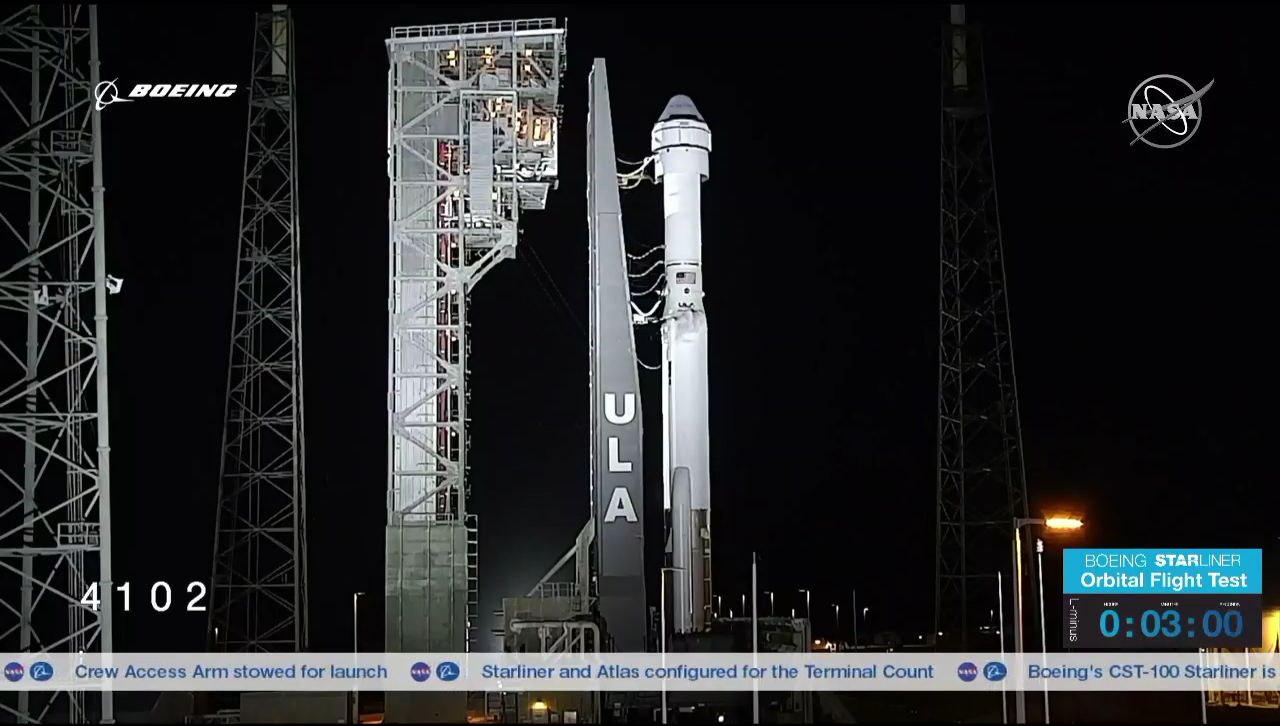
Screenshot from ULA Webcast of the launch of CST 100. Look Mom. No fairing. Just a funny hat

Mission Rundown: ULA - Atlas V N22 - OFT - CST 100

Written: September 12, 2021

Lift Off Time

December 20, 2019 - 06:36:23 EST - 11:36:23 UTC

Mission Name

OFT - Orbital Flight Test

Launch Provider

ULA - United Launch Alliance

Customer

NASA Commercial Crew Program

Rocket

Atlas V N22

Launch Location

Space Launch Complex 41 - SLC-41

Cape Canaveral Space Force Station, Florida

Payload

CST-100 - Boeing Starliner Crew Capsule + Service module

Payload mass

13 000 kg ~ 29 000 pound - Capsule weight

270 kg cargo + 1 test crew member ‘Rosie Riveter’

Where did the Starliner go?

Low Earth Orbit to the International Space Station

Currently ISS is at ~ 402 km x 403 km x 51.66° 

Initially Atlas N22 orbit - 72,7 km x 181,4 km x 51,6° 

Type of launch system?

Atlas Evolved Expendable Launch Vehicle + 2 SRB

The SRB’s fate?

In the Atlantic Ocean northeast of SLC-41

The first stage landing zone?

Bottom of the North Atlantic Ocean

Type of second stage?

Centaur RL10A engine - 842 second burn time link

Is the Centaur stage derelict?

No - Only one Main engine 1st start/cutoff

The orbit was sup-orbital like a Shuttle launch

Type of fairings?

5 meter Crew capsule with aero skirt

This will be the:

– 136th flight of a ULA rocket

– 81st flight of a Atlas V rocket - Tail no. AV-80

– 1st test flight of Boeing Starliner and N22

– 34th ULA mission for NASA

– 5th and last mission for ULA in 2019

Where to watch

Crew Dragon or Starliner read

Where to read more in depth

Boeing ULA YouTube link - NASA YouTube link

Want to know or learn more visit or see Tim Dodd

Scott Manley take on the failure and N22 engines


Launch debriefing

(This did happen)

A failure in the Boeing computer program that should have guided Starliner in orbit doesn’t start itself on time

It starts much later on believing it already has inserted itself in orbit

It corrects itself into a circular orbit using only the small RCS thrusters even though it has the larger OMAC thrusters

To much propellant is wasted before ground control takes over

ISS is a lost target

L-04:04:00

L-01:04:38

Hosts:

L-00:10:27

L-00:07:00

T-00:04:00

T 00:00:00

T+00:00:41

T+00:01:06

T+00:01:35

T+00:02:22

T+00:04:30

T+00:04:36

T+00:04:41

T+00:04:45

T+00:05:05

T+00:11:54

T+00:14:58

T+00:31:00

T+00:43:20

T+01:19:27

T+51:21:34

Planned 4 hour hold at xx:xx

NASA live feed at 00:02

Josh Barreth, Maria Lewis, Dillon Rice, Tori Wills, +others

Crew access arm retracting at 54:13

Final Polling preparing the launch at 57:40

Release -4 minute hold at 1:00:40 - Unseen

Liftoff at 1:04:40 - No T+ clock - 11:36:26 UTC

MaxQ at 1:05:21 - Maximum aerodynamic pressure

Mach 1 at 1:05:46 - Speed Mach One 1225,5 km/h

SRB burn out at 1:06:15 - Still coughing up thrusts

SRB separation at 1:07:02 - flight profile video

BECO at 1:09:10 - I got nothing more to give you

Stage separation at 1:09:16 - Time to lose some weight

Starliner nose cone jettison at 1:09:22

MES-1 of Centaur dual RL10A-4-2 engine at 1:09:25

Aero skirt separation at 1:09:45 - Audio only

SECO-1 at 1:16:34 - Centaur in a free ballistic fall

Starliner deployment at 1:19:34 - Thrusters keep firing

Failed orbit insertion - Thrusters out of sync at 01:32:07

Centaur blowout of remaining gasses and fuel

Centaur deorbits south of Australia

Starliner lands in White Sands, New Mexico 14:58 UTC


Atlas V 551

AEHF-4

Delta IV Heavy

NROL-71

Delta IV M+5,4

WGS-10

Atlas V 551

AEHF-5

Delta IV M+4,2

GPS III SV02

Atlas V N22

OFT Starliner

Atlas V 411

Solar Orbiter

Atlas V 551

AEHF-6

Atlas V 501

OTV-6

Atlas V 541

Mars 2020

Set your clocks. We fly at dawn

Everything is progressing toward the ULA Atlas V launch carrying the Orbital Flight Test OFT of Boeing’s CST-100 Starliner capsule. The mission is set to lift off at 06:36:43 EST on Friday, December 20, 2019 from Space Launch Complex-41 - SLC-41 at Cape Canaveral Air Force Station in Florida.

The uncrewed mission for NASA’s Commercial Crew Program will rendezvous and dock Boeing’s CST-100 Starliner spacecraft with the International Space Station and return to Earth on December 28.

This test flight will give real live valuable data about Starliner’s performance in the actual environment through each phase of flight and demonstrate its capability to transport crew to the space station and bring them home safely.

Data from the mission will validate spacecraft system performance and will move Starliner farther down the path toward its first flight with astronauts aboard.

Major events during launch - Centaur MECO - Starliner separation - Centaur blowout - In the dessert it says Starliner orbit insertion - Red areas are NOTAM with rocket part debris landing fields

The Boeing CST-100 Starliner

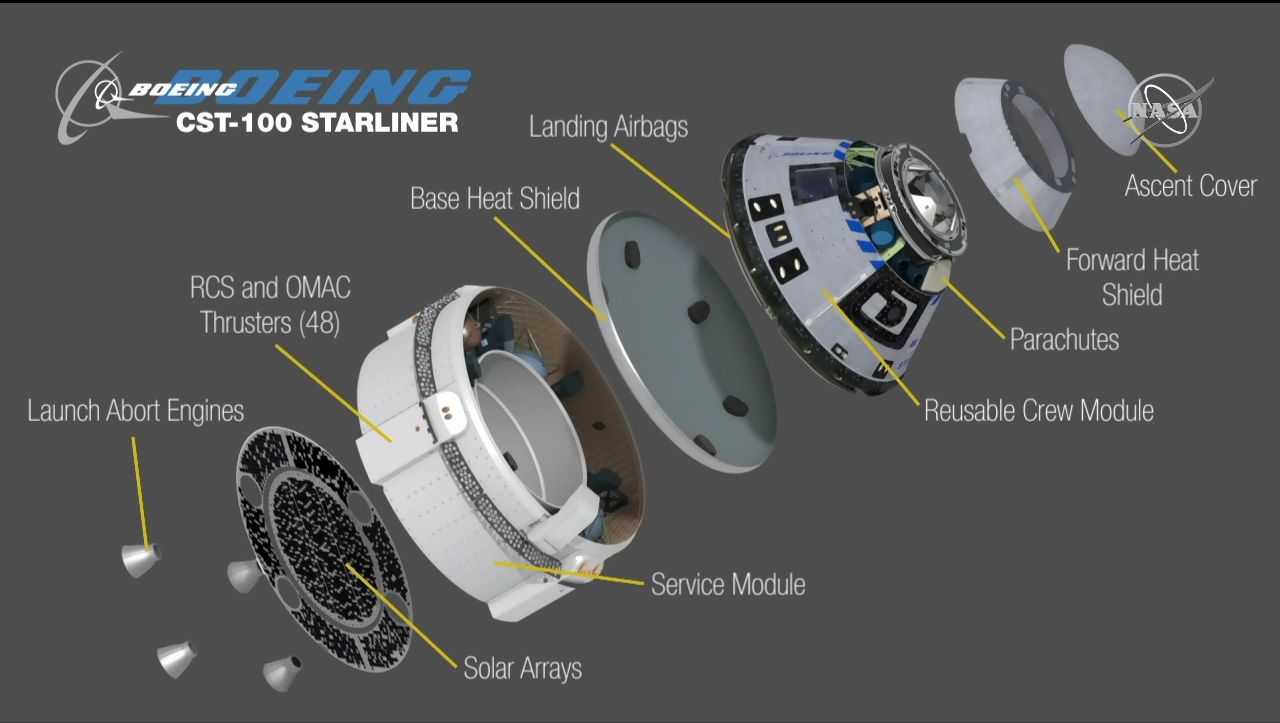
Starliner - Spacecraft 3 - itself is composed of two separate vehicles: the Crew Module and the Service Module. The Crew Module is equipped with 12 Reaction Control System (RCS) thrusters that can produce 100 lbf of thrust each.

The Service Module contains 28 RCS thrusters that produce 85 lbf thrust each and 20 Orbital Maneuvering and Attitude Control (OMAC) engines who produce 1,500 lbf thrust each. The Service Module’s OMAC engines will be used to perform abort maneuver during launch, the first crucial Orbit Insertion Burn after launch, all major in-orbit maneuvers, and the critical deorbit burn at the end of the mission.

The bottom of the Service Module contains the four Launch Abort Engines and all of the solar panels for power. For this OFT mission, the Launch Abort Engines will be disabled.

For OFT, Boeing and ULA did not want a miscalibration of the Emergency Detection System or a “miscommunication” between the system and Starliner to accidentally trigger an abort when nothing is actually wrong with the rocket.

In total, Starliner is capable of launching and landing seven people at the same time.  This is largely driven by NASA’s desire for a full seven-person Station crew to pile into Starliner to quickly evacuate the Station if all crew happen to be on the U.S. side of the outpost if an emergency occurs.

Engineers breakdown of CST-100 in mayor parts - Note launch abort engines doubles as CST-100 orbit insertion engines after detachment from Centaur 2nd stage flying similar to a Shuttles ascent

A complement of four will be the normal crew rotation number, with Boeing having the option to sell a fifth seat to a private astronaut.

To accommodate this NASA requirement, Starliner has an internal pressurized volume of 11 cubic meters  (390 cubic feet) for crew and cargo. 270 kg of ISS cargo being flown on this OFT mission. Most of it is food.

However, the OFT mission to the ISS – set for docking 25 hours after launch – was placed into doubt after Starliner suffered an orbital insertion issue. It was later confirmed that an issue with the Mission Elapsed Clock timing, which was ahead by 11 hours for the orbital insertion burn, had forced the decision to return Starliner to White Sands, as opposed to docking with the ISS, by Sunday.

The OMAC thrusters weren’t used to insert Starliner into the first orbit insertion only the smaller RCS thrusters were burning propellant like crazy to correct the Starliner into its believed orbit in the Mission Elapsed Clock timeline.

Propellant vital for ISS approach maneuvers were wasted and docking with ISS became impossible so that part of the mission got canceled. The rest of the mission went ahead as scheduled with ISS approach maneuvers in a lower orbit, before deorbiting itself for a landing in White Sands Space Harbour, New Mexico.

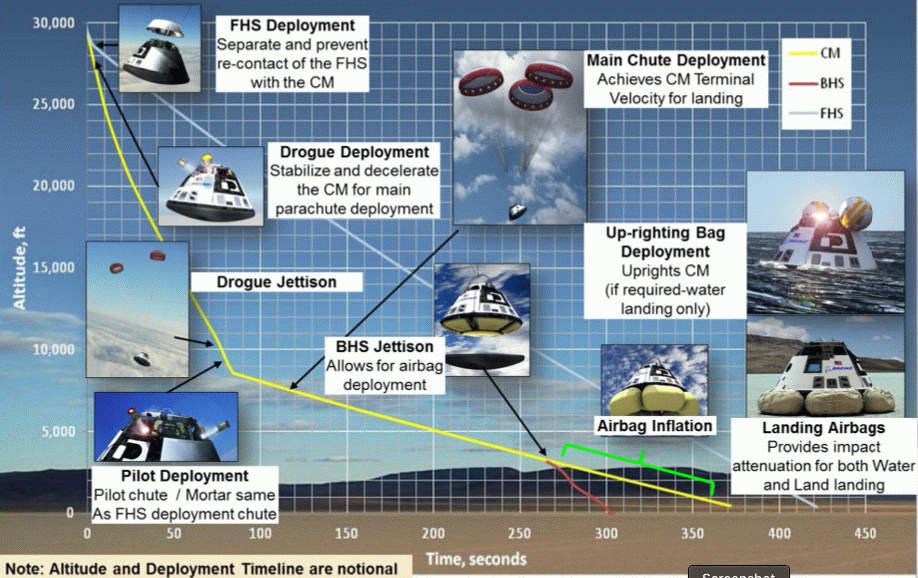
Timeline of Starliner’s descent from orbit to solid ground in the yellow line. Blue line is the Forward Heat Shield under its own parachute. Red is the dropped main heat shield’s descent line.

Boeing, in coordination with NASA and the U.S. Army, is working to return its CST-100 Starliner to land in White Sands, New Mexico, on Sunday Dec. 22. The deorbit burn is scheduled for 7:23 a.m. EST, landing for 7:57 a.m. EST - 12:57:00 UTC.

It takes about four months to refurbish a Starliner in the factory. Mostly just run through the acceptance testing procedures again.

The launch Vehicle Atlas V N22

The Starliner is attached to the Atlas V using a launch vehicle adapter (LVA) which includes an aeroskirt to reduce aerodynamic loads on the vehicle. The Atlas V configuration for this mission is powered by dual Aerojet Rocketdyne RL10A-4-2 engines, each producing 22,600 lbs. of thrust. The Centaur also includes an Emergency Detection System (EDS) that monitors the health of the rocket throughout flight.

The Atlas V N22 rocket stands 52.4 meters - 172 feet tall on SLC-41. The Orbital Flight Test will be the 81st launch of the Atlas V and will mark ULA's 136th mission.

There will be loaded 66000 gallon of cryogenic liquid oxygen and hydrogen in the three remaining tanks. Stage one fuel tank is already loaded with RP-1. First step is loading 4150 gallon of cryogenic liquid oxygen into the Centaurs LOX tank. Next, filling the first stage with 48800 gallon of cryogenic liquid oxygen in the core boosters LOX tank.

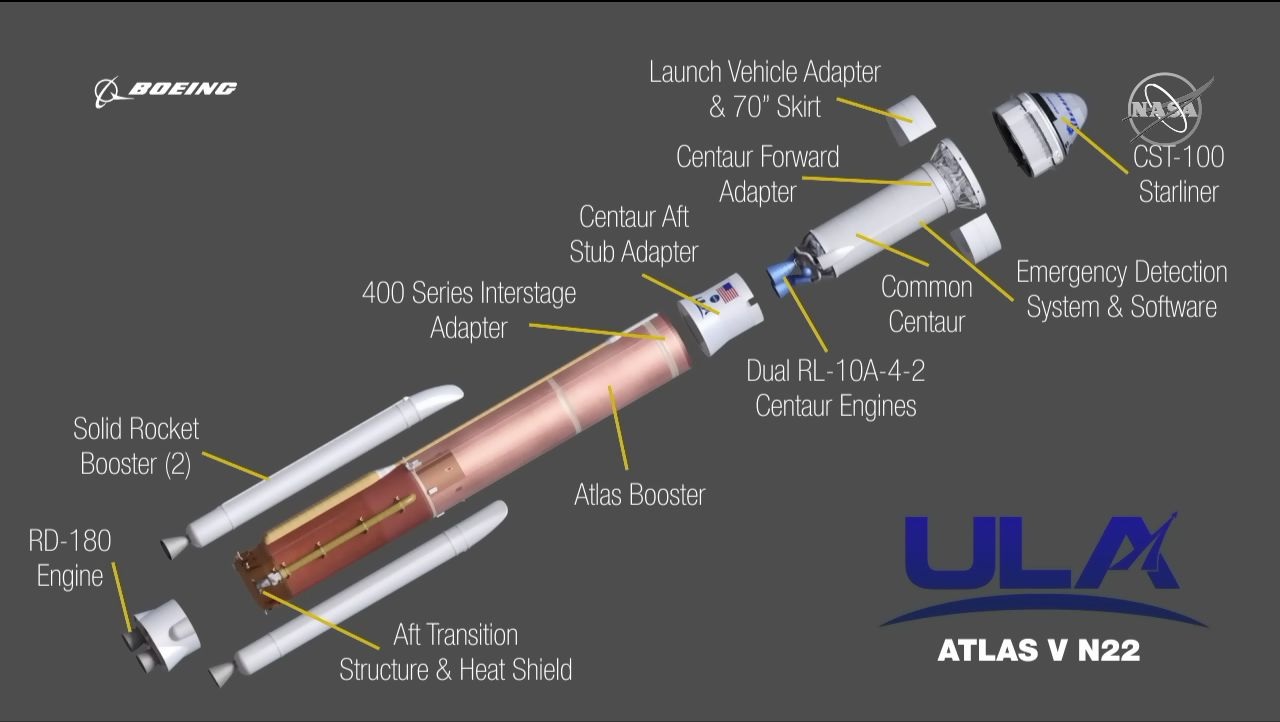
Atlas V N22 is split in its major parts. Without a standard fairing on or encapsulating the Centaur stage a special Forward Adapter with aero skirts must be used. It’s an Atlas V 422 without fairings

The Atlas V rocket will deliver Boeing’s CST-100 Starliner spacecraft to a 98-nautical mile (nmi) sub-orbital trajectory. Following separation from the Atlas V, the Starliner engines will propel the spacecraft to its final orbit and on to the ISS.

Modified specifically for the Boeing CST-100 Starliner spacecraft, the Atlas V Starliner configuration does not include a payload fairing. Instead, the Starliner’s own protective surfaces take the place of the fairing to protect the uncrewed spacecraft during ascent. This is the inaugural flight of this configuration.

The Starliner attached to the Atlas V uses a launch vehicle adapter (LVA) which includes an aeroskirt to reduce aerodynamic loads on the vehicle. The Atlas V configuration for this mission is powered by dual Aerojet Rocketdyne RL10A-4-2 engines, each producing 22,600 lbs. of thrust. The Centaur 2nd stage also includes an Emergency Detection System (EDS) that monitors the health of the rocket throughout flight.

The second stage is the Centaur, a hallmark of the Atlas family that was first used in 1962. Since then, the Centaur has evolved into the Common Centaur used today. To power the stage, an Aerojet Rocketdyne RL10C-1 engine is used to place its payload(s) into its final orbit. The RL10 engine is historic, having been used over several generations of rocket families and has been produced over 500 times.

It’s also the first flight of Atlas V in the N22 configuration (N = no fairing, 2 = two SRBs, 2 = dual-engine bell Centaur).

The only fault with this failed OTF mission was not to insert Starliner in a stable low earth orbit with the Centaur 2nd stage. Later missions could have fiddled with Space Shuttle flight profiles meaning incomplete suborbital launches, and using abort OMAC engines to circularize Starliners first orbit.

It was too risky in my opinion.

Everyday Astronaut: Lost in pre 2020’s

NasaSpaceFlight: Chris Gebhardt

Coauthor/Text Retriever Johnny Nielsen

link to ULA launch list - Link to ULA Fan


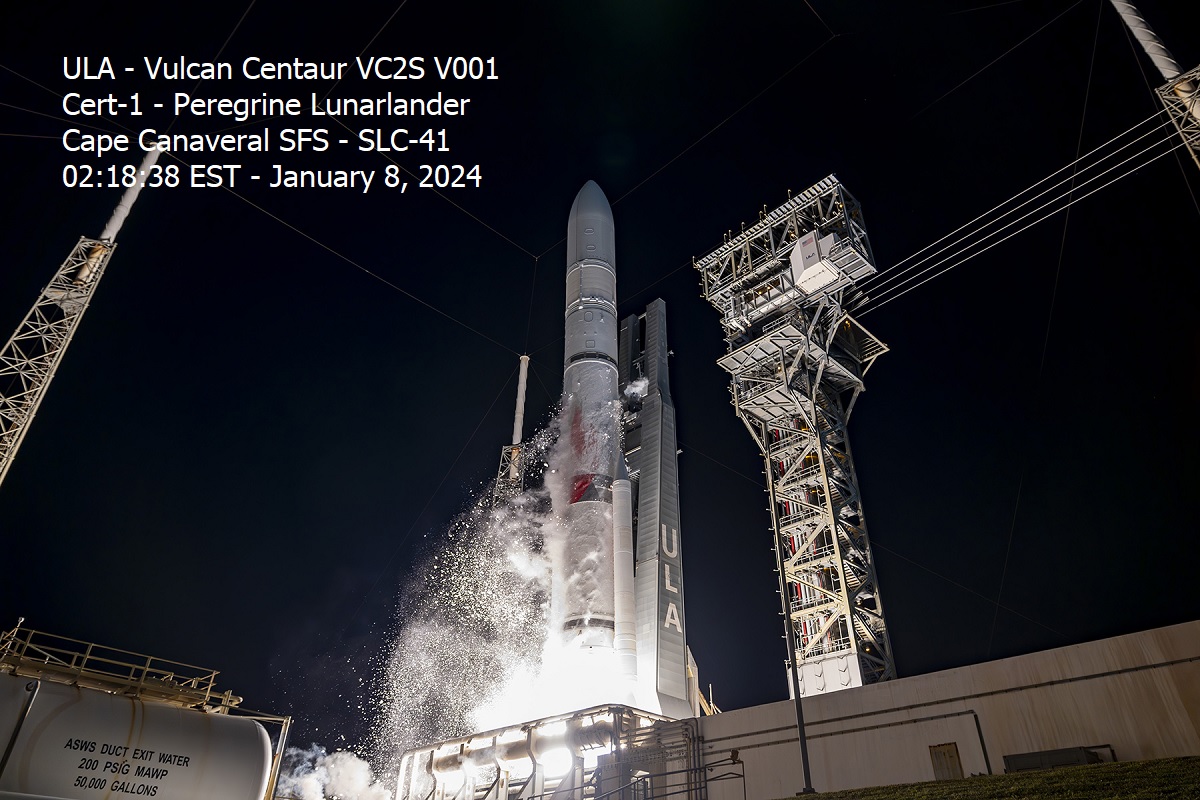
ULA – Vulcan – Peregrine Lunar Lander

Photo from ULA of the Vulcan launch. I’ll huff. I’ll puff. And I’ll blow your pad away. Just you wait… Mission Rundown: ULA – Vulcan Centaur...