fredag den 1. juli 2022

ULA - Atlas V 541 - USSF-12

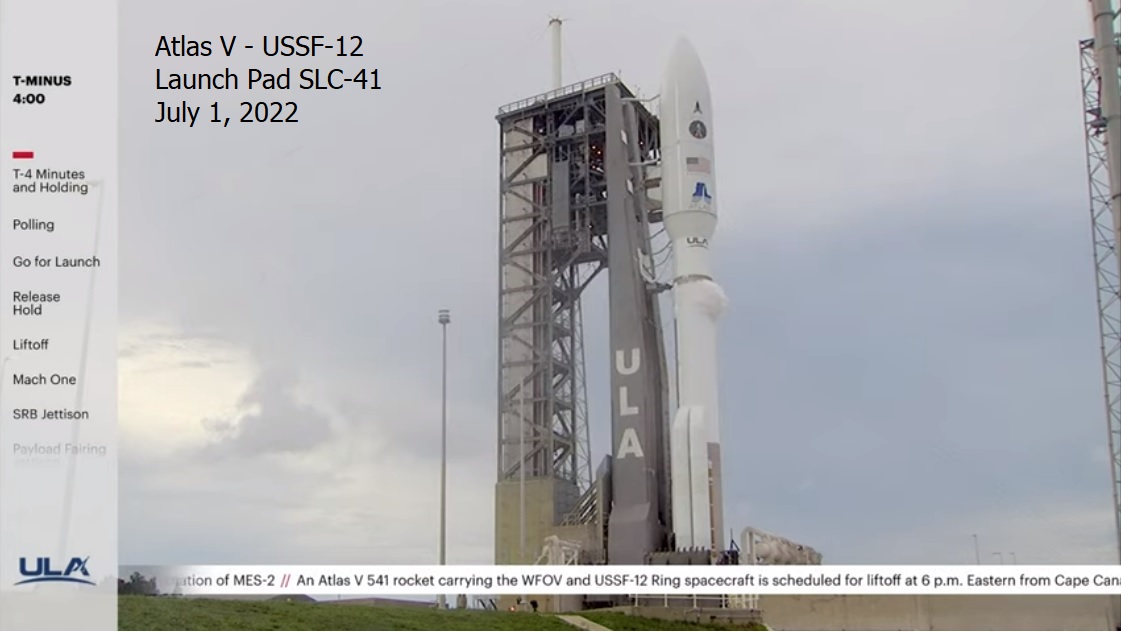
Screenshot from ULA Webcast of the launch of USSF-12. The weather is much better today

Mission Rundown: ULA - Atlas V 541 - USSF-12

Written: December 6, 2022

Lift Off Time

July 1, 2022 - 19:15:00 EST - 23:15:00 UTC

Mission Name

USSF-12

Launch Provider

ULA - United Launch Alliance

Customers

U.S. Space Force

Space System Command - SSC

Department of Defense - DoD

Rocket

Atlas V 541

Launch Location

Space Launch Complex 41 - SLC-41

Cape Canaveral Space Force Station, Florida

Payload

Wide Field Of View - WFOV - Testbed Satellite

USSF-12 Ring Spacecraft - EELV = ESPA ring

Assigned numbers: USA-332 - USA-333 + USA-337

Payload mass

5 000 kg ~ 21 000 pound - Estimated guess

Where did the satellites go?

Geosynchronous Orbit

35 516 km x 35 536 km x 00,01°

Type of launch system?

Atlas Evolved Expendable Launch Vehicle + 4 SRB’s

The GEM-63 SRB’s fate?

In the Atlantic Ocean due east of SLC-41

The first stage landing zone?

Bottom of the Atlantic Ocean further downrange

Type of second stage?

Centaur RL-10C-1-1 engine - 16m 24s burn time

Is the 2nd stage derelict?

Yes - Main engine 4th start/cutoff wasn’t evident

New orbit is 35 180 km x 35 520 km x 00.17° 

Type of fairings?

5.4 meter two part carbon composite fairing

This will be the:

– 151st flight of all ULA rockets

– 94th flight of an Atlas V rocket - Tail no. AV-094

– 92nd National Security Space Launch

– 14th mission for DoD Space Test Program - STP

– 5th mission for US Space Force

– 4th mission for ULA in 2022

Where to watch

Where to read more

ULA YouTube link

Want to know or learn more go visit or see Tim Dodd


Launch debriefing

(This did happen)

Host:

T-00:04:00

T-00:09:00

T-00:07:00

T-00:04:00

T 00:00:00

T+00:00:58

T+00:01:07

T+00:01:36

T+00:01:48

T+00:03:25

T+00:04:24

T+00:04:30

T+00:04:40

T+00:10:58

T+00:23:13

T+00:31:05

T+05:43:54

T+05:49:36

T+05:59:03

T+06:31:41

T+07:06:41

Andrea Lehnhoff

ULA live in a planned 30 minute hold at 01:20

Extended hold awaiting propellant top off at 17:49

Final Polling preparing the launch at 23:16

Release -4 minute hold at 26:15

Liftoff at 40:12 - No T+ clock - 23:15:00.196 UTC

Mach 1 at 40:47 - Speed Mach One 1225,5 km/h

MaxQ at 41:00 - Maximum aerodynamic pressure

SRB burn out at 42:02 - Delayed release 2 by 2

SRB separation at 42:06 - Four GEM-63 spent

Fairing separation at 43:46 - Computer graphics on

BECO at 44:39 - Atlas V booster is empty - 263 second

Stage separation at 44:42 - Just losing 95% weight

MES-1 at 44:52 - Centaur RL-10C-1 engine start

MECO-1 at 53:14 - Coasting toward Africa

MES-2 to SECO-2 in 329 second doing a GTO burn

Wrap up from ULA at 1:09:43 - Calculated T+

MES-3 - SECO-3 in a 146 second insertion burn to GEO

ULA doesn’t show deployment of WFOV

ULA doesn’t show deployment of Ring ESPA

Centaur blowout of remaining gasses and fuel

Centaur 2nd stage becomes derelict space debris


Atlas V 401

Lucy

Atlas V 551

STP-3

Atlas V 511

USSF-8

Atlas V 541

GOES-T

Atlas V N22

OFT-2 Starliner

Atlas V 541

USSF-12

Atlas V 421

SBIRS GEO-6

Delta IV Heavy

NROL-91

Atlas V 531

SES 20 & 21

Atlas V 401

JPSS-2

Giving another ‘Ring’ to Space

United Launch Alliance has deployed a pair of Space Force technology demonstration payloads into geostationary orbit Friday evening. The USSF-12 mission lifted off from Cape Canaveral at 7:15 PM EDT (23:15 UTC) on Friday, following a 24 hour delay from Thursday due to weather as well as additional weather delays early in the Friday window.

United States Space Force 12 (USSF-12) consists of two satellites that will help the Space Force to test and develop systems for future national security space missions. The Wide Field of View (WFOV) satellite will test an infrared sensor to be used on the next generation of missile detection satellites, while the USSF-12 Ring utilizes a free-flying propulsive EELV Secondary Payload Adapter (ESPA) to carry additional research payloads for the Space Test Program.

WFOV will be operated by Space Force’s Space Systems Command. Using space-based sensors allows the maximum possible warning of an incoming missile, giving time for defensive precautions and countermeasures to be employed against the threat and for a nuclear counterattack to be launched if necessary.

The WFOV - USSF-12 Payload

WFOV was constructed by Boeing’s Millennium Space Systems subsidiary, based on the Aquila M8 platform, and has a mass of around 3,000 kilograms. It carries a 200-kilogram infrared imaging system, the Wide Area Six-Degree Payload (WASP), built by L3Harris Technologies.

Unlike WFOV, few details about the smaller USSF-12 Ring have been made public, other than its use of the propulsive ESPA ring developed by Northrop Grumman.

The satellite will be operated by the Space Test Program, an agency under the US Department of Defense that carries out research and development of new space systems for future military applications.

Previous ESPA-derived spacecraft have deployed additional CubeSats after launch, although it is not clear whether this will be an element of the USSF-12 Ring’s mission. One CubeSat - USA-337 has been successfully deployed.
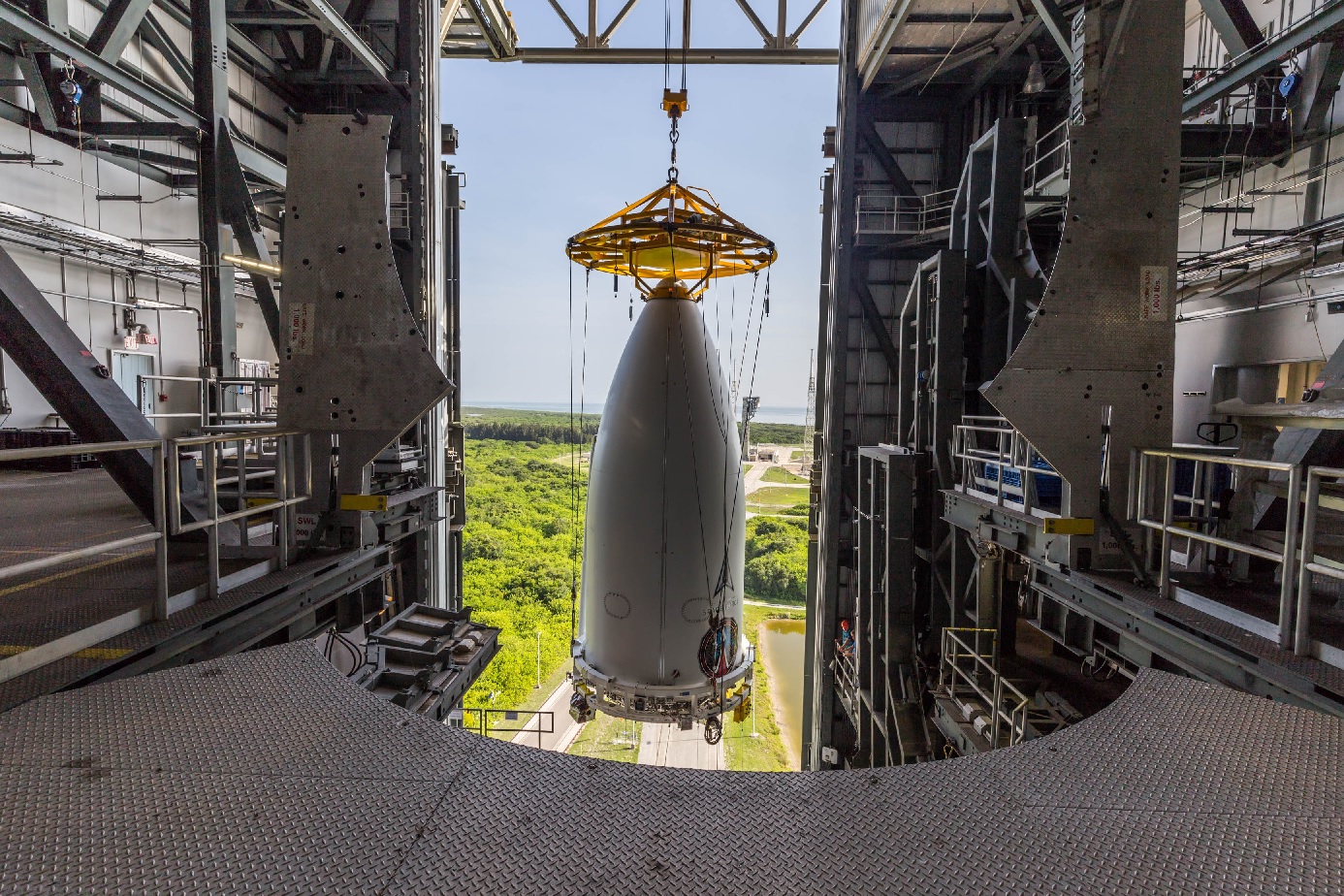
Photo of the payload top half being hoisted up in the VIF. Looks like they are loading a giant gun

The rocket launch

Atlas lifted off from Space Launch Complex 41 (SLC-41) at the Cape Canaveral Space Force Station. Originally a Titan launch pad, SLC-41 has been the East coast home of Atlas V since its introduction and is due to continue in service with ULA for decades to come as the company transitions over to Vulcan.

AV-094 was stacked atop a mobile launch platform within the Vertical Integration Facility (VIF) and then rolled into position at the launch pad for liftoff.

The Common Core Booster is powered by a single RD-180 engine. This ignited at the T-1 second mark in the countdown, with liftoff occurring at T+1 second.

Four GEM-63 solid rocket boosters fired alongside the RD-180 for the first 98 seconds of flight, providing additional thrust as Atlas ascended through the dense lower regions of the Earth’s atmosphere.

After lifting off, AV-094 began a series of pitch and yaw maneuvers to put itself on course for geostationary orbit. The first of these took place 6.9 seconds into the flight, as the rocket assumed an easterly track to minimize its orbital inclination.

It took about 57.8 seconds for the rocket to reach Mach 1, the speed of sound. Less than ten seconds later, AV-094 passed through the area of maximum dynamic pressure, Max-Q.

Although the SRMs only burn for about 98 seconds, they remain attached for about ten seconds after burnout. At one minute and 48 seconds mission elapsed time, the spent boosters separated and fell away from the vehicle.

Three minutes and 26 seconds after liftoff, the payload fairing which encloses the satellites and the Centaur upper stage and provides protection during the climb through the atmosphere was jettisoned.

Shortly after fairing separation, the forward load reactor separated from the forward end of Centaur. Besides supporting the weight from the satellites and the fairing top half it stops hydrogen gasses from entering the payload housing. The satellites are in a nitrogen filled room to prevent water vapors from damaging corrosion and condensing.

The RD-180 continued to power the CCB until Booster Engine Cutoff (BECO) at the four-minute, 24-second mark in the mission. At BECO, the CCB shuts down its engine in preparation for stage separation, which occurs six seconds later. Centaur’s RL10C-1 engine begins its pre-start sequence, igniting ten seconds after separation to begin the first of three planned burns.

While the first stage burns RP-1 kerosene and liquid oxygen - LOX, Centaur uses cryogenic liquid hydrogen - LH2 and LOX. Its first burn lasts six minutes and 18 seconds, putting the upper stage and payloads into an initial parking orbit.

Twelve minutes and 15 seconds later, it restarts for a second burn, firing its engine for five minutes and 28 seconds to reach geosynchronous transfer orbit (GTO).

For many launches, GTO is the final destination for the rocket, with the payloads then released to make their way into their operational orbits.

On Friday’s mission, however, the additional power provided by the Atlas V 541 rocket allows a direct insertion to be made into geostationary orbit. This requires a third burn to be made at the apogee – or highest point – of the transfer orbit, so the mission enters an extended coast phase lasting five hours, 15 minutes, and 12 seconds.

Centaur’s final burn lasts two minutes and 26 seconds, circularizing the orbit and zeroing out its inclination. They are now in geosynchronous orbit around Earth.

Three minutes and 16 seconds after verification of insertion, WFOV was deployed into a near-geostationary orbit with a perigee of 36,106 km (22,435 mi, 19,496 nmi), an apogee of 36,168 km (22,473 mi, 19,529 nmi) and inclination of 0.0 degrees.

Once WFOV separated, Centaur reoriented itself, performed another short burn and jettisoned the payload release adaptor that was sitting between the satellites.

The USSF-12 ring separated into a 36,167 by 36,323 km (22,473 x 22,570 mi, 19,529 x 19,613 nmi) orbit 15 minutes and 45 seconds after WFOV’s deployment.

About 26 minutes and 20 seconds later, Centaur will perform a blowdown to help passivate itself, reducing the risk of an on-orbit explosion since deorbiting the stage is not possible with Friday’s mission profile.

The USSF-12 mission will officially end at T+ seven hours, six minutes and 41 seconds.

The Atlas V 541 rocket

The USSF-12 mission launched aboard an Atlas V rocket, operated by United Launch Alliance (ULA). The Atlas V has been a workhorse for the US government’s military and scientific space missions across its first twenty years of service.

Originally developed in 2002 by Lockheed Martin for the US Air Force’s Evolved Expendable Launch Vehicle (EELV) program, Atlas was selected for development alongside Boeing’s Delta IV – which is now also operated by ULA formed in 2006.

Atlas V itself is a two-stage rocket, with a Common Core Booster (CCB) first stage and a Centaur upper stage. Different configurations vary the number of strap-on solid rocket motors (SRMs) that augment the first stage during the initial phase of flight, the size of the rocket’s payload fairing, and the number of engines on the Centaur stage.

USSF-12 Atlas flew in its 541 configuration, which means a five-meter diameter payload fairing, four solid rocket motors, and a single-engine Centaur (SEC). Atlas V has a unique tail number; the USSF-12 mission is AV-094.

Facts on the Atlas V launch vehicle

Height of Atlas V 541: 196 feet (59.7 meters)

Fuel onboard: 91,000 gallons of liquid propellant

First stage Atlas: 25,000 gallon RP-1 - 48,800 gallon LOX

Second Stage Centaur: 13,050 gallon LH2 - 4,150 gallon LOX

LOX+LH2 = 66,000 gallon of cryogenic liquid propellant

150 kg (340 lb) of Hydrazine is stored in a pair of bladder tanks

Helium storage tanks: Unknown so far

4 GEM-63 SRB: 400,000 pounds of solid fuel

Mass at liftoff: 1,182,975 pounds (536,180 kg)

Thrust at liftoff: 2.3 million pounds (10.44 mega-Newtons)

Orbit: Geosynchronous - 22,000 miles (35,500 km)
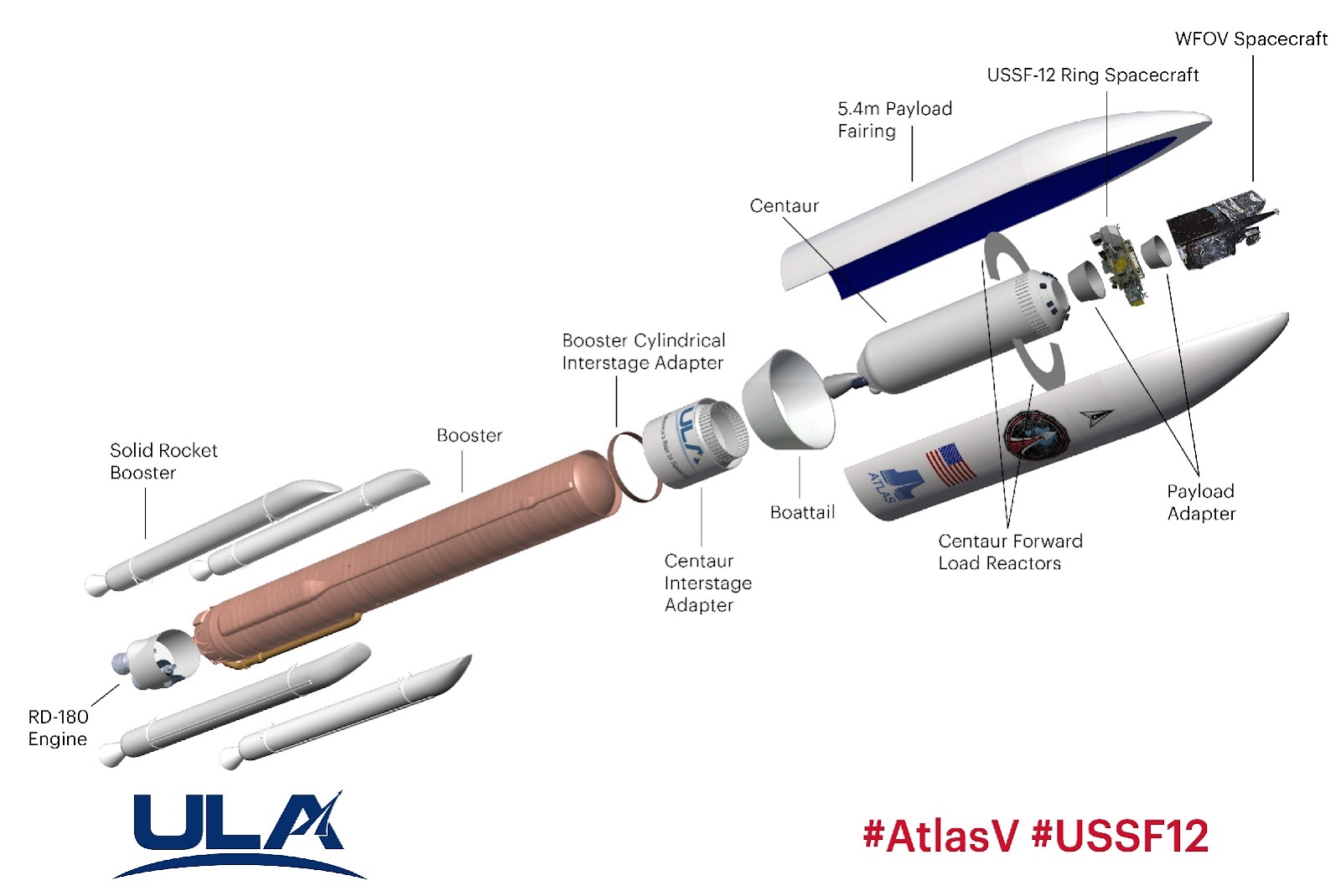
Graphic of Atlas V 541 split in its major pieces. The Ring Spacecraft was once a payload adaptor

Atlas V rocket is filled with 344 472 liter - 91 000 gallons of RP-1, liquid oxygen and liquid hydrogen. They contain 344,47 m3 RP-1, cryogenic oxygen and cryogenic hydrogen.

The Common Core Booster holds 184 728 liter - 48 800 gallon liquid oxygen chilled to below -182,96 0C Celsius or -297,33 0F Fahrenheit that can fit in a 184,73 m3 oxygen tank.

The Common Core Booster holds 94 635 liter - 25 000 gallon RP-1 highly refined kerosine at room temperature that can fit in a 94,64 m3 fuel tank.

The Centaur upper stage holds about 49 400 liter - 13 050 gallons of liquid hydrogen chilled to -252,8 0C Celsius or -423 0F Fahrenheit that can fit in a 49,40 m3 hydrogen tank.

The Centaur upper stage holds about 15 709 liter - 4 150 gallons of liquid oxygen chilled to below -182,96 0C Celsius or -297,33 0F Fahrenheit that can fit in a 15,71 m3 fuel tank.

Still to find is data on Helium gas, pressures used and number of COPV to store it.

150 kg (340 lb) of Hydrazine is stored in a pair of bladder tanks to store propellant used for RCS maneuvering during ascent and in orbit.

Everyday Astronaut: Florian Kordina link

NasaSpaceFlight: William Graham link

Coauthor/Text Retriever Johnny Nielsen

link to ULA launch list - Link to ULA Fan


torsdag den 19. maj 2022

ULA - Atlas V N22 - OFT-2 Starliner

Screenshot from ULA Webcast of the launch of CST-100 Test 2. It better work this time

Mission Rundown: ULA - Atlas V N22 - OFT-2 - CST-100

Written: November 27, 2022

Lift Off Time

May 19, 2022 - 18:54:47 EST - 22:54:47 UTC

Mission Name

OFT-2 - Orbital Flight Test 2 - CST-100 

Launch Provider

ULA - United Launch Alliance

Customer

Boeing - NASA Commercial Crew Program

Rocket

Atlas V N22

Launch Location

Space Launch Complex 41 - SLC-41

Cape Canaveral Space Force Station, Florida

Payload

CST-100 - Starliner Crew Capsule + Service module

Payload mass

13 000 kg ~ 29 000 pound - Capsule weight

270 kg cargo + 1 test crew member ‘Rosie Rocketer’

Where did the Starliner go?

Low Earth Orbit to the International Space Station

Currently at ~ 402 km x 403 km x 51.66° 

Initially orbit - 74,6 km x 180,1 km x 51,6° 

Type of launch system?

Atlas Evolved Expendable Launch Vehicle + 2 SRB’s

The SRB rocket’s fate?

In the Atlantic Ocean northeast of SLC-41

The first stage landing zone?

Bottom of the North Atlantic Ocean

Type of second stage?

Centaur RL10A-4-2 engine - 700 second burn time link

Is the Centaur stage derelict?

No - Only one Main engine 1st start/cutoff

The orbit was sup-orbital like a Shuttle launch

Type of fairings?

5 meter Crew capsule with nose cover and aero skirt

This will be the:

– 150th flight of all ULA rockets

– 93rd flight of an Atlas V rocket - Tail no. AV-085

– 264th launch with a Centaur upper stage

– 2nd flight of Atlas V N22 rocket

– 3rd test flight of Boeing Starliner

– 39th ULA mission for NASA

– 3rd mission for ULA in 2022

Where to watch

Where to read more in depth

NASA/Boeing/ULA YouTube link

Want to know or learn more visit or see Tim Dodd


Launch debriefing

(This did happen)

Host kept coming in so here is their names

Brian Cizek - Weather

Brandi Dean

Josh Barreth

Gary Jordan

Megan Cruz

Suni Williams

Delay between T+ timer and computer graphic second timer. One of them is 3 seconds off

No second count on all activities after docking of Starliner leaves 13 seconds on repeat on the T+ timeline

L-00:53:36

Hosts:

L-00:11:03

L-00:07:00

T-00:04:00

T 00:00:00

T+00:00:47

T+00:01:09

T+00:01:38

T+00:02:19

T+00:04:31

T+00:04:43

T+00:04:47

T+00:05:09

T+00:11:52

T+00:14:53

T+00:31:23

T+25:33:13

+139:41:13

+143:12:13

+143:54:13

NASA live feed at 02:03

Dee Russell, Darryl Nail, Lauren Seebrook, Dillon Rice,

Crew access arm is retracting at 44:35

Final Polling preparing the launch at 48:39

Terminal countdown begins at 51:38

Liftoff at 55:39 - No T+ clock - 22:54:47 UTC

MaxQ at 56:27 - Maximum aerodynamic pressure

Mach 1 at 56:48 - Speed Mach One 1225,5 km/h

SRB burn out at 57:18 - No more extra thrust

SRB separation at 57:59 - flight profile video

BECO at 1:00:11, stage separation at 1:00:17

Starliner nose cover jettison at 1:00:23

MES-1 of Centaur dual RL10A-4-2 engine at 1:00:27

Aero skirt separation at 1:00:49

SECO-1 at 1:07:32 - In a suborbital free fall

Starliner deployment at 1:10:30

Starliner insertion burn at 1:26:43 - Orbit raising

Docking at ISS Harmony module at 00:28:00 UTC

Undocking 5 days later on May 25 at 18:36:00 UTC

Reentry burn complete at 22:07:00 UTC

Touchdown White Sands Space Harbour - 22:49:00 UTC


Atlas V 401

Lucy

Atlas V 551

STP-3

Atlas V 511

USSF-8

Atlas V 541

GOES-T

Atlas V N22

OFT-2 Starliner

Atlas V 541

USSF-12

Atlas V 421

SBIRS GEO-6

Delta IV Heavy

NROL-91

Atlas V 531

SES 20 & 21

Atlas V 401

JPSS-2

Reset your clocks. We fly again

Boeing’s Starliner spacecraft has launched on its Orbital Flight Test 2 mission atop a United Launch Alliance Atlas V rocket Thursday. OFT-2 departed Space Launch Complex 41 at Cape Canaveral at 18:54:47 EDT (22:54 UTC), to the International Space Station.

Orbital Flight Test 2, or OFT-2, is a repeat of Starliner’s 2019 OFT mission, now also known retrospectively as OFT-1. An uncrewed test of the Starliner spacecraft, developed by Boeing for NASA’s Commercial Crew Program (CCP), the original OFT had been intended as the last test before NASA entrusted astronauts on a Crewed Flight Test (CFT).

Due to the original OFT’s failure to complete a number of key objectives, including rendezvous and docking with the International Space Station, the OFT-2 mission was added ahead of the first crewed flight.

Starliner is one of two spacecraft developed to carry astronauts to and from the International Space Station under NASA’s Commercial Crew Program. The OFT and CFT missions conclude the development and demonstration phase of this program, paving the way for future crew rotation flights to the station. SpaceX has already completed these milestones with their Crew Dragon spacecraft, the other vehicle built for this program, which is currently undertaking its fourth long-duration crew mission to the ISS.

Major events during launch - Centaur MECO - Starliner separation - Centaur blowout - In the dessert it says Starliner orbit insertion - Red areas are NOTAM rocket part debris fields

OFT-2 marks the first flight of Starliner spacecraft number 2, which has not yet been named. Spacecraft number 3, now named Calypso, carried out the original OFT mission and is now expected to fly again for the CFT when Starliner carries its first crew.

To launch Starliner, Boeing has partnered with United Launch Alliance (ULA). The spacecraft rode atop a two-stage Atlas V N22 rocket, carrying it most of the way to orbit. Starliner then completed orbital insertion using its own propulsion systems before beginning a day-long chase to reach the International Space Station.

The rocket used on Thursday had tail number AV-085. For its 2021 launch attempt, OFT-2 was originally stacked atop AV-082, but after the delays to Starliner’s mission, the rocket was taken apart. The CCB flew with a single-engine Centaur as part of AV-096, which launched NASA’s Lucy mission last October, while AV-082’s dual-engine Centaur is now part of the AV-085 vehicle that has been tasked with deploying OFT-2.

In short hand AV-085 Atlas V flew with Centaur dual engine AV-082. Then AV-082 Atlas V got renamed AV-096 Atlas V together with Centaur single engine AV-096 and they flew with Lucy to look at some rocks in outer space. Confused. I am. Sort of.

Atlas V’s East Coast launch facility is Space Launch Complex 41 (SLC-41) at the Cape Canaveral Space Force Station. SLC-41 consists of a single launch pad, with rockets assembled atop a mobile launch platform in the nearby Vertical Integration Facility (VIF) before being moved into position for launch. SLC-41 was originally built for the Titan family of rockets, which it served until 1999 when it began conversion for Atlas. It will also be used by ULA’s forthcoming Vulcan rocket.

Starliner is currently expected to dock with the ISS at 19:10:24 EDT (23:10:24 UTC) on Friday – or 24 hours, 15 minutes, and 39 seconds mission elapsed time. It will dock at the forward port of the Harmony module, via Pressurized Mating Adaptor 2 (PMA-2) and International Docking Adaptor-Forward (IDA-F). Starliner will stay at the ISS for about four days before undocking to begin its return to Earth.

Following a deorbit burn, the capsule and service module will separate. The service module will burn up on reentry, while Starliner’s capsule will land at the White Sands Space Harbor in New Mexico. If the OFT-2 mission is completed successfully, Starliner’s next mission will be the Crewed Flight Test (CFT) when it will carry astronauts into orbit for the first time.

The Boeing CST-100 Starliner

The Crew Space Transportation 100 (CST-100), Starliner consists of a reusable capsule that can theoretically seat seven astronauts – although it will typically fly with up to four – and an expendable service module (SM).

Starliner is designed to spend up to 220 days in space docked to a space station and can operate for up to 60 hours in free flight.

Starliner itself is composed of two separate vehicles: the Crew Module and the Service Module. The Crew Module is equipped with 12 Reaction Control System (RCS) thrusters that can produce 100 lbf of thrust each.

The Service Module contains 28 RCS thrusters that produce 85 lbf thrust each and 20 Orbital Maneuvering and Attitude Control (OMAC) engines who produce 1,500 lbf thrust each. The Service Module’s OMAC engines will be used to perform abort maneuver during launch, the first crucial Orbit Insertion Burn after launch, all major in-orbit maneuvers, and the critical deorbit burn at the end of the mission.

The bottom of the Service Module contains the four Launch Abort Engines and all of the solar panels for power. For this OFT mission, the Launch Abort Engines will be disabled.

For OFT, Boeing and ULA did not want a miscalibration of the Emergency Detection System or a “miscommunication” between the system and Starliner to accidentally trigger an abort when nothing is actually wrong with the rocket.

In total, Starliner is capable of launching and landing seven people at the same time.  This is largely driven by NASA’s desire for a full seven-person Station crew to pile into Starliner to quickly evacuate the Station if all crew happen to be on the U.S. side of the outpost if an emergency occurs.

Engineers breakdown of CST-100 in mayor parts - Note launch abort engines doubles as CST-100 orbit insertion engines after detachment from Centaur 2nd stage flying similar to a Shuttles ascent

A complement of four will be the normal crew rotation number, with Boeing having the option to sell a fifth seat to a private astronaut.

To accommodate this NASA requirement, Starliner has an internal pressurized volume of 11 cubic meters  (390 cubic feet) for crew and cargo. 270 kg of ISS cargo being flown on this OFT mission. Most of it is food.

However, the OFT mission to the ISS – set for docking 25 hours after launch – docking with the ISS, by Friday. The rest of the mission went ahead as scheduled with ISS approach maneuvers in a lower orbit, before detaching and deorbiting itself for a landing in White Sands Space Harbour, New Mexico.

Boeing, in coordination with NASA and the U.S. Army, is working to return its CST-100 Starliner to land in White Sands, New Mexico, on Wednesday May 25. The deorbit burn is scheduled for 6:07 a.m. EDT, landing for 6:57 a.m. EDT - 22:49:00 UTC.

Timeline of Starliner’s descent from orbit to solid ground in the yellow line. Blue is free falling with the Forward Heat Shield. It would be a ballistic line. Red is the main heat shield’s descent line.

The forward heat shield has its own parachute, so the blue descent line makes sense now.

Starliner capsule no. 2 is expected to be refurbished and is currently expected to fly again on the first operational crew mission, which will follow the successful completion of the Crewed Flight Test 2 - CFT-2.

The launch Vehicle Atlas V N22

The Atlas V rocket will deliver Boeing’s CST-100 Starliner spacecraft to a 98-nautical mile (nmi) sub-orbital trajectory. Following separation from the Atlas V, the Starliner engines will propel the spacecraft to its final orbit and on to the ISS.

Modified specifically for the Boeing CST-100 Starliner spacecraft, the Atlas V Starliner configuration does not include a payload fairing. Instead, the Starliner’s own protective surfaces take the place of the fairing to protect the uncrewed spacecraft during ascent. This is the inaugural flight of this configuration.

The Atlas V N22 rocket stands 52.4 meters - 172 feet tall on SLC-41. The Orbital Flight Test will be the 81st launch of the Atlas V and will mark ULA's 136th mission.

During the Wet Dress Rehearsal - WDR 25000 gallon of RP-1 kerosene was loaded into the main booster core - 1st stage where it remained until launch day.

There will be loaded 66000 gallon of cryogenic liquid oxygen and hydrogen in the three remaining tanks. Stage one fuel tank is already loaded with RP-1. First step is loading 4150 gallon of cryogenic liquid oxygen into the Centaurs LOX tank. Next, filling the first stage with 48800 gallon of cryogenic liquid oxygen in the core boosters LOX tank.

Atlas V N22 is split in its major parts. Without a standard fairing encapsulating the Centaur stage a special narrow Stub Adapter must be used. The Centaur is usually inside the 5 meter fairing

The Starliner attached to the Atlas V uses a launch vehicle adapter (LVA) which includes an aeroskirt to reduce aerodynamic loads on the vehicle. The Atlas V configuration for this mission is powered by dual Aerojet Rocketdyne RL10A-4-2 engines, each producing 22,600 lbs. of thrust. The Centaur 2nd stage also includes an Emergency Detection System (EDS) that monitors the health of the rocket throughout flight.

The second stage is the Centaur, a hallmark of the Atlas family that was first used in 1962. Since then, the Centaur has evolved into the Common Centaur used today. Recently to power the stage, an Aerojet Rocketdyne RL10C-1 engine is used to place its payload(s) into its final orbit. The RL10 engine is historic, having been used over several generations of rocket families and has been produced over 500 times.

The second flight of Atlas V is still in the N22 configuration (N = no fairing, 2 = two SRB’s, 2 = dual-engine bell Centaur). More boosters will give more lift, but the gravity loads on the crew inside would be exceeding 3.5 g. The restraints on Atlas V N22 caused by the gravity drag reduces its thrust and expands its flight time.

Meaning burning more fuel to beat the gravity drag which is gravity loads over time.

The only fault with those OTF missions was not to insert Starliner in a stable low earth orbit with the Centaur 2nd stage. Later missions could have fiddled with Space Shuttle flight profiles meaning incomplete suborbital launches, and using abort OMAC engines to circularize Starliners first orbit. They made it work this time.

Everyday Astronaut: Claire Percival link

NasaSpaceFlight: Chris Gebhardt link

Coauthor/Text Retriever Johnny Nielsen

link to ULA launch list - Link to ULA Fan


ULA – Vulcan – Peregrine Lunar Lander

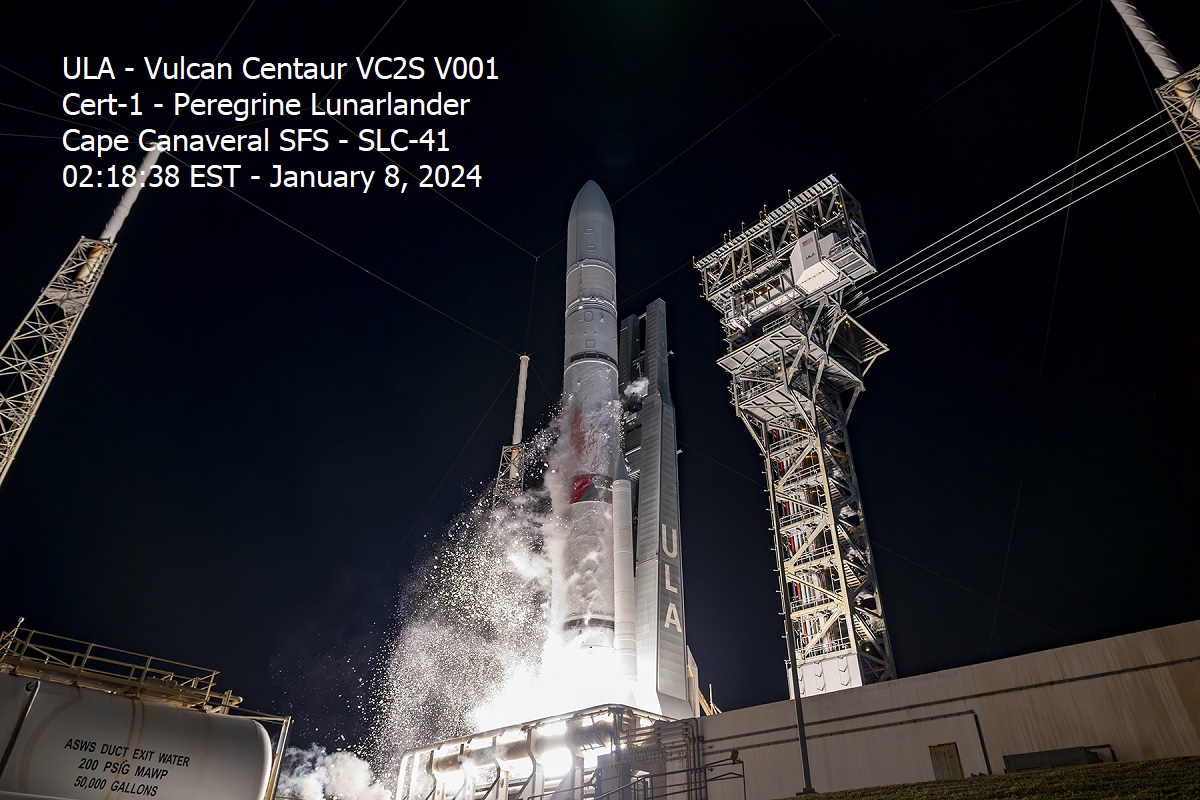
Photo from ULA of the Vulcan launch. I’ll huff. I’ll puff. And I’ll blow your pad away. Just you wait… Mission Rundown: ULA – Vulcan Centaur...