lørdag den 18. november 2017

ULA - Delta II 7920-10 - JPSS-1

Screenshot from ULA Webcast of the JPSS-1 launch. Nasa sure like to keep the lights on

Mission Rundown: ULA - Delta II 7920-10 - JPSS-1

Written: December 13, 2022 

Lift Off Time

November 18, 2017 - 01:47:36 PST - 09:47:36 UTC

Mission Name

JPSS-1

Launch Provider

ULA - United Launch Alliance

Customer

NOAA - National Oceanic Atmospheric Administration

NASA - National Aeronautics and Space Administration

Rocket

Delta II 7920-10C

Launch Location

Space Launch Complex 2W - SLC-2W

Vandenberg Air Force Base, California

Payload

Global Weather Monitoring Satellite ~ NOAA-20

ELaNa 14 with 4 + 1 CubeSats

Payload mass

2 540 kg ~ 5 600 pounds - 3 017 kg is max. payload

Where did the satellite go?

Sun-Synchronous Polar Orbit - 817 km x 821 km x 98,71°

Type of launch system?

Delta II Evolved Expendable Launch Vehicle + 9 SRB’s

The GEM-40 SRB’s fate?

In the Pacific Ocean south of SLC-2W

The first stage landing zone?

Bottom of the Pacific Ocean further downrange

Type of second stage?

Delta AJ10-118K engine - 436 seconds of burn time

Is the 2nd stage derelict?

Yes - Main engine 4th start/cutoff was 41 seconds

New orbit is 80 km x 820 km x 98.71° We’re going down

Type of fairing?

3.0 meter two part carbon composite fairing

This will be the:

378th flight of any type of Delta rockets

53rd Delta II launch for NASA Launch P.

– 123rd flight of all ULA rockets

– 154th flight of a Delta II rocket - D-378

– 29th ULA mission for NASA

– 8th mission for ULA in 2017

Where to watch

Where to read more in depth

NASA/ULA YouTube link provided by Julien Danzer

Want to know or learn more go visit or see Tim Dodd


Launch debriefing

(This did happen)

I just don’t get these holds, but launch time was adjusted to UTC or 09:47:36 Zulu

A two second delay in the video timeline is found at T+8:00 or 09:55:36 UTC because the video shows 41:41

At 1:24:31 MES-2 starts

At 1:48:42 MES-3 starts

ELaNa 14 deployments over Greenland wasn’t shown in detail

L-00:34:38

Host:

T-00:15:00

T-00:04:00

L-00:07:00

T-00:04:00

T 00:00:00

T+00:00:33

T+00:00:48

T+00:01:04

T+00:01:05

T+00:01:26

T+00:01:50

T+00:02:12

T+00:04:25

T+00:04:31

T+00:04:35

T+00:04:41

T+00:10:40

T+00:50:50

T+00:57:26

T+01:15:01

T+01:21:40

T+01:29:41

T+01:51:15

T+01:55:00

T+02:11:29

NASA/ULA live at 01:22 in a planned 15 minute hold

Tory McLendon, Josh Finch, Mike Curie, Patrick Moore

15 minute countdown resumed at 08:13

Planned 10 minute hold at 19:06 - T0 slips 30 second

Final Polling preparing the launch at 26:39

Release -4 minute hold at 29:39

Liftoff at 33:39 - No T+ clock - 09:47:36 UTC

Mach 1 at 34:12 - Speed Mach One 1225,5 km/h

MaxQ at 34:27 - Maximum aerodynamic pressure

SRB first burn out at 34:43 - Delayed released 3 by 3

SRB air ignition at 34:44 - Three GEM-40 lith in flight

SRB first separation at 35:05 - Six GEM-40 spent

SRB second burn out at 35:29 - Delayed 2nd release

SRB second separation at 35:51 - Three GEM-40 spent

BECO at 38:04 - Delta II is empty - Verniers got 8 more

Stage separation at 38:10 - Just losing 95% weight

MES-1 at 38:14 - Delta AJ10-118K engine start up

Fairing separation at 38:20 - Computer graphics on

MECO-1 at 44:21 - Coasting toward Antarctica

MES-2 to SECO-2 - Doing a 24 second insertion burn

ULA show deployment of JPSS at 1:31:07

MES-3 - SECO-3 Doing a 13 second orbit change burn

Deployment of ELaNa 14 in 3-1-1 takes 220 seconds

Wrap up from ULA at 2:03:20

MES-4 - SECO-4 Doing a 41 second deorbit burn

Delta K blowout of remaining gasses and fuel

Delta K deorbits in the South Pacific Ocean


Atlas V 541

NROL-42

Atlas V 421

NROL-52

Delta II 7920-10

JPSS-1

Delta IV M+5,2

NROL-47

Atlas V 411

SBIRS GEO-4

Atlas V 541

GOES-S

Atlas V 551

AFSPC-11

Atlas V 401

Mars Insight

Delta IV Heavy

Parker Solar

Delta II 7420-10

ICESat-2

One launch left on the shelf

United Launch Alliance (ULA) launched – at the third attempt – the second to last Delta II mission on Saturday, November 18, 2017 carrying the JPSS-1 weather satellite on its path to orbit from Vandenberg Air Force Base in California. Liftoff, from Space Launch Complex 2W, occurred during a 62-second window opening at 01:47 Pacific time (09:47 UTC).

The Joint Polar Satellite System (JPSS) is the nation's advanced series of polar-orbiting environmental satellites.

JPSS represents significant technological and scientific advancements in observations used for severe weather prediction and environmental monitoring. These data are critical to the timeliness and accuracy of forecasts three to seven days in advance of a severe weather event. JPSS is a collaborative effort between NOAA and NASA.

JPSS satellites circle the Earth from pole-to-pole and cross the equator 14 times daily in the afternoon orbit--providing full global coverage twice a day.

The JPSS-1 Payload

JPSS-1, which will be renamed NOAA-20 once it is in orbit, is the newest satellite in the US National Oceanic and Atmospheric Administration’s (NOAA’s) fleet of polar-orbit weather satellites. JPSS-1 is the first of four planned Joint Polar Satellite System (JPSS) spacecraft, successors to the organization’s current-generation Polar Operational Environmental Satellite (POES) constellation.

The JPSS program grew out of the canceled National Polar-Orbiting Operational Environmental Satellite System, or NPOESS, which aimed to replace the NOAA’s POES system and the Air Force’s Defense Meteorological Satellite Program (DMSP) with a single fleet of satellites.

The 2,540-kilogram (5,600 lb) JPSS-1 satellite was constructed by Ball Aerospace, and is based around the BCP-2000 satellite bus. Expected to operate for seven years, it carries the same suite of five instruments as Suomi.

Its Visible Infrared Imaging Radiometer Suite (VIIRS), images the Earth at twenty-two visible-light and infrared wavelengths. The data it collects will help scientists to monitor a wide range of phenomena on the Earth’s surface and in the atmosphere.

Clouds and the Earth’s Radiant Energy System (CERES) FM6 is the sixth in a series of instruments designed to measure Earth’s radiation budget: the amount of radiation the planet emits and the amount of sunlight that it reflects.

CERES instruments have previously flown aboard the Terra and Aqua satellites – which carried two each – and Suomi NPP.

Photo of JPSS-1 getting packed for transport to Vandenberg Air Force Base. Strike a pose

Two atmospheric sounders – the Cross-track Infrared Sounder (CrIS) and the Advanced Technology Microwave Sounder (ATMS) – will allow the satellite to build temperature, pressure and humidity profiles of Earth’s atmosphere.

CrIS uses a 1,305-channel Fourier transform spectrometer to take readings at infrared wavelengths, while ATMS has 22 spectral channels and operates at microwave wavelengths. The atmospheric profiles produced by these instruments will aid both weather forecasting and monitoring of changes in the Earth’s climate.

PSS-1’s Ozone Mapping and Profiler Suite (OPMS) consists of two hyperspectral imagers which will be used to monitor the level and distribution of ozone within the upper atmosphere and troposphere.

The instrument will allow NOAA to monitor the recovery of Earth’s ozone layer, as well as helping to forecast ultraviolet radiation levels and to report on air quality.

The ELaNa 14 Share Ride

In addition to JPSS-1, five small satellites were aboard the launch. Four of these were being carried as part of NASA’s Educational Launch of Nanosatellites, or ELaNa, program and the ELaNa XIV mission. ELaNa is a NASA program which provides launch opportunities for mostly university payloads built to the CubeSat standard, a very common specification for nanosatellites.

EagleSat is a single-unit CubeSat which was built by the Embry-Riddle Aeronautical University. The satellite will be used to study how solid-state storage devices are affected by exposure to the radiation environment that spacecraft experience. A GPS receiver aboard the spacecraft will also allow students to track changes in its orbit over time – allowing its orbital decay to be characterized.

Another single-unit CubeSat, MakerSat-0, will study how several polymers used in 3D printing are affected by exposure to space. The satellite is a pathfinder for Northwest Nazarene University’s MakerSat project, which later aims to construct a satellite wholly in space and deploy it from the International Space Station.

Vanderbilt University’s RadFxSat-1 was built in partnership with AMSAT. A single-unit CubeSat, it will be used to investigate how electronic components are affected by radiation in orbit, helping to prove their suitability for future missions and refine their manufacturing processes. The spacecraft also carries an amateur radio transponder for AMSAT, who uses the name Fox-1B for the satellite.

The last of the ELaNa 14 CubeSats is, Microwave Radiometer Technology Acceleration, or MiRaTA, was a 5.5-kilogram (12.1 lb), three-unit CubeSat built by the Lincoln Laboratory at the Massachusetts Institute of Technology (MIT).

The satellite carries an ultra-compact microwave radiometer to be tested in orbit, as well as an experimental GPS receiver which will be used to help study the occultation of GPS signals as they pass through the atmosphere – which allows atmospheric conditions to be inferred from how the signals are affected.

MiRaTA will also demonstrate how the measurements from its GPS receiver can be used to calibrate the radiometer.

The final CubeSat aboard the launch is not part of the ELaNa program. The Buccaneer Risk Mitigation Mission (Buccaneer RRM) satellite is a three-unit CubeSat being flown in partnership between the University of New South Wales and the Australian Department of Defence’s Defence Science and Technology Group (DSTG).

The satellite is a prototype, being launched ahead of another satellite – Buccaneer – which will be used to help calibrate Australia’s Jindalee Operational Radar Network (JORN).

The Delta II Rocket Launch

Delta 378 ignited its RS-27A main engine and both verniers at T-2.7 seconds before the countdown reached T0 . At T0, six of the nine GEM-40 solid rocket motors ignited, and Delta lifted off to begin the journey into orbit.

With its six ground-lit solids burning Delta climbed quickly away from Vandenberg, reaching a speed of Mach 1 32.9 seconds after liftoff and passing through the area of maximum dynamic pressure – or max-Q – 14.9 seconds later.

The six solid motors burned for about 64 seconds. The remaining three GEM-40 motors were air-lit and also burned for 64 seconds, igniting about one and a half seconds after the ground-lit solids burned out. The ground-lit solid motors jettisoned about 86 seconds into the flight, with the air-lit motors separating at the 131.5-second mark.

After the solids separate, Delta’s RS-27A engine continued to burn until four minutes, 23.4 seconds after liftoff, when it shut down. This event is designated main engine cutoff, or MECO, and followed shortly afterward by vernier engine cutoff, or VECO. Eight seconds after MECO the first stage was jettisoned, with the second stage’s AJ10 engine ignited five and a half seconds after stage separation, beginning the first of four planned burns.

The first burn of the Delta-K second stage lasted six minutes and 1.3 seconds. About 4.1 seconds into the burn Delta’s payload fairing separated from around JPSS-1 at the nose of the rocket. The first burn established an initial parking orbit, and was followed by a 40-minute, 11.8-second coast phase before the second burn began.

Lasting twenty-four seconds, Delta-K’s second burn circularized the orbit for the primary payload, JPSS-1. Six minutes and 16 seconds after the end of the burn, JPSS-1 separated into its operational orbit.

The target parameters for this launch are a semi-major axis of 7,201.1 kilometers (4,474.6 miles, 3,888.3 nautical miles) and eccentricity of 0.001 – giving an orbit of 822.9 by 837.3 kilometers (511.3 x 520.3 miles, 444.3 x 452.1 nautical miles). This orbit will be inclined at 98.7 degrees, with an argument of perigee of 69.2 degrees.

Separation of the primary payload isn’t the end of this flight, 17 minutes 30 seconds after spacecraft separation, the Delta-K made its third burn – lasting 10.2 seconds – to adjust its orbit for deployment of the five CubeSats.

The three single-unit CubeSats were released six minutes and 29.8 seconds after the end of the burn, with the first of the three-unit satellites separating 120 seconds later and the other and 100 seconds after that.

The fourth and final burn of the Delta-K – beginning 29 minutes and 25 seconds after the last CubeSat deployment lasted 41 seconds – deorbited the upper Delta-K stage to a safe, destructive, reentry in the Ocean.

The Delta II rocket

For this mission, Delta II flew in the 7920-10C configuration.

Delta was one of the first rockets to adopt a systemic numbering system for different configurations, with the first digit denoting the type of first stage and boosters, the second digit giving the number of solid rocket boosters, the third digit representing the type of second stage and the fourth indicating the type of third stage, if one is present.

The final part of the designation gives the type of payload fairing being used, with the 10C fairing a three-meter (ten-foot) carbon composite model.

Delta II loads 10 000 gallon RP-1 - kerosene and LOX - liquid oxygen into its first stage propellant tanks which will feed the RS-27A rocket engine to generate 789 000 pounds of thrust to lift Delta II with JPSS-1 into low earth polar orbit.

The “7000-series” Delta II uses an Extra-Extended Long Tank Thor (XELTT) first stage, with three, four or nine Graphite Epoxy Motor 40 (GEM-40) solid rocket motors.

The launch was the last time Delta flew with nine solid rocket motors – the family’s most common booster configuration since the 1970s.

SRB 6, 4 and 5 are fitted with a larger nozzle given that they will perform better in altitude using those nozzles. The SRB’s no. 2 8 6 3 9 4 1 7 5 are mounted in this order on the main core booster of Delta II. That order can’t be the ignition order since 6, 4 and 5 are in the middle grouping. 7, 8 and 9 would be a natural launch order in that chase.

The XELTT, which is descended from the Thor IRBM, is powered by an RS-27A engine. Two additional Vernier motors help to steer the rocket during first stage flight.

Delta II’s second stage is a Delta-K, powered by an AJ10-118K engine, while in the 7920 configuration no third stage is present.

Both the first and second stages are liquid-fuelled, with the first stage burning RP-1 propellant oxidized by liquid oxygen and the second stage Aerozine 50 – a mixture in equal parts of hydrazine and unsymmetrical dimethylhydrazine – and dinitrogen tetroxide.

NasaSpaceFlight: Chris Bergin link

Gunter’s Space Page: Details link

Coauthor/Text Retriever Johnny Nielsen

link to ULA launch list - Link to ULA Fan


lørdag den 14. oktober 2017

ULA - Atlas V 421 - NROL-52

Screenshot from ULA Webcast of the launch of NROL-52. Note the green poll from mission control

Mission Rundown: ULA - Atlas V 421 - NROL-52

Written: December 14, 2022 

Lift Off Time

October 15, 2017 - 03:28:00 EDT - 07:28:00 UTC

Mission Name

NROL-52

Launch Provider

ULA - United Launch Alliance

Customer

NRO - National Reconnaissance Office

Rocket

Atlas V 421

Launch Location

Space Launch Complex 41 - SLC-41

Cape Canaveral Space Force Station, Florida

Payload

Military Communication Satellite - USA-278

Payload mass

7 000 kg ~ 15 400 pound - Maximum GTO payload

Where did the satellite go?

Geostationary Transfer Orbit  - 1 800 - 35 000 km x 18,7° 

Type of launch system?

Atlas Evolved Expendable Launch Vehicle + 2 SRB’s

The AJ-60A SRB’s fate?

In the Atlantic Ocean due east of SLC-41

The first stage landing zone?

Bottom of the Atlantic Ocean 2 500 km downrange

Type of second stage?

Centaur RL-10C-1 engine - 16m 24s burn time

Is the 2nd stage derelict?

Yes - Engine 3rd start/cutoff was evident at 08:33 UTC

Deorbit is -288 km x 28 046 km x 18.9° 

Type of fairing?

4.2 meter two part metallic fairing

This will be the:

– 122nd flight of all ULA rockets

– 74th flight of an Atlas V rocket - Tail no. AV-075

– 26th ULA mission for NRO

– 7th mission for ULA in 2017

Where to watch

Where to read more in detail

ULA YouTube link

Want to know or learn more go visit or see Tim Dodd


Launch debriefing

(This did happen)

Computer graphics are delayed 10 seconds to announcers callouts

The flight data is correct but just not to the video timeline - engine start and stop times will be accurate enough but just delayed in the video

L-00:26:46

Host:

L-00:07:00

T-00:04:00

T 00:00:00

T+00:00:49

T+00:00:59

T+00:01:36

T+00:02:09

T+00:04:10

T+00:04:16

T+00:04:26

T+00:04:34

T+00:05:16

T+00:15:39

T+00:16:29

T+00:31:05

T+00:42:47

T+00:43:20

T+01:19:27

ULA live feed at 07:00 - 15 minute hold at 07:46

Anton Kolomiets, Marty Malinovski

Final Polling preparing the launch at 19:46

Release -4 minute hold at 22:46

Liftoff at 26:46 - No T+ clock - 03:28:00 UTC

Mach 1 at 27:35 - Speed Mach One 1225,5 km/h

MaxQ at 27:45 - Maximum aerodynamic pressure

SRB burn out at 28:24 - Delayed release of them

SRB separation at 28:55 - Two AJ-60A spent

BECO at 30:56 - Atlas V booster is empty

Stage separation at 31:02 - Just losing 95% weight

MES-1 at 30:10 - Centaur RL-10C-1 engine start

Fairing separation at 31:18 - Computer graphics on

Wrap up from ULA at 32:00 - Media blackout

MECO-1 at 53:14 - Coasting toward Africa

MES-2 to SECO-2 in 329 second doing a GTO burn

ULA doesn’t show deployment of NROL-52

MES-3 - SECO-3 in a 46 second deorbit burn

Centaur blowout of remaining gasses and fuel

Centaur takes a 44 G dive 750 km south of Hawaii


Atlas V 541

NROL-42

Atlas V 421

NROL-52

Delta II 7920-10

JPSS-1

Delta IV M+5,2

NROL-47

Atlas V 411

SBIRS GEO-4

Atlas V 541

GOES-S

Atlas V 551

AFSPC-11

Atlas V 401

Mars Insight

Delta IV Heavy

Parker Solar

Delta II 7420-10

ICESat-2

Telephone exchange in the Sky

United Launch Alliance’s clandestine Atlas V launch in support of NRO the US National Reconnaissance Office finally departed SLC-41 on Sunday, after previously failing to dodge bad weather and then suffering a telemetry transmitter issue. Liftoff of NROL-52 from the Cape Canaveral Air Force Station occurred on October 15, 2017 at 07:28 EDT.

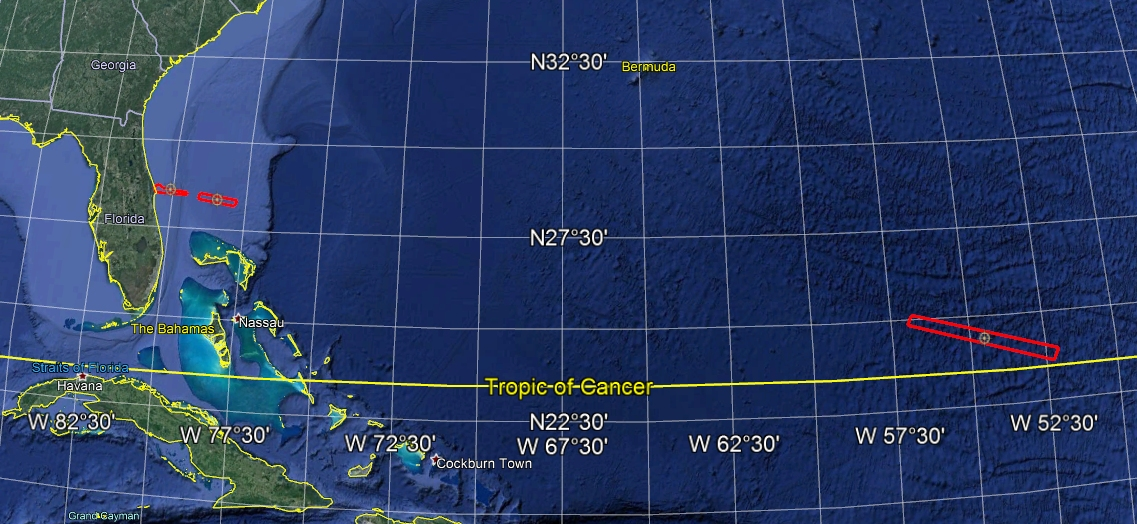
Notam: NROL-52 will drop of two SRB’s, two fairings and its first stage booster in the red zones

The launch – which is only broadcast to fairing jettison – is carrying out the NROL-52 mission for the National Reconnaissance Office (NRO), deploying an unspecified payload into Earth orbit. The sixth flight of Atlas this year, this launch followed the successful deployment of the NROL-42 mission – whose payload is now designated USA-278 – from Vandenberg Air Force Base in late September.

The NROL-52 Payload

NROL-52 is a classified mission being conducted in the interests of national security. Despite this secrecy, experts and amateur observers are often able to identify different classes of spacecraft, track the satellites in orbit and make deductions about their missions and some of their capabilities.

The use of the more powerful Atlas V 421 over the Atlas V 401 for the NROL-61 and NROL-52 launches suggests a new fourth-generation satellite that is heavier than its predecessors, while the use of the extra-extended fairing instead of the Long Payload Fairing that was used for third-generation Quasars, indicates that the new spacecraft are also physically larger or carry bigger antennae.

Satellite Data System (SDS) ‘Quasar’ spacecrafts are communication relay satellites for transmitting real-time data from US reconnaissance satellites (e.g. KH-11, Onyx, Topaz). They are also used for communications to USAF aircraft and connect the various ground stations of the Air Force Satellite Control Network (AFSCN). The spacecraft relayed the downlinked data to a ground station at Fort Belvoir, Virginia.

These satellites are the fourth generation of the system, the SDS-4, which appears to use only the geostationary orbit and no longer the earlier highly elliptical Molniya orbits.

Quasar 21 is the second satellite launched of this class of communication satellites.

The Atlas V 421 Launch

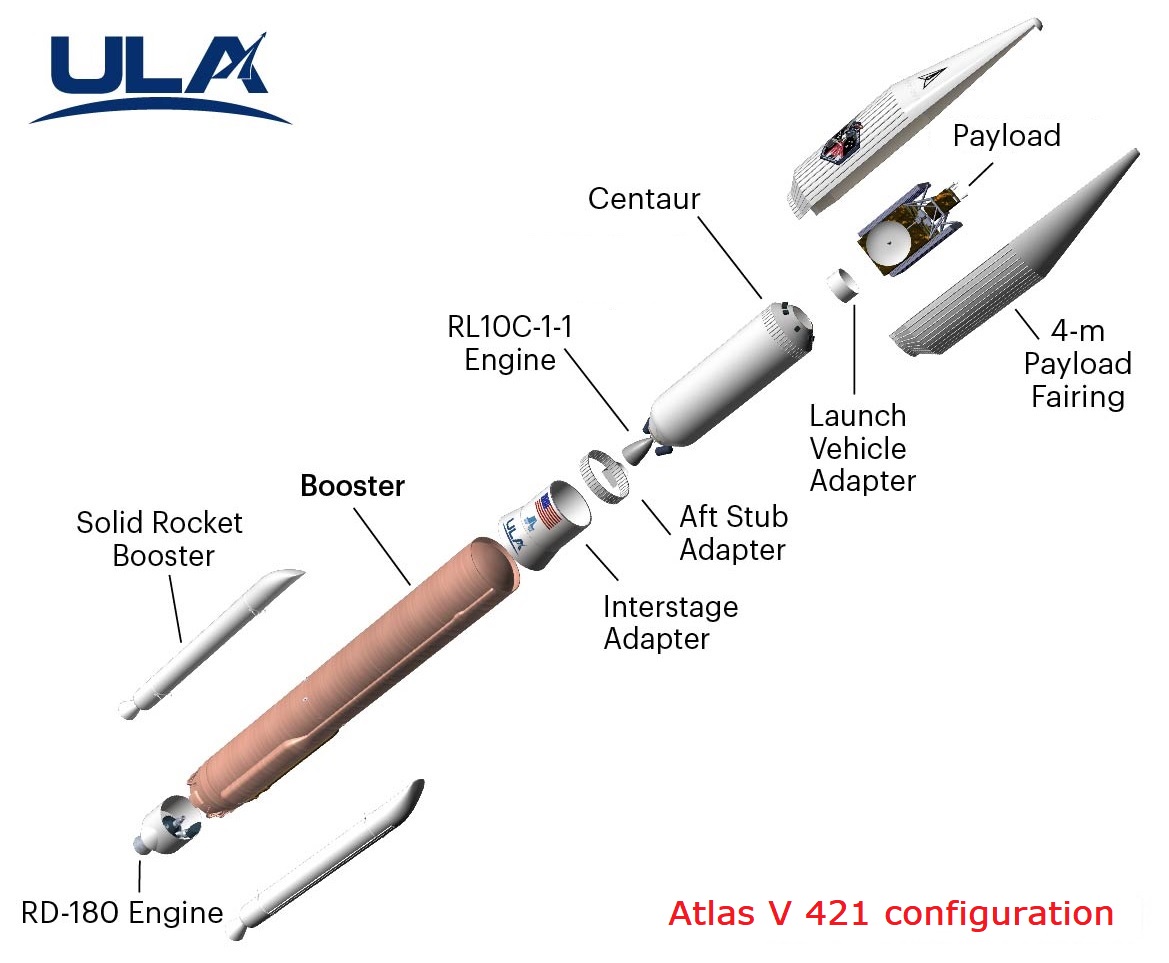
The Atlas V that launched NROL-52 had tail number AV-075. Flying in the 421 configuration it consists of a Common Core Booster (CCB) first stage, two Aerojet Rocketdyne AJ-60A solid rocket motors, a single-engine Centaur upper stage and the four by fourteen meter Extra-Extended Payload Fairing (XEPF).

The Common Core Booster burns RP-1 kerosene propellant, oxidized by liquid oxygen. Centaur burns liquid hydrogen and liquid oxygen.

About 2.7 seconds before Atlas’ launch time the first stage’s single RD-180 engine ignited.

Ignition of the solid rocket motors and liftoff of the rocket followed at about 1.1 seconds after the zero mark in the countdown. AV-075 lifted off from SLC-41 and began her ascent towards orbit, beginning a series of pitch, roll and yaw maneuvers to attain the planned launch trajectory shortly after liftoff.

About 47 seconds into the flight Atlas reached Mach 1 – the speed of sound – passing through the area of maximum dynamic pressure – or Max-Q – five seconds later.

The boosters burned for the first 91 seconds of flight before depleting their propellant and burning out. The spent motors jettisoned 38 seconds later, two minutes and nine seconds into the flight.

Following burnout of the boosters, the CCB’s RD-180 engine continued to power Atlas towards orbit. RD-180 cutoff came four minutes and ten seconds after liftoff, with the Common Core Booster separating six seconds later.

Ten seconds after stage separation, Centaur ignited its RL10C-1 engine to begin its first burn of the mission. Eight seconds later the payload fairing separated from the nose of the rocket. At this point, official coverage of the mission entered a news blackout, except for confirmation of a successful launch following spacecraft separation.

Centaur will likely make two burns prior to spacecraft separation, with its first lasting about eleven minutes to establish an initial parking orbit. Following a coast of about ten minutes, Centaur will restart its engine for a second burn of about four minutes to reach geostationary transfer orbit.

Shortly after this burn concludes, the NROL-52 payload will separate from Centaur. The deployment orbit is expected to be around 1,100 by 35,800 kilometers (680 by 22,200 miles, 590 by 19,300 nautical miles), with inclination of about 18.7 degrees.

From this transfer orbit NROL-52 will under its own power raise itself into a full circular geostationary orbit, where it will join its ‘brothers in arms’.

Following spacecraft separation, Centaur will make a further burn at 08:33 UTC to deorbit itself, with reentry expected to occur over the Pacific Ocean, to the south of Hawaii.

The white rectangle is the NOTAM hazard zone. Hawaii is just visible on the horizon, 750 km to the north. The re-entry impact zone was an approximately 160 x 600 km rectangular region, centered near 11.87 N, 154.63 W.

The depicted re-entry trajectory begins at about 1000 km altitude. The alternating red and white line segments span 5 seconds of flight.

The TLE propagated to theoretical impact within the NOTAM boundaries, near 11.92 N, 155.62 W, at about 15:57 UTC - 12 min. after the start of the NOTAM period.

The Centaur reached a maximum velocity of nearly 10.2 km/s inertia (not far below escape velocity), 9.7 km/s relative to the atmosphere. Maximum deceleration of about 44 G occurred at about 49 km altitude. Nearly all horizontal velocity had been lost by 30 km altitude, following which any surviving debris would have fallen almost vertically.

The final vertical descent is clearly depicted in the above graphic.

The Atlas V 421 rocket

The Atlas V is an expendable medium lift launch system and member of the Atlas rocket family. The rocket is one of the most reliable in the world, having more than 76 launches with no complete failures.

The Atlas V 421 rocket, tail no. AV-075 is standing 59.1 meters - 194 feet tall on SLC-41.

The rocket has two stages. The first is a Common Core Booster (CCB), which is powered by an RD-180 engine with two bells and burns kerosene (RP-1) and liquid oxygen (LOX). This is accompanied by up to five strap-on solid rocket boosters. The second stage is the Centaur upper stage, which is powered by one or two RL10 engines and burns liquid hydrogen (LH2) and liquid oxygen (LOX).

Atlas V rocket is filled with 344 472 liter - 91 000 gallons of RP-1, liquid oxygen and liquid hydrogen. Question is now how much goes to fill each stage and the four tanks. Together they can contain 344,47 m3 RP-1, cryogenic oxygen and cryogenic hydrogen.

Atlas V 421 split in its major parts. This is a generic non mission specific graphic configuration

The Common Core Booster holds 184 728 liter - 48 800 gallon liquid oxygen chilled to below -182,96 0C Celsius or -297,33 0F Fahrenheit that can fit in a 184,73 m3 oxygen tank.

The Common Core Booster holds 94 635 liter - 25 000 gallon RP-1 highly refined kerosine at room temperature that can fit in a 94,64 m3 fuel tank.

The Centaur upper stage holds about 49 400 liter - 13 050 gallons of liquid hydrogen chilled to -252,8 0C Celsius or -423 0F Fahrenheit that can fit in a 49,40 m3 hydrogen tank.

The Centaur upper stage holds about 15 709 liter - 4 150 gallons of liquid oxygen chilled to below -182,96 0C Celsius or -297,33 0F Fahrenheit that can fit in a 15,71 m3 fuel tank.

Still to find is data on Helium gas, pressures used and number of COPV to store it. And are there tanks to store propellant used to maneuver during ascent and in orbit.

HAZ GAS operations are completed when the hydrazine is loaded. The RCS thrusters on the Centaur stage are using hydrazine as a monopropellant during orbit insertion.

The reaction control system (RCS) includes the ullage pressure thrust from the tanks and consists of twenty hydrazine monopropellant engines located around the stage in two 2-thruster pods and four 4-thruster pods. For propellant, 150 kg (340 lb) of Hydrazine is stored in a pair of bladder tanks and fed to the RCS engines with pressurized helium gas, which is also used to accomplish some main engine start up functions.

In the 421 configuration, the Atlas V is capable of carrying up to 14,067 kg to Low Earth Orbit (LEO), and 6,890 kg to Geostationary Transfer Orbit (GTO).

The Atlas V 421 rocket has a three number configuration code.

The first number represents the fairing diameter size in 4 or 5 meters, so in this instance there is a 4 meter fairing. This launch will use the 14-meter-long (46 ft) XEPF.

The standard four-meter fairing, named the Long Payload Fairing (LPF), measures 12.2 meters (40 feet) in length and was first introduced as an optional larger fairing for the Atlas I rocket in 1990.

One or two 90-centimeter (3-foot) cylindrical segments can be added to the fairing to form an Extended Payload Fairing (EPF - 43 feet tall) or Extra-Extended Payload Fairing (XEPF - 46 feet tall) respectively for payloads that require a little additional space.

The second number denotes the number of solid rocket boosters (SRBs), which attach to the base of the rocket. The number of SRBs for a 4 meter fairing can range from 0 – 3. In this case there will be 2 SRBs attached to the center core.

The third number shows the number of engines on the Centaur Upper Stage, which is 1 in this configuration. So this means that this rocket will have a 4 meter faring, 2 solid rocket boosters, and 1 engine bell on the Centaur Upper Stage.

NasaSpaceFlight: William Graham link

Gunter’s Space Page: Details link

Coauthor/Text Retriever Johnny Nielsen

link to ULA launch list - Link to ULA Fan


ULA – Vulcan – Peregrine Lunar Lander

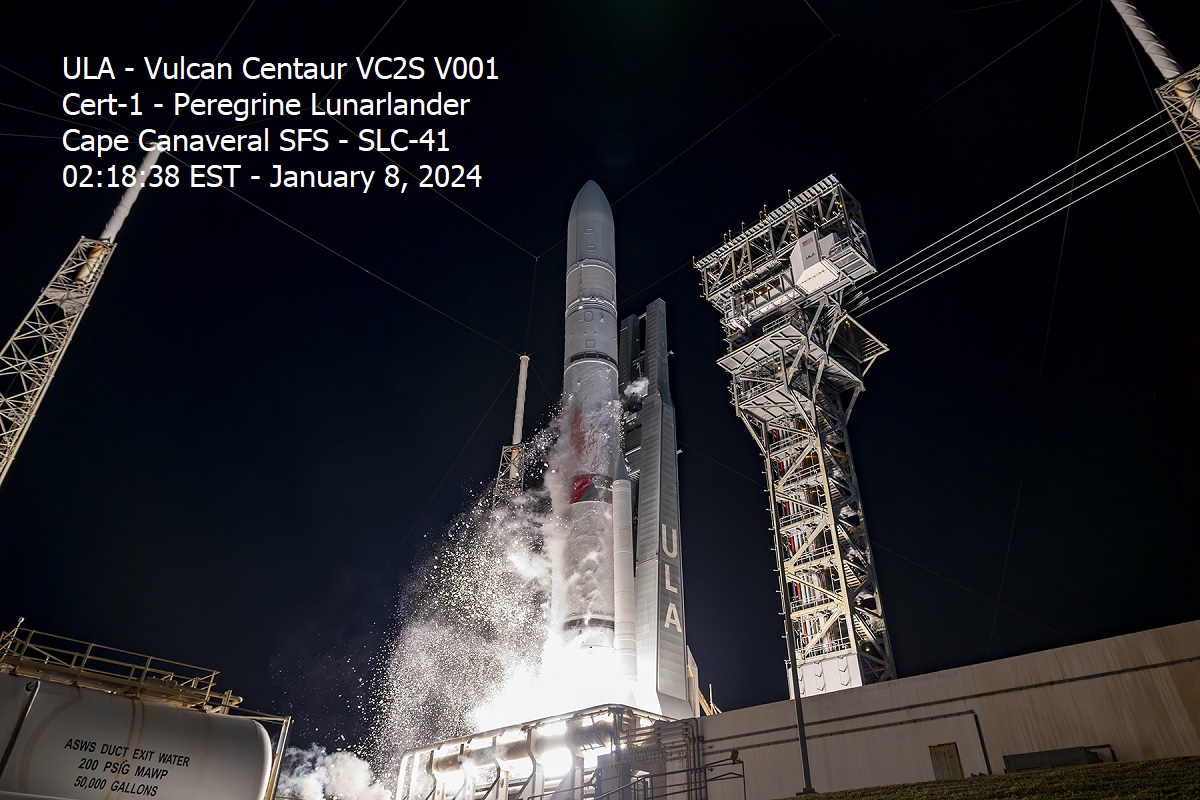
Photo from ULA of the Vulcan launch. I’ll huff. I’ll puff. And I’ll blow your pad away. Just you wait… Mission Rundown: ULA – Vulcan Centaur...