lørdag den 14. april 2018

ULA - Atlas V 551 - AFSPC-11

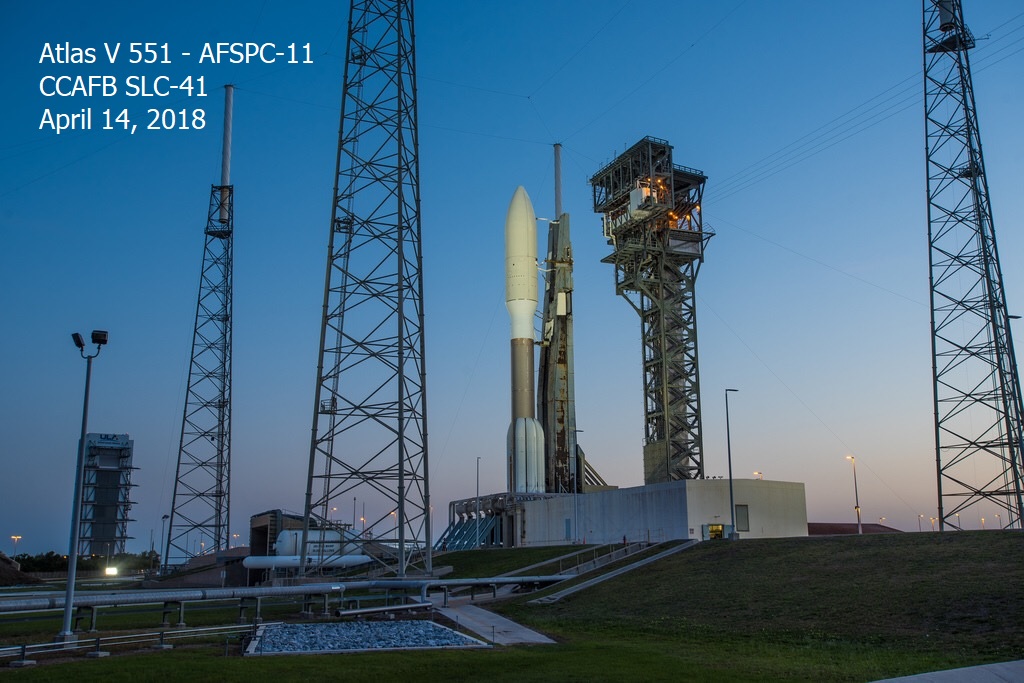
Photo from ULA prior to launch of AFSPC-11. Standing tall among four lightning towers - Wow

Mission Rundown: ULA - Atlas V 551 - AFSPC-11

Written: December 2, 2022

Lift Off Time

April 14, 2018 - 19:13:00 EDT - 23:13:00 UTC

Mission Name

AFSPC-11

Launch Provider

ULA - United Launch Alliance

Customer

US Air Force Military Communication Directorate

Rocket

Atlas V 551

Launch Location

Space Launch Complex 41 - SLC-41

Cape Canaveral Space Force Station, Florida

Payload

CBAS Geostationary Communication Satellite

EAGLE experimental ESPA Payload Host - 600 kg

Payload mass

3 850 kg ~ 8 488 pounds - Maximum GEO payload

Where did the satellites go?

GEO - 35 185 km - 35 288 km x 0,01°

Type of launch system?

Atlas Evolved Expendable Launch Vehicle + 5 SRB’s

The AJ-60A SRB’s fate?

In the Atlantic Ocean due east of SLC-41

The first stage landing zone?

Bottom of the Atlantic Ocean 2600 km downrange

Type of second stage?

Centaur RL-10C-1 engine - 14m 26s burn time

Is the 2nd stage derelict?

Yes - Main engine 4th start/cutoff was a few seconds

New orbit is 32 000 km x 35 344 km x 0.17° 

Type of fairings?

5.4 meter two part composite carbon fiber fairing

This will be the:

– 127th flight of all ULA rockets

– 77th flight of all Atlas V rockets - AV-079

– 8th flight of Atlas V in a 551 configuration 

– 49th ULA mission for the US Air Force

– 4th mission for ULA in 2018

Where to watch

Where to read more

ULA YouTube link

Want to know or learn more go visit or see Tim Dodd


Launch debriefing

(This did happen)

Being a defense mission the video feed ends after fairing jettison. Sorry

Only times noted in bold text are evident in the video feed. The rest is unseen planned events

Centaur blowout of remaining gasses and fuel is unknown

The Eagle ESPA is what all derelict parts of spacecrafts should be carrying into orbit

A passive pack of solar powered instruments keeping an eye on things changing in space

If nothing else a beacon

L-00:19:38

Host:

L-00:19:00

L-00:07:00

T-00:04:00

T 00:00:00

T+00:00:34

T+00:00:46

T+00:01:31

T+00:01:46

T+00:03:29

T+00:04:33

T+00:04:39

T+00:04:50

T+00:08:33

T+00:10:51

T+00:22:58

T+00:28:46

T+05:34:46

T+05:37:23

T+06:57:23

T+06:57:24

T+06:57:24

ULA live feed at 01:20

Tyler Strickland, Patrick Moore

Planned 15 minute hold at 01:57

Final Polling preparing the launch at 14:00

Release -4 minute hold at 16:58

Liftoff at 20:59 - No T+ clock - 23:13:00 UTC

Mach 1 at 21:33 - Speed Mach One 1225,5 km/h

MaxQ at 21:45 - Maximum aerodynamic pressure

SRB burn out at 22:30 - Small thrusts or coughing

SRB separation at 22:45 - First 2 then 3 drop of 

Fairing separation at 24:30 - Ice breaks of fairings

BECO 25:33 - Audio - Atlas V core booster is empty

Stage separation 25:40 - Just losing 95% weight

MES-1 at 25:51 - 361 second burn time expected

Wrap up from ULA at 29:34

MECO-1 - Centaur coasting in Low Earth Orbit

MES-2 and MECO-2 in 348 seconds gave a velocity boost from 26 477 km/h to 36 136 km/h? - to T+28:46

MES-3 - MECO-3 in 156 seconds circulizes the orbit

CBAS deployment window opens up

EAGLE deployment window closes down

Centaur blowout of remaining gasses and fuel

Mission closes - Centaur is derelict below GEO


Atlas V 541

GOES-S

Atlas V 551

AFSPC-11

Atlas V 411

Mars Insight

Delta IV Heavy

Parker Solar

Delta II 7420-10

ICESat-2

Atlas V 551

AEHF-4

Delta IV Heavy

NROL-71

Delta IV M+5,4

WGS-10

Atlas V 551

AEHF-5

Delta IV M+4,2

GPS III SV02

It’s an Air Force radio thingy

United Launch Alliance’s Atlas V 551 rocket launched the AFSPC-11 mission for the United States Air Force on Saturday, April 14, 2018 deploying the CBAS communications satellite and EAGLE technology demonstrator. Liftoff occurred without problems the first time asking for a 19:13 EDT - Eastern Daylight savings Time - 23:13 UTC liftoff.

Saturday’s launch from SLC-41 involved Atlas undertaking a lengthy mission to inject its payloads directly into near-geostationary orbit, 35,786 kilometers (22,236 miles, 19,323 nautical miles) above the equator.

The Air Force Space Command 11 (AFPSC-11) payload consists of two satellites which will separate from their carrier rocket over five-and-a-half hours after liftoff.

The AFSPC-11 Payloads

The primary payload for the AFSPC-11 mission is the Continuous Broadcast Augmenting SATCOM (CBAS) satellite. Few details of the CBAS mission have been made public. However, the spacecraft is known to be coordinated by the US Air Force’s Military Satellite Communications Directorate, who also manage the operational Wideband Global Satcom (WGS) and Advanced Extremely High Frequency (AEHF) communications programmes.

CBAS will serve as a communications relay for senior military commanders and augment the United States’ existing military satellite communications architecture.

CBAS was flying in the upper position for Saturday’s dual-satellite launch. The Air Force Research Laboratory’s ESPA-Augmented Geostationary Laboratory Experiment (EAGLE) satellite was mounted below it.

EAGLE has been built on an EELV Secondary Payload Adaptor (ESPA), which incorporates the separation mechanism for CBAS. This allows the two satellites to be stacked directly atop each other without the need for an additional payload adaptor.

EAGLE was developed by Orbital ATK and hosts an array of technology demonstration payloads. The satellite is based on Orbital’s ESPAStar platform, which adds propulsion, power-generation and flight systems to an ESPA payload adaptor ring with six payload ports on its side, turning it into a free-flying satellite.
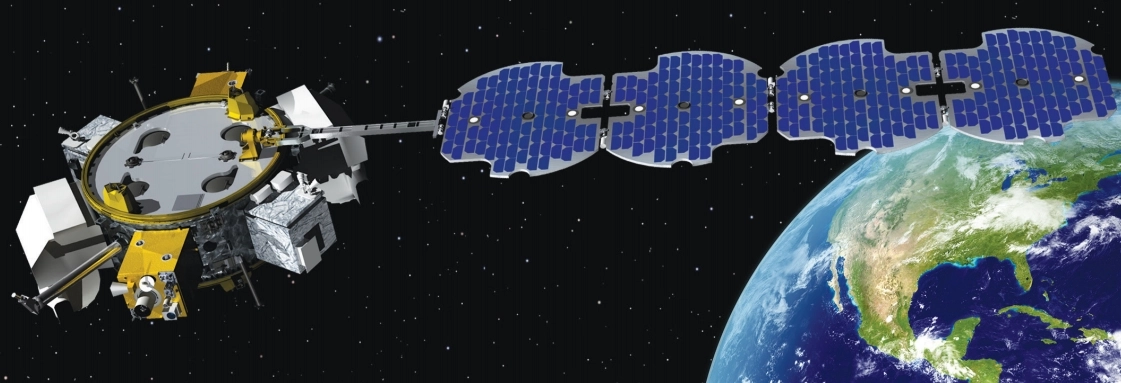
Graphic by Orbital ATK of EAGLE in orbit. Six ports. BUS in the middle. CBAS release ring on edge

The core ESPAStar spacecraft has a dry mass of 430 to 470 kilograms (950 to 1,040 pounds), with a hydrazine-based monopropellant propulsion system mounted inside the payload adaptor ring ‘Bus’ with up to 310 kilograms (680 lb) of fuel.

The platform is three-axis stabilized and provides power via a 96 amp-hour battery and a deployable solar array, which will generate 1.2 kilowatts of power at the beginning of the satellite’s operational life.

On the outside of the ESPAStar platform’s adaptor ring, six hardpoints are available to mount payloads. Each hardpoint can accommodate a 181-kilogram payload (400-pound), either fixed to the satellite or a deployable subsatellite. EAGLE is the first mission to test the ESPASat bus, which is optimized for geostationary missions but can also be used in other orbits.

EAGLE is a partnership between the AFRL and the Space Test Program (STP). It is carrying four fixed experiments and a deployable subsatellite.

The fixed experiment packages are the AFRL-1201 Resilient Spacecraft Bus Development Experiment (ARMOR), Compact Environmental Anomaly Sensor III Risk Reduction (CEASE-III-RR), Hypertemporal Imaging Space Experiment (HTI-SpX) and the Inverse Synthetic Aperture LADAR (ISAL). These experiments are primarily geared towards developing space situational awareness and satellite inspection capabilities.

A subsatellite, Mycroft, will be deployed from EAGLE at an unspecified future date. Mycroft is based around Orbital ATK’s ESPASat platform, designed specifically for deployment from the ESPA.

Mycroft has a design life of three years. Measuring 56.6 by 56.6 by 70.0 centimeters (22.3 by 22.3 by 27.4 inches) before payload installation the bus has a dry mass of 70 kilograms (150 lb). It can carry up to 22.7 kilograms (50.0 lb) of hydrazine propellant and a secret military 30 kilograms (66 lb) hosted payload.

The ESPASat platform provides three-axis control with six degrees of freedom via reaction wheels and attitude control thrusters. It incorporates a 24 amp-hour lithium ion battery with a solar panel generating up to 265 watts of power.


The AtLas V 551 Launch

AFSPC-11 was launched by United Launch Alliance’s workhorse Atlas V rocket, flying in its 551 configuration. The rocket had tail number AV-079 and the seventy-seventh flight of an Atlas V. One of the most reliable rockets in service worldwide, Atlas V has never lost a mission – the only blemish on its record was a partial failure back in 2007 that left a pair of NRO ocean surveillance satellites in an incorrect orbit.
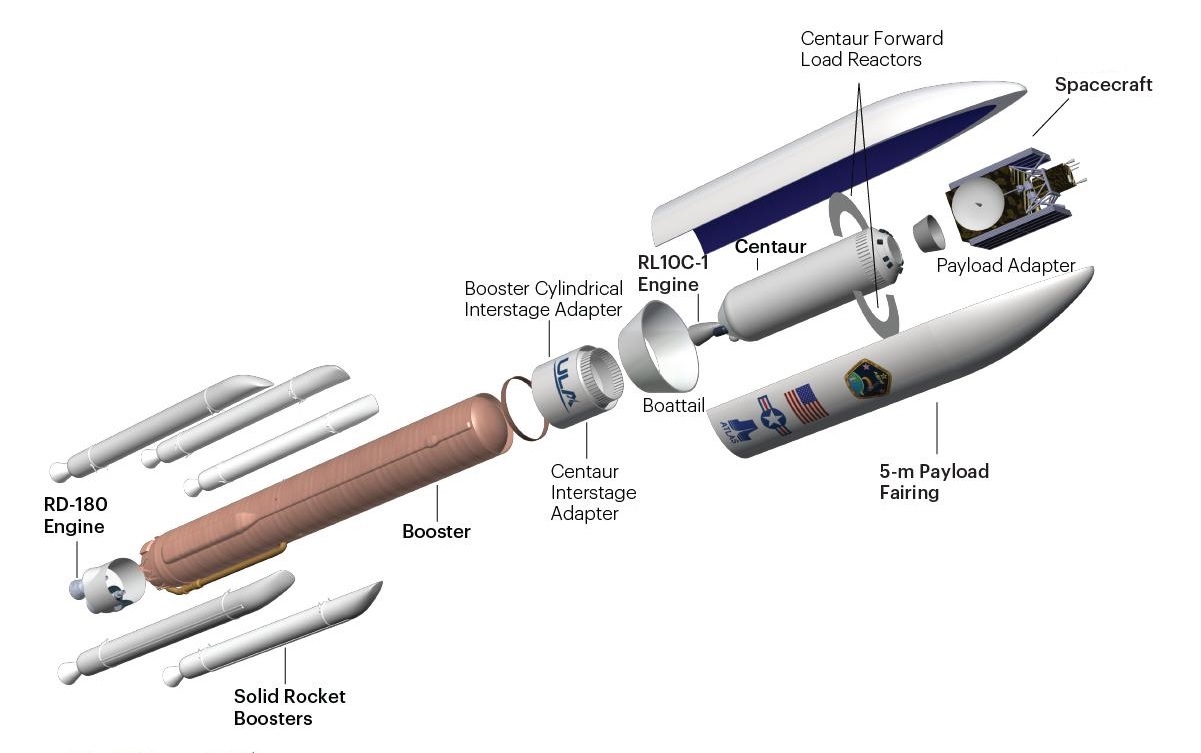
Graphic of Atlas V 551 in its major parts. Five SRB’s, main booster, Centaur 2nd stage and CBAS

Atlas V is a two-stage rocket, consisting of a Common Core Booster (CCB) first stage and a Centaur upper stage. The rocket is able to fly in many different configurations – varying the size of its payload fairing, the number of engines on the Centaur stage and the number of solid rocket boosters clustered around the CCB – depending on different payloads.

The 551 configuration used for Saturday’s launch is the most powerful version to have been developed. A more powerful version of the rocket, Atlas V Heavy, would have used two additional CCB’s strapped to either side of the central core, however this never left the drawing board.

Atlas V used a five-meter (16-foot) diameter payload fairing, five solid rocket motors and a single-engine Centaur (SEC) upper stage. Three different lengths of five-meter fairing can be used on Atlas 5 missions – with the AFSPC mission using the shortest of the three. Built by Swiss firm RUAG, the fairing measures 20.7 meters (68 feet) in length and encapsulates Centaur as well as the payload.

The AFSPC-11 launch took place from Space Launch Complex 41 (SLC-41) at the Cape Canaveral Air Force Station.
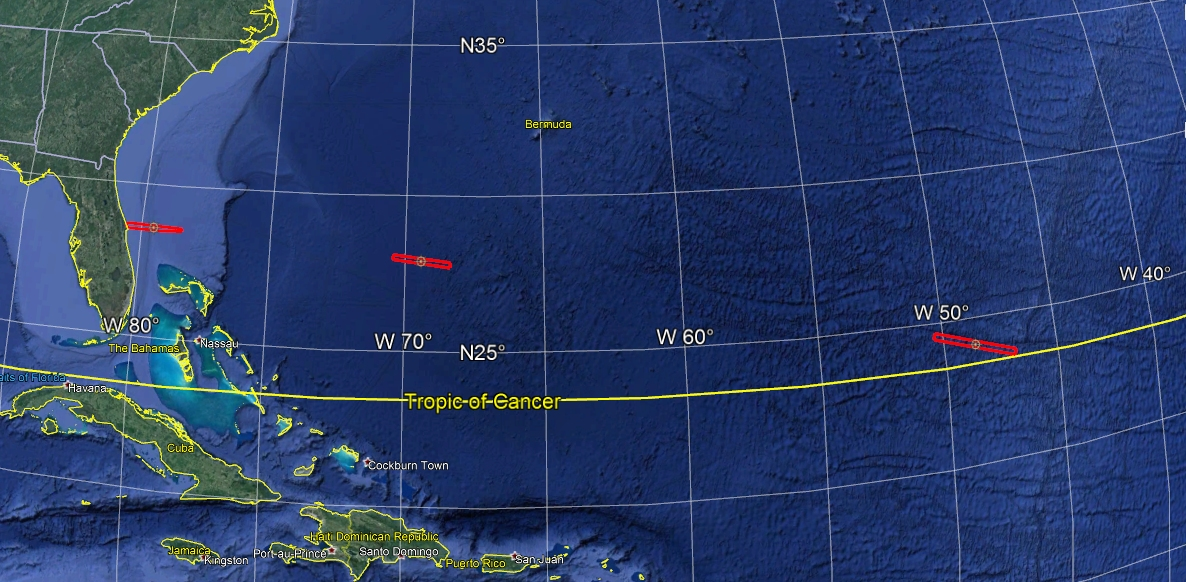
Landing zones for Atlas V 551 spent parts: Five SRB’s, two fairing halves and a main core booster

Saturday’s mission began with ignition of the Atlas Common Core Booster’s RD-180 engine, 2.7 seconds before the countdown reached zero. Built by Russia’s NPO Energomash, the RD-180 is derived from the RD-170 family of engines originally developed for the Soviet Union’s Zenit and Energia rockets. A single engine with two combustion chambers and two nozzles, the RD-180 burns RP-1 propellant – rocket-grade kerosene – oxidized by liquid oxygen. Five Aerojet Rocketdyne AJ-60A solid rocket motors will augment the CCB at liftoff, igniting about T+1.1 seconds as the rocket lifts off.

Climbing away from Cape Canaveral, AV-079 began a series of pitch and yaw maneuvers 3.9 seconds into its mission, placing the rocket onto an 89.9-degree azimuth – almost due East – for the journey into orbit. Atlas reached Mach 1, the speed of sound, 34.4 seconds after liftoff, passing through the area of maximum dynamic pressure – Max-Q – eleven-and-a-half seconds later.

The AJ-60A boosters burned for a little over ninety seconds before their thrust tails off and the boosters burned out. Two of the boosters jettisoned 107 seconds into the flight, with the remaining three separating a second and a half later.

The RD-180 engine continued to burn as Atlas climb’s out of the atmosphere. About three minutes and 31 seconds after liftoff the payload fairing separated from the rocket. This structure, which encloses the upper stage and payload to protect them from the atmosphere and preserve the rocket’s aerodynamic qualities, is no longer needed once the vehicle reaches space and is jettisoned to reduce weight.

Shortly after the fairing separates the forward load reactor, a device attached at the top of the Centaur to stiffen the fairing and reduce vibrations, was also jettisoned.

Atlas’ Common Core Booster burned out four minutes and 33.5 seconds after liftoff – a milestone in the launch that is designated booster engine cutoff (BECO). The spent core is discarded, separating four seconds after BECO, with Centaur igniting its RL10C-1 engine ten seconds later.

Centaur made at least three burns during Saturday’s launch as it carried AFSPC-11 into geostationary orbit. The first burn lasted six minutes and 1.2 seconds, injecting itself into an initial parking orbit. After a twelve-minute, 6.7-second coast Centaur restarted as it passes over the west coast of Africa, making a five-minute, 48.9-second burn to place itself into a geosynchronous transfer orbit. Five hours and six minutes after the end of the second burn, after reaching geostationary altitude, Centaur made a two-minute, 36.2-second burn to circularize its orbit and reduce its orbital inclination to zero.

United Launch Alliance has not confirmed the separation times for either CBAS or EAGLE, nor whether Centaur will undertake any further maneuvers between separation of its two payloads.

However, they confirmed After successful separation events, which would have been followed by Centaur placing itself into a disposal orbit to reduce the chances of it colliding with a satellite in geostationary orbit. The mission ended at six hours, 57 minutes and 24.4 seconds elapsed time – one hour, twenty minutes and two seconds after the end of Centaur’s third burn.

Saturday’s launch was the third Atlas V mission of 2018, following successful launches in January and March that respectively carried the SBIRS-GEO-4 satellite for the US Air Force and GOES 17 for the National Oceanic and Atmospheric Administration (NOAA).

Everyday Astronaut:  Lost in pre 2020’s

NasaSpaceFlight: William Graham link

Coauthor/Text Retriever Johnny Nielsen

link to ULA launch list - Link to ULA Fan


torsdag den 1. marts 2018

ULA - Atlas V 541 - GOES-S

Screenshot from NASA/ULA Webcast of the launch of GOES-S. Springtime in Florida - No leaves

Mission Rundown: ULA - Atlas V 541 - GOES-S

Written: December 2, 2022

Lift Off Time

March 1, 2018 - 17:02:00 EST - 22:02:00 UTC

Mission Name

GOES-S

Launch Provider

ULA - United Launch Alliance

Customer

NOAA - National Oceanic Atmospheric Administration

Rocket

Atlas V 541

Launch Location

Space Launch Complex 41 - SLC-41

Cape Canaveral Space Force Station, Florida

Payload

Geostationary Observation Environmental Satellite

Payload mass

5 182 kg ~ 11 466 pounds

Where did the satellite go?

Geostationary Orbit 35 780 - 35 792 km x 0,02°

Type of launch system?

Atlas Evolved Expendable Launch Vehicle + 4 SRB’s

The AJ-60C SRB’s fate?

In the Atlantic Ocean due east of SLC-41

The first stage landing zone?

Bottom of the Atlantic Ocean 2600 km downrange

Type of second stage?

Centaur RL-10C-1 engine - 14m 39s burn time

Is the 2nd stage derelict?

Yes - Main engine 3rd start/cutoff didn’t deorbit

New orbit is 7 631 km x 34 950 km x 9.8° 

Type of fairing?

5.4 meter two part carbon composite fairing

This will be the:

– 126th flight of all ULA rocket types

– 76th flight of all Atlas V rockets - Tail no. AV-077

– 30th ULA mission for NASA - 18th for NOAA

– 3rd mission for ULA in 2018

Where to watch

Where to read more in depth

NASA/ULA YouTube link is gone Baby

Want to know or learn more go visit or see Tim Dodd


Launch debriefing

(This did happen)

This is Tim Dodd-s first ULA coverage so he is learning fast since he started last year

Tim likes to learn and then teach about rockets check out his deep dives videos into all things about rockets

There will be muting

NASA/ULA video is 7 seconds behind the commentary and the black countdown clock was also 4 seconds delayed

Pipe seen leaking on engine bell after MES-1

Tim’s taking questions throughout his video

L-00:46:09

Host:

L-00:30:39

L-00:19:24

L-00:07:00

T-00:04:00

T 00:00:00

T+00:00:35

T+00:00:47

T+00:01:36

T+00:01:50

T+00:03:27

T+00:04:22

T+00:04:28

T+00:04:38

T+00:12:12

T+00:22:38

T+00:28:09

T+00:32:14

T+03:28:08

T+03:32:31

T+03:58:51

T+04:32:11

Tim Dodd live feed with Q&A at 00:01

Josh Finch, Mike Curie, Marty Malinovski

NASA/ULA live at Tim’s at 15:30

NASA clock appears at 26:50 -4 minute hold

Final Polling preparing the launch at 39:09

Release -4 minute hold at 42:09

Liftoff at 46:16 - No T+ clock - 22:02:00 UTC

Mach 1 at 46:51 - Speed Mach One 1225,5 km/h

MaxQ at 47:03 - Maximum aerodynamic pressure

SRB burn out at 47:52 - Small thrusts or coughing

SRB separation at 48:06 - First 2 then 2 more 

Fairing separation at 49:45 - Computer graphics

BECO 50:40 - Audio 50:32 - Atlas V booster is empty

Stage separation 50:42 - Just losing 95% weight

MES-1 at 50:52 - 454 second burn time expected

MECO-1 at 58:26 - Centaur coasting in Low Earth Orbit

MES-2 - MECO-2 in 331 seconds gave a velocity boost from 26 477 km/h to 36 136 km/h - at 1:08:57

Wrap up from NASA/ULA at 1:18:30 ish…

MES-3 - MECO-3 in 94 second expands the GTO

GOES-S deployment - I can up get there by myself

Centaur blowout of remaining gasses and fuel

Mission closes - Centaur is derelict below GEO


Atlas V 541

NROL-42

Atlas V 421

NROL-52

Delta II 7920-10

JPSS-1

Delta IV M+5,2

NROL-47

Atlas V 411

SBIRS GEO-4

Atlas V 541

GOES-S

Atlas V 551

AFSPC-11

Atlas V 411

Mars Insight

Delta IV Heavy

Parker Solar

Delta II 7420-10

ICESat-2

Weather mean Sun, Rain and Shitstorms

United Launch Alliance’s Atlas V rocket has deployed an advanced weather satellite for the US National Oceanic and Atmospheric Administration Thursday. The mission to deploy the GOES-S satellite began with liftoff from the Cape Canaveral Air Force Station at the opening of a two-hour window at 17:02 Eastern Time (22:02 UTC).

GOES-S is the second of four satellites making up the fifth generation of the Geostationary Operational Environmental Satellite (GOES) program, a series of spacecraft that the National Oceanic and Atmospheric Administration (NOAA) uses to provide continuous monitoring of weather conditions in the United States and across the western hemisphere. At any time, the GOES constellation consists of two operational satellites in geostationary orbit, plus a number of spares.

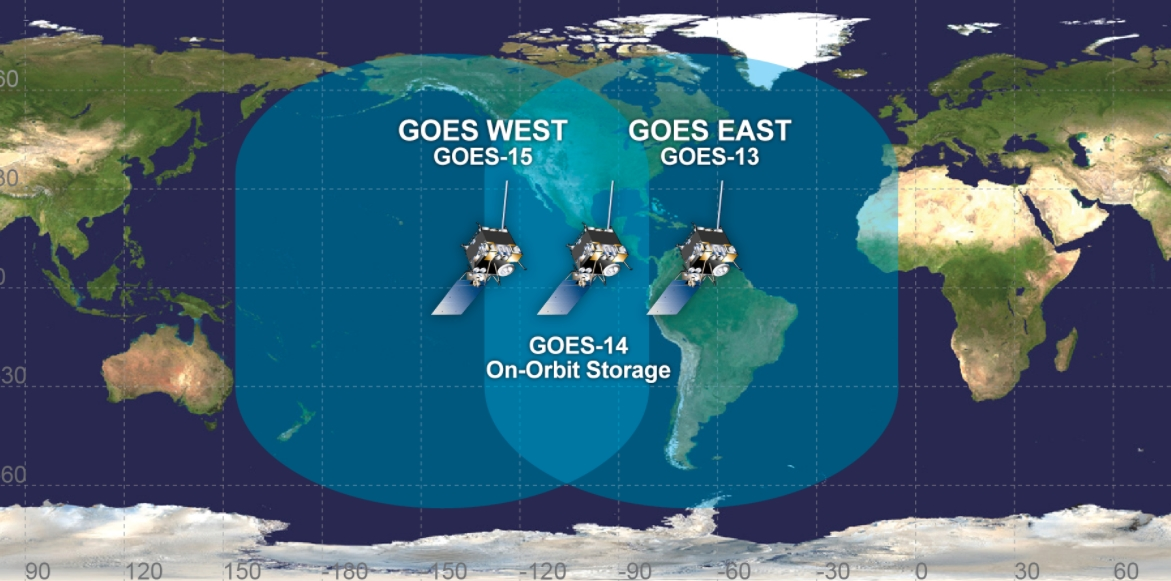
The two operational satellites are stationed at 75 and 137 degrees West – places or slots designated GOES-EAST and GOES-WEST respectively.

GOES satellites with area of observation. GOES-S will replace GOES-15 as GOES-17 - via NOAA

The satellite occupying GOES-EAST is responsible for monitoring the eastern United States, the Atlantic Ocean, Caribbean and the Gulf of Mexico. GOES-WEST covers the western regions of the continental United States, Alaska and Hawaii and the Pacific Ocean. GOES-S, which will be renamed GOES 17 after it reaches geostationary orbit, is expected to replace the eight-year-old GOES 15 in the GOES-WEST slot towards the end of this year.

The GOES-S Payload

The GOES-R-class satellites are being built by Lockheed Martin. They are based on the A2100A satellite bus and each has a mass at launch of 5,192 kilograms (11,466 lb) with dimensions of 6.1 by 5.6 by 3.9 meters (20 by 18 by 13 feet). The satellites are designed to operate in orbit for fifteen years: consisting of five years’ on-orbit storage and ten years of weather monitoring. GOES-S is equipped with a LEROS-1C liquid apogee motor, which will be used following launch to raise the satellite into its final geostationary orbit. Electrical power is generated through a single five-panel solar array that will provide over four kilowatts for the satellite’s systems and instruments.

The core propulsion module forms the main central structure of the satellite and carries the propellant and thrusters needed to maneuver the spacecraft after it is separated from the launch vehicle. Solar panels, batteries, memory data banks, avionics and receivers with high gain antennas also are a major part of the main central structure.

It’s hard to believe that more than 70 electronics boxes mounted within the system module provide the functionality to operate the spacecraft and its six instruments.

GOES-S carries a suite of six scientific instruments and is also equipped with a data relay payload. The satellite’s main instrument is the Advanced Baseline Imager (ABI), which is mounted on its nadir – Earth-facing – side. ABI can produce images of the Earth in sixteen different spectral bands, covering visible light through to infrared. At a visible-light wavelength of 0.64 nanometres, ABI can achieve an imaging resolution of 500 meters (547 yards), while in the infrared it can image at a resolution of up to 2,000 meters (2,187 yards). This is twice the resolution provided by the imager aboard the GOES 15 satellite that GOES-S will replace.

The imager can be operated in full-disc, regional and mesoscale modes. In normal operation it will produce four full-disc images of the whole visible face of the Earth, twelve regional scans of the United States and 120 mesoscale images – each covering an area of one million square kilometers (390,000 square miles) – per hour. An alternative mode of operation allows the satellite to produce full-disc images exclusively, outputting a new image every five minutes.

A second Earth-facing payload, the Geostationary Lightning Mapper (GLM), will monitor the Earth for sudden visual events in order to help build a map of lightning activity. GLM was first flown aboard GOES 16, and the instrument aboard GOES-S will help to provide similar data for the western United States to that now available for the eastern states. By monitoring lightning, GOES satellites will help forecasters predict storms, provide warnings of severe weather, and determine whether ongoing storms are increasing or decreasing in strength. In the west, this data will also help firefighters to identify lightning strikes that may cause wildfires.

As well as monitoring the Earth’s weather, GOES-S will perform solar observations to help forecast space weather. Its Solar Ultraviolet Imager (SUVI) and Extreme Ultraviolet and X-Ray Irradiance Sensors (EXIS) are mounted on the sun-tracking arm that connects the satellite’s solar array to its body. This affords them a near-continuous view of the sun as the solar array tracks it across the sky.

SUVI operates in the extreme ultraviolet, capturing full-disc images of the sun that can be used to monitor eruptions, solar flares and changes on the solar surface. EXIS, which consists of the Extreme Ultraviolet Sensor (EUVS) and X-Ray Sensor (XRS), monitors specific spectral bands in light coming from the Sun. EUVS looks for variations in emission lines from helium, hydrogen and magnesium that can be used to characterize emissions from different parts of the sun and to model its ultraviolet spectrum as a whole. XRS helps to characterize solar flares and measure the sun’s irradiance.

The Space Environment In-Situ Suite (SEISS) will be used to take readings of the immediate space environment in which GOES-S will operate. it consists of five sensors: the Energetic Heavy Ion Sensor (EHIS), two Magnetic Particle Sensors (MPS-Hi and MPS-Lo), two Solar and Galactic Proton Sensors (SGPS) and a boom-mounted magnetometer.

EHIS will be used to measure the flux of heavier ions trapped in Earth’s magnetosphere or incoming from extraterrestrial sources. The Magnetic Particle Sensors will measure the flux of protons and electrons: MPS-Hi will monitor higher-energy particles and MPS-Lo will measure lower-energy particles. The two identical SGPS sensors will measure protons incident from the sun and from outside the solar system.

GOES-S will also be used as a relay satellite through its Unique Payload Services (UPS) suite which will support four communications applications. GOES Rebroadcast (GRB) allows compatible receivers to download the latest observational data directly from the satellite, without waiting for the NOAA to publish it. The Data Collection System (DCS) is used to relay data from remote unmanned research stations back to the NOAA. The Emergency Managers Weather Information Network (EMWIN) is used to provide forecasts and other data to support emergency response and management.

Through their communications payloads, the GOES spacecraft also support the international COSPAS-SARSAT search and rescue program. GOES satellites can pick up distress signals from ships, aircraft and personal locator beacons (PLBs) and relay them to a control center from where rescue operations can be coordinated.

The Atlas 541 Launch

Atlas V, which was originally developed by Lockheed Martin, is a two-stage rocket. First flown in August 2002, Atlas has completed seventy-five missions prior to Thursday’s launch which is launch number 76.

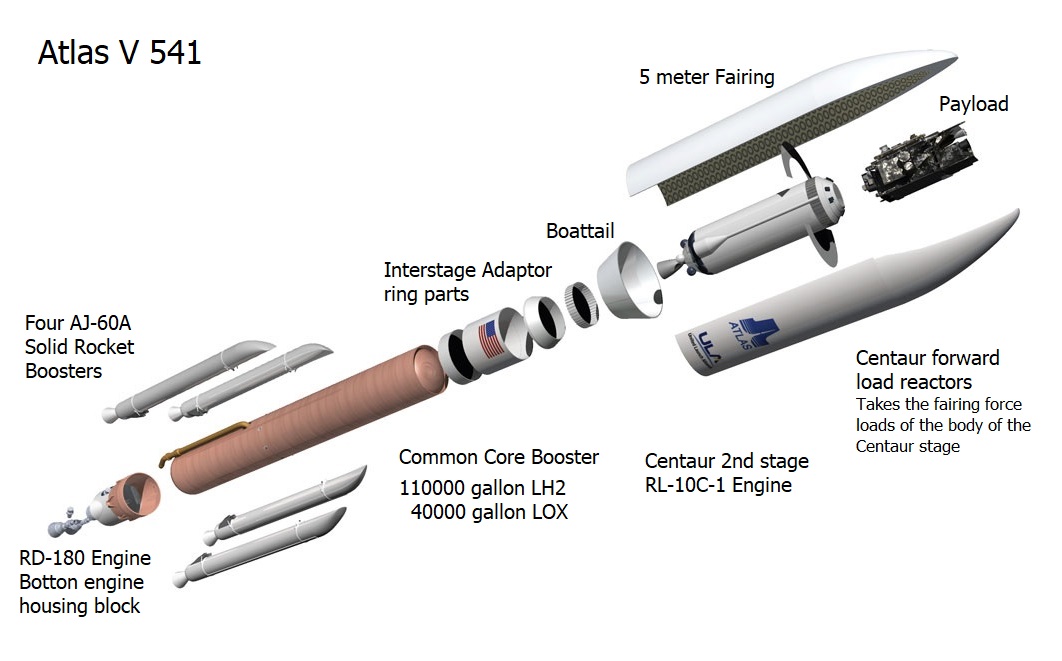
Atlas consists of two liquid-fuelled stages, with optional solid rocket motors attached to the first stage which can provide additional thrust during the early stages of flight. The rocket can fly in several different configurations, varying the number of solid rocket motors between zero and five, using a single or dual-engine second stage and a payload fairing with a diameter of four or five meters (13 or 16 feet). This allows it to cater to different mission requirements in terms of payload mass, volume and target orbit.

Graphic of the Atlas 541 split apart in its major parts. The fairing is actually in four parts. Stacked together between the Centaur top avionics and the payload adaptor fitting below GOES-S.

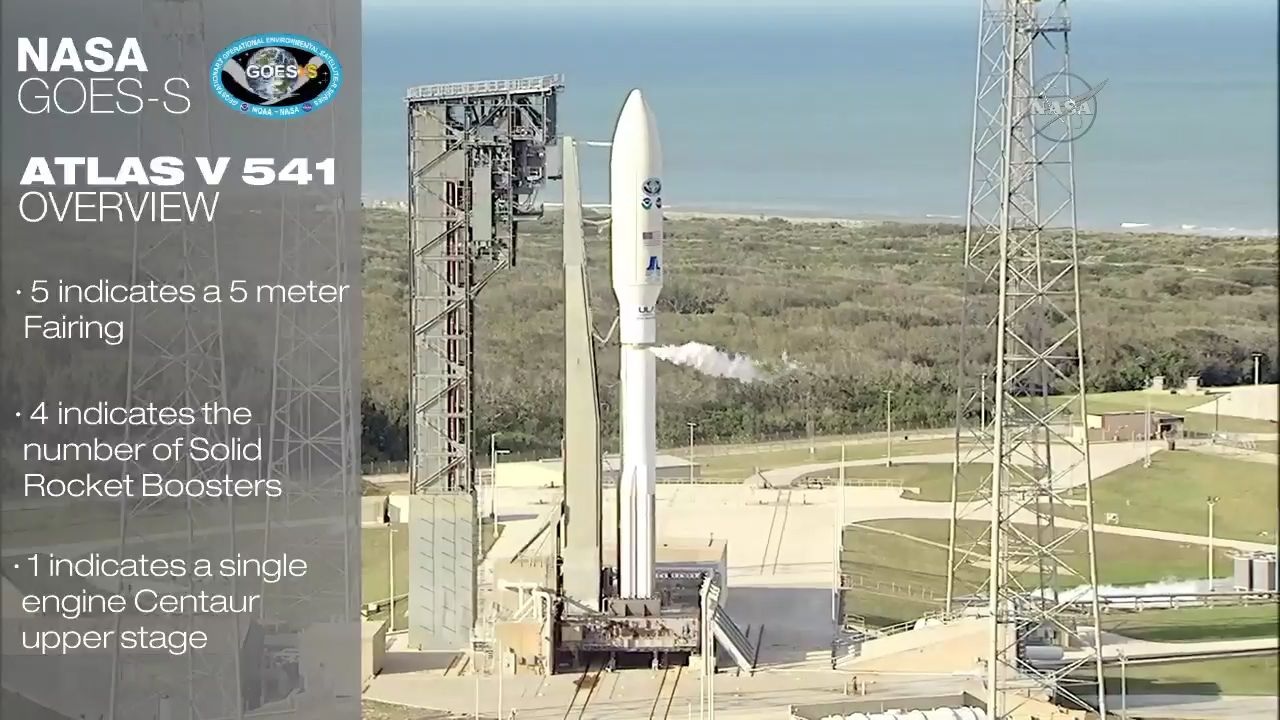
For Thursday’s launch, Atlas flew in the 541 configuration, which uses a five-meter payload fairing, four solid rocket motors and a single-engine Centaur upper stage. The five-meter fairing, which is built by Swiss firm RUAG, encloses both the GOES-S satellite and the Centaur stage, protecting them from the atmosphere as Atlas climbs towards space. The Atlas V that performed Thursday’s launch has tail number AV-077. It launched from Space Launch Complex 41 (SLC-41) at the Cape Canaveral Air Force Station.

During Thursday’s countdown, Atlas was fuelled, checked-out and made ready to launch. The rocket’s first stage, or Common Core Booster (CCB), is powered by a single RD-180 engine which ignites 2.7 seconds before the countdown reaches zero. Ignition of the four Aerojet AJ-60A solid rocket motors occurred at liftoff, which took place at about T+1.1 seconds. The vehicle began a series of pitch and yaw maneuvers 4.1 seconds later, placing it onto the planned course for its ascent to orbit.

Under the power of its main engine and four solid rocket boosters, AV-077 climbed quickly away from Cape Canaveral, reaching Mach 1 – the speed of sound – 35.2 seconds after liftoff. The rocket passed through Max-Q, the area of maximum dynamic pressure, 47.1 seconds into flight.

The solid rocket motors burned out around 98 seconds into the mission. Their spent casings were jettisoned at the 110.3-second mark in the flight. With the AJ-60s gone, the CCB’s RD-180 engine continued to burn as AV-077 climbed out of the atmosphere. The RD-180 burns RP-1 kerosene propellant, oxidized by liquid oxygen.

Once Atlas reached space, the payload fairing was no longer needed to protect its payload and was discarded to reduce the vehicle’s weight. The fairing separated about three minutes, 29.9 seconds after launch. Shortly afterward the Forward Load Reactor (FLR), which attaches to the rocket’s upper stage to help increase the rigidity of the fairing, was also separate.

The Atlas booster exhausted its fuel and ended its burn four minutes and 21.9 seconds after lifting off. This event, designated Booster Engine Cutoff (BECO), was followed by stage separation six seconds later. Atlas’ second stage, a single-engine Centaur (SEC), ignited its RL10C-1 engine ten seconds after separation. Centaur, which traces its heritage back to the early 1960s, is a cryogenically-fuelled stage burning liquid hydrogen propellant and liquid oxygen. During Thursday’s launch, it made three burns.

Centaur’s initial burn lasted seven minutes and 33.8 seconds, placing itself into a parking orbit. Restarting after a ten-minute, 26.7-second coast as it crosses the equator, the stage fired for a further five minutes and 30.9 seconds to reach geosynchronous transfer orbit. The third and final burn lasted 94.4 seconds, beginning after an almost-three-hour coast phase at three hours, 28 minutes and 7.9 seconds mission elapsed time. This raised the perigee and lower the inclination of the rocket’s orbit, reducing the amount of fuel that GOES-S will need to expend raising itself into geostationary orbit.

GOES-S separated from AV-077 about two minutes and 49 seconds after the third burn ends. The target orbit for spacecraft separation is 8,215.47 by 35,286.67 kilometers (5,104.86 by 21,926.12 miles, 4,436.00 by 19,053.28 nautical miles) at an inclination of 9.52 degrees and with an argument of perigee of 179.69 degrees. About 26 minutes and 20 seconds after deploying GOES-S, Centaur began a blowdown to secure itself, before the expected end of mission, at four hours, 32 minutes and 11.3 seconds after liftoff – twenty seconds shy of an hour after spacecraft separation.

Thursday’s launch was the second of the year for the Atlas V rocket, following January’s successful deployment of the SBIRS GEO-4 missile detection satellite.

Everyday Astronaut: Lost in pre 2020’s

NasaSpaceFlight: William Graham link

Coauthor/Text Retriever Johnny Nielsen

link to ULA launch list - Link to ULA Fan


ULA – Vulcan – Peregrine Lunar Lander

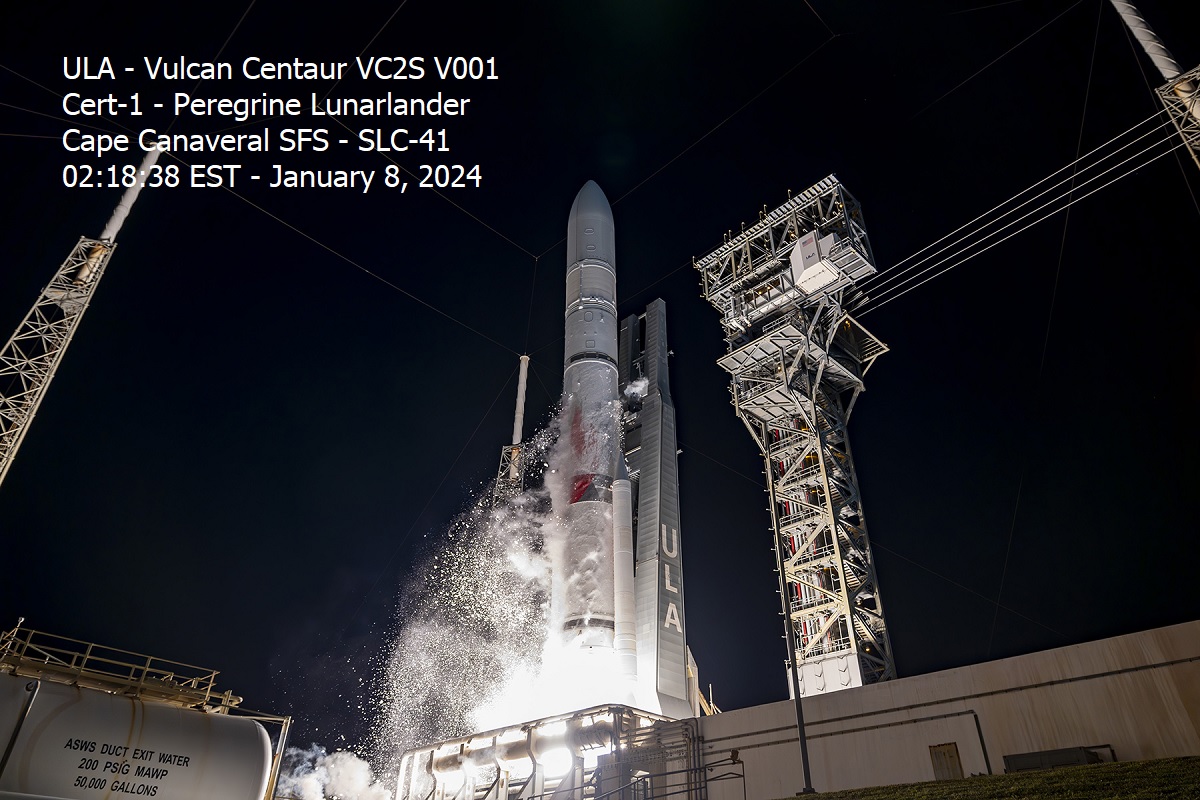
Photo from ULA of the Vulcan launch. I’ll huff. I’ll puff. And I’ll blow your pad away. Just you wait… Mission Rundown: ULA – Vulcan Centaur...