lørdag den 15. september 2018

ULA - Delta II - ICESat-2

Screenshot from NASA/ULA Webcast of ICESat-2. You got me up now. Light what candle?

Mission Rundown: ULA - Delta II - ICESat-2

Written: September 24, 2021 - Edit: December 1, 2022

Lift Off Time

September 15, 2018 - 06:02:00 PST - 13:02:00 UTC

Mission Name

ICESat-2

Launch Provider

ULA - United Launch Alliance

Customer

NASA

Rocket

Delta II 7420-10C

Launch Location

Space Launch Complex 2W - SLC-2W

Vandenberg Air Force Base, California

Payload

Ice, Cloud and Elevation Satellite 2 - LEOStar-3

 4 CubeSats from ELaNa 18 - 3U, 3U, 2U & 1U

Payload mass

1 580 kg ~ 3 483 pound

Where did the satellite go?

Sun-Synchronous Polar Orbit - 446 km x 470 km x 92,0°

Type of launch system?

Delta II Evolved Expendable Launch Vehicle + 4 SRB

The GEM-40 SRB’s fate?

In the Pacific Ocean south of SLC-2W

The first stage landing zone?

Bottom of the Pacific ocean further downrange

Type of second stage?

Delta K AJ10-118K engine - 7m 10s burn time

Is the 2nd stage derelict?

No - Main engine 4th start/cutoff was used to deorbit the 2nd stage - Burn time was only 13 seconds

Type of fairing?

3 meter - 10 feet two part carbon composite fairing

This will be the:

Two Delta II failed their missions and it doesn't count three pre NASA Thor’s with Delta second stages.

144th Delta II launch from US soil

– 130th flight of all ULA rockets

– 30th ULA launch of a Delta II rocket - D-381

– 381st launch of all Delta rocket types

– 33rd ULA mission for NASA

– 7th mission for ULA in 2018

Where to watch

Where to read more in depth

NASA/ULA YouTube link - Search varius home pages

Want to know or learn more visit or see Tim Dodd


Launch debriefing

(This happens)

Vernier vector engines are used to steer the rocket in the right course - it's a reaction control thrust system RCS - just a lot bigger

First orbit is 185.9 km x 477.3 km x 92.00

Second burn circulize the orbit to 445.9 km x 470.3 km x  92.00


L-00:31:28

Host:

L-00:21:58

L-00:07:00

T-00:04:00

T 00:00:00

T+00:00:31

T+00:00:46

T+00:01:03

T+00:01:22

T+00:04:25

T+00:04:31

T+00:04:38

T+00:04:39

T+00:05:06

T+00:11:04

T+00:47:40

T+00:53:43

T+00:58:22

T+01:00:54

T+01:05:54

T+01:50:04

T+02:10:46

Tim Dodd live feed at 00:00 - NASA/ULA at 05:25

Tim Dodd - Everyday Astronaut doing Q&A

Extended hold awaiting helium cooling at 25:26

Final Polling preparing the launch at 40:24

Release -4 minute hold at 43:24

Liftoff at 47:24 - No T+ clock per usual - 13:02:00 UTC

Mach 1 at 47:55 - Speed Mach One 1225,5 km/h

MaxQ at 48:10 - Maximum aerodynamic pressure

SRB burn out at 48:27 - Small thrusts coughing up

SRB separation at 48:46 - Dropping the stowaways

MECO at 51:49 - Delta II 1st stage booster is empty

VECO 51:55 - Vernier vector engines are empty too 

Stage separation at 52:02 - Just losing 95% weight

MES-1 at 52:05 - 6m 23s burn time - 383 seconds

Fairing separation at 52:30 - So this is space

SECO-1 at 58:28 and coasting - Delay on simulation

MES-2 - SECO-2 at 1:35:06 - 9.5s burn time

ULA/NASA shows ICESat-2 deployment at 1:40:07

Wrap up from Tim Dodd at 1:45:36

MES-3 to SECO-3 in 8 seconds put distance to ICESat-2

ELaNa 18 CubeSat deployment at 45:55

MES-4 - SECO-4 in 38 seconds deorbits 2nd stage

Delta K 2nd stage impacts in South Pacific Ocean


Atlas V 541

GOES-S

Atlas V 551

AFSPC-11

Atlas V 411

Mars Insight

Delta IV Heavy

Parker Solar

Delta II 7420-10

ICESat-2

Atlas V 551

AEHF-4

Delta IV Heavy

NROL-71

Delta IV M+5,4

WGS-10

Atlas V 551

AEHF-5

Delta IV M+4,2

GPS III SV02

60 years of service for USA

The ICESat-2 spacecraft was launched on 15 September 2018 at 06:02 PDT - 13:02 UTC from VAFB, CA Space Launch Complex -2W on a Delta-II 7420-10 vehicle configuration.

After twenty-nine years of reliable service, United Launch Alliance’s veteran Delta II rocket made its final flight Saturday with the deployment of the ICESat-2 climate research satellite for NASA. Delta lifted off from Vandenberg Air Force Base at 06:02 Pacific Daylight Time, beginning a mission that also closed the final chapter in the 60-year-long history of the Thor missile, from which Delta II’s first stage evolved.

The Delta II rocket rocking chair

Delta II made ULA’s first launch on 16 December 2006, deploying the USA-193 – or NROL-21 – satellite for the National Reconnaissance Office. Although Delta performed perfectly, the payload failed immediately after separating from the rocket.

In 2008 it was shot down by a US Navy destroyer using a RIM-161 Standard Missile 3 (SM-3), ostensibly to prevent the satellite causing any damage when it reentered the atmosphere. That’s at least 160 kilometers above Earth's surface. Impressive.

Okay. Mikey. Take aim and hit that target up yonder.

With Saturday’s mission, ULA has launched its last and 30th of the 155 Delta II rockets.

ICESat-2 will operate in a near-circular sun-synchronous low Earth orbit, at an altitude of 500 kilometers (310 miles, 270 nautical miles), inclined at 92 degrees to the Equator. This orbit will take it over Earth’s polar regions, allowing it to see the whole of the globe between 88 degrees North and 88 degrees South.

A two-stage Delta II rocket, flying in the 7420-10C configuration, provided ICESat-2 and the ELaNa 18 CubeSats with their ride into orbit. The 7420-10C configuration consists of an Extra Extended Long Tank Thor first stage augmented at liftoff by four GEM-40 solid rocket motors and a Delta-K second stage. ICESat-2 is encapsulated within a 10-foot (3-meter) wide composite payload fairing at the nose of the rocket.

Delta II’s first stage engine burns RP-1 propellant – kerosene – and liquid oxygen. The Delta-K consumes storable propellant: Aerozine 50 – a mixture of equal parts hydrazine and unsymmetrical dimethylhydrazine – which is oxidized by dinitrogen tetroxide.

The Delta II rocket stands 40.2 meters - 132 feet tall and weighs about 162 386 kilograms - 358 000 pounds fully fueled. It will launch on nearly 2,89 Mega Newtons - 650 000 pounds of thrust from the RS-27A main engine and four side-mounted solid rocket motors.

The Delta II family used a four-digit system to generate its technical names.

The first digit was either 6 or 7, denoting the 6000- or 7000-series Delta rocket.

The second digit indicated the number of boosters. Most Delta II rockets flew with 9 boosters, but some flew with 3 or 4.

The third digit was always 2, denoting a second stage with an Aerojet AJ10 engine. Only Deltas prior to the 6000-series used a different engine, the TR-201.

The fourth digit denoted the third stage. 0 denoted no third stage, 5 indicated a Payload Assist Module (PAM) stage, the Star 48B solid motor, 6 indicated the Star 37FM motor.

An H following the four digits denoted that the vehicle used the larger Delta III GEM-46 boosters. The Heavy variant could be launched only from Cape Canaveral (Vandenberg's pad wasn't modified to handle the larger SRBs), and was retired with the closure of that launch site in 2011.

Numbers and letters following those indicate the type of fairing. -9.5 means that the vehicle had a 9.5 ft (2.9 m) diameter fairing, -10 means a 10 ft (3.0 m) diameter fairing, and -10L indicates a lengthened 10 ft (3.0 m) diameter fairing.
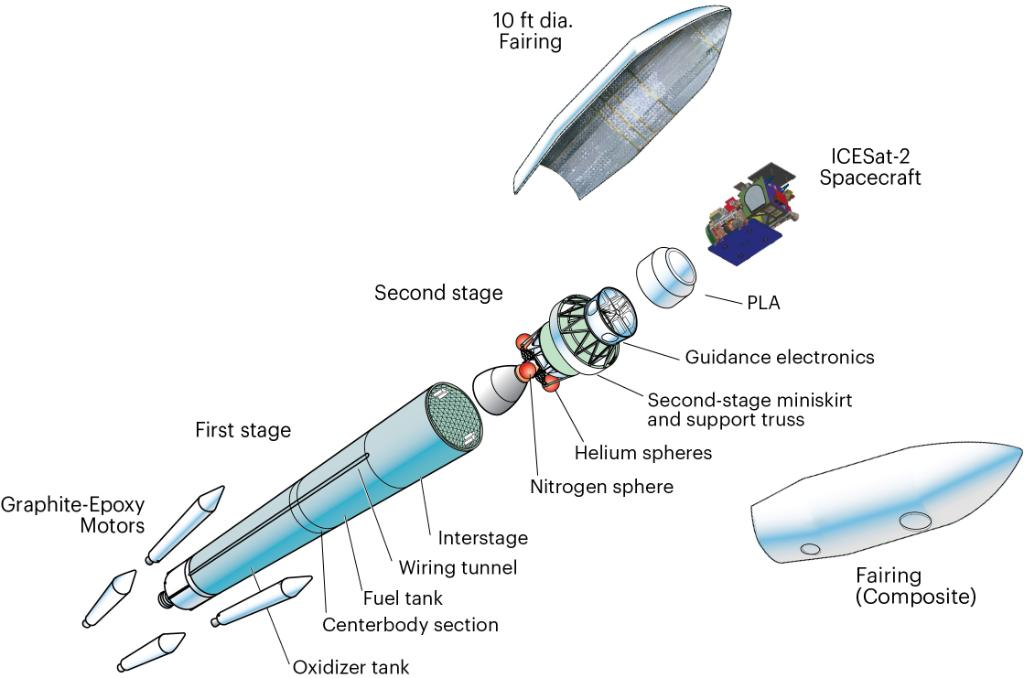
Graphic of Delta II seen split in its major parts. Interstage and fairings hides most of 2nd stage

For example, This Delta II 7420-10 used an RS-27A engine, four GEM-40 boosters, no third stage, and a lengthened 10 ft (3.0 m) diameter, the C means a carbon composite fairing.

Photo of a Delta II fairing being unwrapped. Do you by any chance want to buy an empty boat hull?

Delta II rockets have launched satellites that continue to play a role in everyday life – such as most of the US Air Force’s current Global Positioning System (GPS) as well as seventeen commercial geostationary communications satellites, much of the first-generation Iridium and Globalstar communications networks and weather satellites that provide accurate meteorological data to NOAA.

Delta II has also made a huge contribution to science, deploying missions to study the Earth, visit the planets and observe the cosmos.

Delta II rockets were used to send eight missions to Mars: Mars Global Surveyor, Mars Pathfinder, Mars Climate Orbiter, Mars Polar Lander, Mars Odyssey, the two Mars Exploration Rovers: Spirit and Opportunity, and Phoenix.

Delta II also deployed the NEAR, Deep Space 1, Stardust, CONTOUR, Deep Impact and Dawn missions to explore asteroids and comets – with Dawn also visiting the dwarf planet Ceres – the MESSENGER probe to Mercury and the GRAIL probes – Ebb and Flow – to study the Moon’s gravitational field.

Other significant missions that started atop a Delta II rocket included the Fermi, Kepler, Spitzer, Swift and WISE space telescopes and the Genesis spacecraft that returned a sample of solar wind to Earth.

The Science Payload

ICESat-2 is a NASA follow-up mission to ICESat with the goal to continue measuring and monitoring the impacts of the changing environment. The ICESat-2 observatory contains a single instrument, an improved laser altimeter called ATLAS (Advanced Topographic Laser Altimeter System). ATLAS is designed to measure ice-sheet topography, sea ice freeboard as well as cloud and atmospheric properties and global vegetation. The requirements call for a 5-year operational mission with a goal of 7 years.

ICESat-2, with high altimetric fidelity, will provide high-quality topographic measurements that allow estimates of ice sheet volume change. High-accuracy altimetry will also prove valuable for making long-sought repeat estimates of sea ice freeboard and hence sea ice thickness change, which is used to estimate the flux of low-salinity ice out of the Arctic basin into the marginal seas.

Altimetry is the best (and perhaps only) technique for change studies, because sea ice areas and extends have been well observed from space since the 1970s and significant trends have been shown, but there is no such record for sea ice thickness.

The instrument will use a micro-pulse multi-beam photon-counting approach. Science and ancillary data will be collected, stored on-board and subsequently downlinked to ground stations via an X-band communications link.

This link will also include stored housekeeping telemetry. The observatory will also receive and store/execute commands and transmit real-time housekeeping telemetry via an S-band link to the NASA Ground Network.

ICESat-2 uses the LEOStar-3 platform (for NASA's Landsat-8, the GeoEye-1 Earth imaging satellite) and is being built and integrated at the Gilbert, AZ, location of Orbital ATK.

As for propulsion it uses blowdown hydrazine, four main 22 N thrusters and eight station keeping 4.5 N thrusters, there is only a 158 kg tank capacity giving it a 3-5 year lifespan and with a frugal 7 service length flying on vapors.

NASA/GSFC engineers fitted a small telescope in the ICESat-2. In a Goddard cleanroom, teams are working in parallel on two sections of ATLAS: the box structure, which holds electronics that control the instrument, and the optical bench, which supports the instrument's lasers, mirrors, and the 0.8 m, 20.8 kg beryllium telescope that collects light.

Each ATLAS laser pulse contains more than 200 trillion photons, but only a dozen or so return to the telescope, where they're sent via optical fibers to the instrument's detectors. To catch those few photons, the telescope and its associated equipment, called the RTA (Receiver Telescope Assembly), need to align perfectly to the laser.

In addition to ICESat-2, this mission includes ELaNa 18’s four cubesats that will launch from dispensers mounted to the Delta II’s second stage.

The secondary payloads on IceSat-2 are:

• ELFIN (Electron Losses and Fields Investigation), a pair of 3U CubeSats of UCLA (University of California Los Angeles).

• SurfSat (Surface charging Satellite), a 2U CubeSat mission developed at the UCF (University of Central Florida), Orlando, FL.

• CP-7 (CalPoly-7) or DAVE (Damping And Vibrations Experiment), a 1U CubeSat, a collaboration of Northrop Grumman Aerospace Systems and CalPoly.
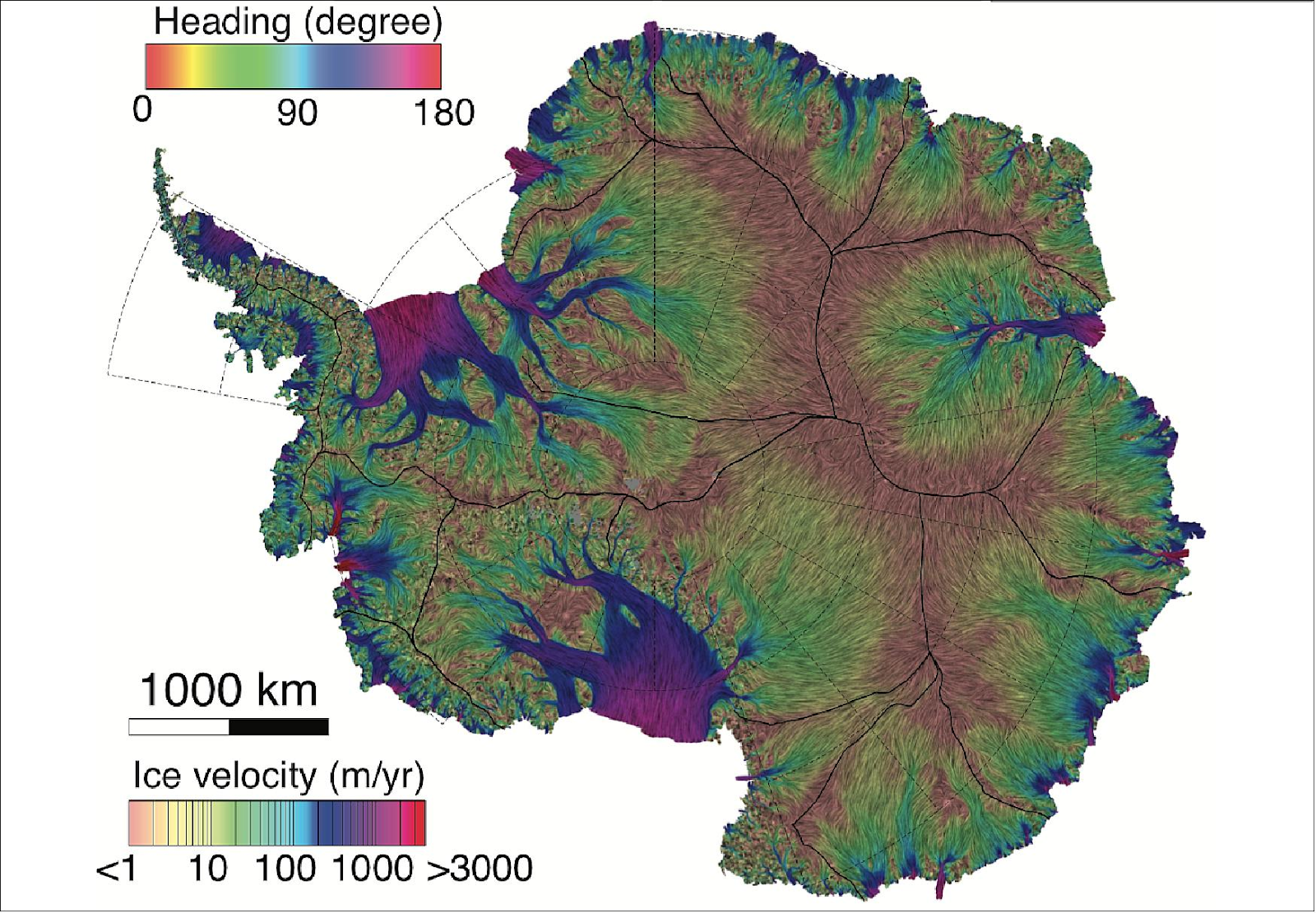
This new NASA/UC Irvine map of ice velocity in Antarctica is 10 times more accurate than any previous map and shows flows over 80% of the continent, where older maps showed about 20%. Colored lines indicate direction of flow; background colors show speed (image credit: UCI/Jeremie Mouginot) source

ICESat-2 will provide scientists with height measurements that create a global portrait of Earth’s third dimension, gathering data that can precisely track changes of terrain including glaciers, sea ice, forests and more.

The single instrument on ICESat-2 is ATLAS, the Advanced Topographic Laser Altimeter System, will measure melting ice sheets and investigate how this affects sea level rise, investigate changes in the mass of ice sheets and glaciers, estimate and study sea ice thickness, and measure the height of vegetation in forests and other ecosystems worldwide.

Scientists are using ICESat-2 to measure all kinds of ecosystems far beyond the polar regions, including sea grass growth in shallow coastal waters, forest growth in Africa and even the areas where Penguins congregate. Maps of the shallow waters around coral reefs worldwide are being produced using data from ICESat-2.

Everyday Astronaut:  Lost in pre 2020’s

NasaSpaceFlight: William Graham link

Coauthor/Text Retriever Johnny Nielsen

link to ULA launch list - Link to ULA Fan


lørdag den 11. august 2018

ULA - Delta IV Heavy - Parker Solar Probe

Screenshot from NASA Webcast of Parker Solar Probe. The minute they let go. You jump up

ULA - Delta IV Heavy - Parker Solar Probe

Written: September 28, 2021 - Edit: November 30, 2022

Lift Off Time

August 12, 2018 - 03:31:00 EDT - 07:31:00 UTC

Mission Name

Parker Solar Probe

Launch Provider

ULA - United Launch Alliance

Customer

NASA

Rocket

Delta IV Heavy

Launch Location

Launch Complex 37B - LC-37B

Cape Canaveral Air/Space Force Station, Florida

Payload

Science Satellite

Payload mass

685 kg ~ 1 510 pound

Where did the satellite go?

Heliocentric Orbit - 0,205 AU Aph.. x 1,01 AU Perihelium

Type of launch system?

Delta Evolved Expendable Launch Vehicle - 3 Core’s

The Delta boosters fate?

In the Atlantic Ocean east of SLC-37B

The Delta center core crashes?

At the bottom of the Atlantic Ocean at 40° West

Type of second stage?

Delta DCSS + RL-10B-2 engine - 19m 11s burn time

Is the 2nd stage derelict?

Yes - 2nd stage blowout was conducted 3 432 km above the Indian Ocean on approximately E78° S31° 

Type of third stage?

STAR 48BV - solid propellant stage - 1m 24s burn time

Is the 3rd stage derelict?

Yes - One burn to reduce orbit speed relative to Earth

New heliocentric orbit is unknown

Type of fairing?

5.4 meter two part carbon composite fairing

This will be the:

– 129th flight of all ULA rockets

– 10th flight of a Delta IV Heavy rocket - D-380

– 380th launch of all Delta rocket types

– 32nd ULA mission for NASA

– 6th mission for ULA in 2018

Where to watch

Where to read more in depth

NASA/ULA YouTube link - Global News - Deep Space TV

Want to know or learn more visit or see Tim Dodd


Launch debriefing

(This happens)

DCSS is a acronym for Delta Cryogenic Second Stage - an extension of the Delta IV core booster

Patrick Moore is host during Delta IV Heavy’s launch and flight

Computer graphic is late by 5-6 seconds - Clear picture at 348 second but it's accurate now

Early ignition on DCSS at T+355 seconds

Time slip in video and the Computer graphic it’s 8 seconds behind

LOS of 3rd stage all time stamps after are delayed

L-00:31:31

Hosts:

L-00:07:00

T-00:04:00

T 00:00:00

T+00:01:18

T+00:01:19

T+00:03:55

T+00:03:57

T+00:05:40

T+00:05:45

T+00:05:55

T+00:06:06

T+00:10:46

T+00:23:27

-

T+00:38:09

T+00:39:09

T+00:41:29

T+00:43:58

T+00:43:18

T+00:00:00

NASA/ULA live coverage on DSTV at 02:14:47

Marie Lewis, Mic Woltman, Josh Finch, Franklin F, Tori M,

Final Polling preparing the launch at 2:38:15

Release -4 minute hold at 2:41:15

Liftoff at 2:45:15 - No T+ clock - 07:31:00 UTC

Mach 1 at 2:46:34 - Speed Mach One 1225,5 km/h

MaxQ at 2:46:35 - Maximum aerodynamic pressure

Delta booster pair burn out at 2:49:10 - Running on fumes

Delta booster pair separation at 2:49:12 - Double drop off

BECO 2:50:55 - Delta IV core booster is empty

Stage separation 2:51:00 - Just losing 95% weight

MES-1 at 2:51:10 - Burn Time 291 seconds

Fairing separation at 2:51:26 - 4.0 m/s - 14.486 mi/hr

SECO-1 at 2:56:01 - Coasting - Target 7.4 m/s

MES-2 and SECO-2 in 14 min 20 sec gave a velocity boost from 26 477 km/h to 36 136 km/h - at 3:08:42 - 2261s

3rd stage separation from DCSS at 3:23:30 - 2289s

MES-3 - Third Stage STAR 48BV ignition - Unseen

SECO-3 - Third stage burn out - No deorbit evident

Parker Solar Probe Separation confirmed at 3:30:41

Blowout of 2nd stage at 3 432 km over Indian Ocean

Wrap up from NASA at 3:51:15


Atlas V 541

GOES-S

Atlas V 551

AFSPC-11

Atlas V 411

Mars Insight

Delta IV Heavy

Parker Solar

Delta II 7420-10

ICESat-2

Atlas V 551

AEHF-4

Delta IV Heavy

NROL-71

Delta IV M+5,4

WGS-10

Atlas V 551

AEHF-5

Delta IV M+4,2

GPS III SV02

Let’s get one hell of a Suntan

A mission nearly 60 years in the making has launched on a historic flight to become the first spacecraft to “touch the surface of the Sun”.

NASA’s Parker Solar Probe, named after Dr. Eugene Parker, will unlock many of the mysteries still held by our solar system’s Star. The probe launched atop a United Launch Alliance Delta IV Heavy rocket on Sunday from the Cape’s SLC-37.

This was the 10th launch of a Delta IV Heavy at 03:31 EDT on August 12, 2018.

NOTAM with three splashdown areas. A is launch failure. B is Delta side boosters plus fairing parts and C is the main Delta booster core. There is no 2nd stage splashdown area specified.

A series of three Wet Dress Rehearsals were undertaken by the United Launch Alliance team for this particular Delta IV Heavy rocket in an attempt to ferret out any ground and vehicle issues that required attention and fixing prior to the scheduled launch.

Only the third WDR was successful, and a Mission Dress Rehearsal earlier this week and a final Flight Readiness Review all cleared the rocket and payload for launch.

After liftoff, Delta IV Heavy pitched downrange and headed due east over the Atlantic Ocean. Shortly after liftoff, the center core of the three Common Booster Cores (CBCs) of the first stage throttled back to conserve propellant.

After the second DCSS engine cutoff, the 2nd and 3rd stages separate – with the Northrop Grumman-built third stage, the STAR 48BV.  This is a solid propellant stage that produced 17,490 lbs of thrust for just 84 seconds. But in that 84 seconds, the third stage imparted two-thirds of the total velocity of the launch phase.

(Of note, this is not the only part of the Delta IV Heavy built by Northrop Grumman.  The first stage engine nozzles, pressurization tanks, payload fairing, and most of the white areas on the rocket are all built by Northrop Grumman.)

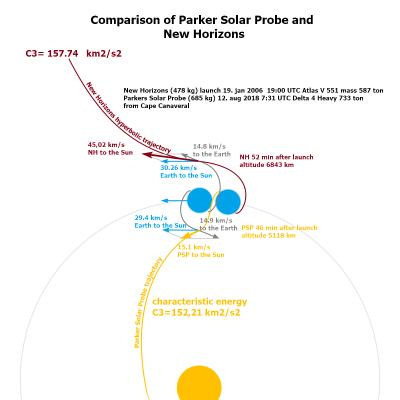
The specific mission parameters that call for Parker Solar Probe to make 24 close flybys of the Sun require a very specific trajectory and orbit. When Earth is moving around the Sun (and taking Parker with it), Parker Solar Probe actually has to start slowing down (relative to the Sun) during the powered phase of launch.

This sounds contradictory to what we generally think of for launches, but part of the job of the third stage, in this case, is to start that slowing down process.  

During launch, the third stage’s velocity will increase because the speed relative to Earth is increasing.  But, in fact, the velocity relative to the Sun is slowing down. This slow down burn will allow the Sun’s gravity to begin pulling Parker Solar inward toward Venus.

Once that small duration burn was complete, Parker Solar Probe separated from the third stage and was on its inward dive toward Venus.

Graphic with two spacecrafts paths to the Sun and Pluto both from Earth in a roundabout way

Parker Solar Probe will then execute seven gravitational assist flybys of Venus, first on 2 October 2018, so that it can perform progressively closer and closer flybys of the Sun’s surface – perihelion at 35.7 Sun Radii – on 5 November 2018. - Sun Radius?

These progressively closer orbits are achieved by the probe’s interactions with Venus, which slow Parker Solar down (the slower you go, the closer you get to the Sun’s surface due to the Sun’s gravitational forces) and gives some of its energy to Venus in the process.

Graphic of the Parker’s orbit trajectory between Venus and the Sun. RS is Sun Radii - Sun Radius

The Parker Solar Probe

Because United Launch Alliance has built up the reputation over the past few decades of being an incredibly reliable launch provider, they can often be trusted with high value payloads such as Mars missions, future piloted missions, and government contracts.

Keep in mind that the only purpose of ULA is to boost the Parker Solar Probe satellite into orbit. After it separates from the Delta Cryogenic Second Stage (DCSS), ULA no longer is in charge of the satellite and NASA takes over flight control.

Unlike other solar telescopes and missions, the Parker Solar Probe will venture where no probe has gone before – into the Sun’s corona.  Mission planning calls for the probe to approach the Sun to within 6 million km (3.7 million miles) or just 0.04 AU – 8.5 solar radii.

Parker Solar Probe will seek to answer three very important questions about the Sun:

  1. Why and how is the solar wind accelerated to supersonic speeds inside the corona?

  2. What is the mechanism that heats and accelerates particles in the corona?

  3. What is accelerating some particles, very few, to near the speed of light (creating highly energetic particles)?

Answering that third question holds potentially great significance for our lives here on Earth and our quest to move beyond Earth and out into the solar system because these highly energetic particles are highly charged and can penetrate walls of spacecraft and be harmful for astronauts – like giving them a constant x-ray.  

These highly energetic particles can also wreak havoc with our electronics on Earth, in orbit, and in space.  Therefore, part of Parker Solar’s mission is to help us better understand how the particles are accelerated/created in the corona – which in turn will help us better predict their occurrence and create improved plans for how to protect our technology and astronauts.

Graphic: Parker Solar Probe in 3rd stage burn slowing it down relative to the Earth’s orbit speed

In order to survive the intense environment of the outer corona, an area in which the probe will experience solar intensity 520 times greater than Earth does, a specialized heat shield and cooling system were designed to protect the spacecraft and scientific instruments.

The heat shield (or solar shadow-shield), which was installed for integrated vehicle testing in September 2017 at the Johns Hopkins Applied Physics Lab (APL), is made of reinforced carbon-carbon composite.

Reinforced carbon-carbon is most widely and infamously known for its use on the Space Shuttle, as the nose cap and Wing Leading Edge elements of the Thermal Protection System on the five Orbiters – though it was initially developed for the nose cones of intercontinental ballistic missiles and is currently used in the brake systems for Formula One racing cars.

For Parker Solar Probe, reinforced carbon-carbon will serve as the solar shadow-shield, which will block direct radiation from the Sun for the probe’s instrumentation and experiment packages and will keep temperatures behind the shield at a comfortable 85°F (29.4℃) while temperatures on the Sun-facing side of the shield will soar to 2,500°F (1,377℃) during closest approaches

While the surface of the solar shadow-shield will reach temperatures in excess of 2,500°F, the specially designed cooling system for the solar arrays will keep the arrays at a temperature of just 320°F or below.

This will be the first-of-its-kind actively cooled solar array system and was developed by APL in partnership with United Technologies Aerospace Systems (which manufactured the cooling system) and SolAero Technologies (which produced the solar arrays).

The cooling system itself is composed of a heated accumulator tank that will hold water (the coolant) during launch, two-speed pumps, and four radiators made of titanium tubes and aluminum fins just two hundredths of an inch thick.

Water was chosen as the coolant because of the temperature range the system will encounter throughout the mission.  “For the temperature range we required, and for the mass constraints, water was the solution,” said Lockwood.

Mission update so far

March 3, 2022: As NASA's Parker Solar Probe completes its latest swing around the Sun, it's doing so in full view of dozens of other spacecraft and ground-based telescopes.

- These powerful instruments can't actually see Parker itself – the van-sized spacecraft is far too small for visible detection – but they offer from a distance what the probe is sensing close-up, as it samples and analyzes the solar wind and magnetic fields from as close as 5.3 million miles (8.5 million km) from the Sun's surface.

- Occurring at 10:36 a.m. EST (15:36 UTC) on Feb. 25, this was the 11th close approach – or perihelion in the spacecraft's orbit around the Sun – of 24 planned for Parker Solar Probe's primary mission. Most of these passes occur while the Sun is between the spacecraft and Earth, blocking any direct lines of sight from home. But every few orbits, the dynamics work out to put the spacecraft in Earth's view – and the Parker mission team seizes these opportunities to organize broad observation campaigns that not only include telescopes on Earth, but several spacecraft as well.

- More than 40 observatories around the globe, including the recently commissioned Daniel K. Inouye Solar Telescope in Hawaii, among other major installations in the southwestern United States, Europe and Asia, are training their visible, infrared and radio telescopes on the Sun over the several weeks around the perihelion.

A dozen spacecraft, including NASA's STEREO, Solar Dynamics Observatory, TIMED and Magnetospheric Multiscale missions, ESA's and NASA's Solar Orbiter, ESA's BepiColombo, the JAXA-led Hinode, and even NASA's MAVEN at Mars are making simultaneous observations of activity stretching from the Sun to Earth and beyond.

- The pass also marked the midway point in the mission's 11th solar encounter, which began Feb. 20 and continues through March 2. The spacecraft checked in with mission operators at APL – where Parker Solar Probe was designed and built – on Feb. 28 to report that it was healthy and operating as expected.

The Delta IV Heavy

One of the more powerful rockets currently in operation, the Delta IV Heavy has launched payloads including NROL satellites and the Parker Solar Probe, a mission to study the Sun. All of the previous Delta IV Heavy launches have been successful.

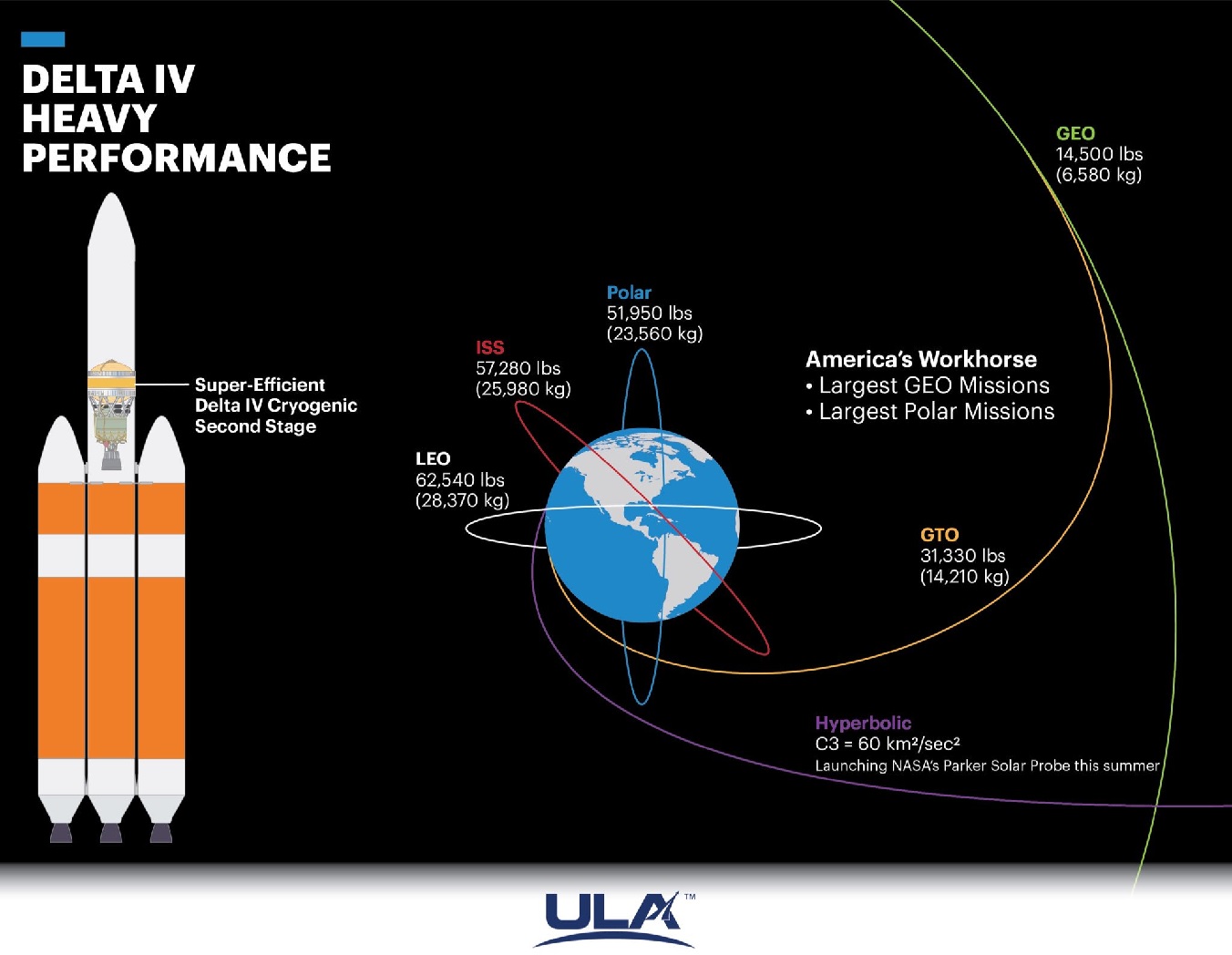
The Delta IV Heavy is a reliable heavy lift launch vehicle, meaning that it can take bigger and heavier payloads into orbit. It can launch up to 28,000 kg (61,000 lbs) to a 0 degree inclination from French Guiana, 14,000 kg (30,000 lbs) toward a Geostationary Transfer Orbit and on a 53 degree inclination in a Low Earth Orbit (LEO) towards ISS it lifts 25,980 kg (51,950 lbs). Be aware. ULA data must be confirmed from several sources.

And now from another source we hear this. Numbers? Who need them?

The Delta IV Heavy rocket stands 71 meters - 233 feet tall, is 16.15 - 53 feet wide and weighs 725.75 tons - 1.6 million pounds fully fueled. It will launch on 9.34 Mega Newtons - 2.1 million pounds of thrust from the three RS-68A main engines.

The Parker Solar Probe atop the launch vehicle is 2.98 meter - 9.8 feet tall, about 1 meter - 3.3 feet in diameter and has a mass of over 635 kilograms - 1,400 pounds.

Customers can choose between different payload fairing sizes to better optimize for their specific payload. Why choose something that tall to that short satellite?

To accommodate payloads of all sizes, ULA offers two different payload fairing heights both at 5 m (16 ft) wide. A 14 meter (47 ft) tall fairing and a 19.1 m (62.7 ft) tall fairing.

The Delta IV Heavy first stage consists of three nearly identical 40.8 meter boosters strapped together. Each booster has one RS-68A engine also manufactured by Aerojet Rocketdyne. The first stage is infamously known for lighting itself on fire just before launch to burn off extra hydrogen. It does this because it needs to get rid of any hydrogen so it does not explode unintentionally during liftoff.

The Delta IV Heavy first stage consists of three nearly identical 40.8 meter - 170 foot boosters strapped together. The Hydrogen and Oxygen tanks hold together 470 000 gallon of liquid propellant in 6 tanks measuring about 1 792 m3 in needed tank volume.

NROL-82 states that 120 000 gallons of liquid Oxygen is loaded. NROL-44 gave me these numbers. Second source found. Is 470 000 gallon of liquid propellant with DCSS +?

Each booster has one RS-68A engine also manufactured by Aerojet Rocketdyne. Together with DCSS and fairing they stand 71,6 meters - 235 feet tall on the launch pad.


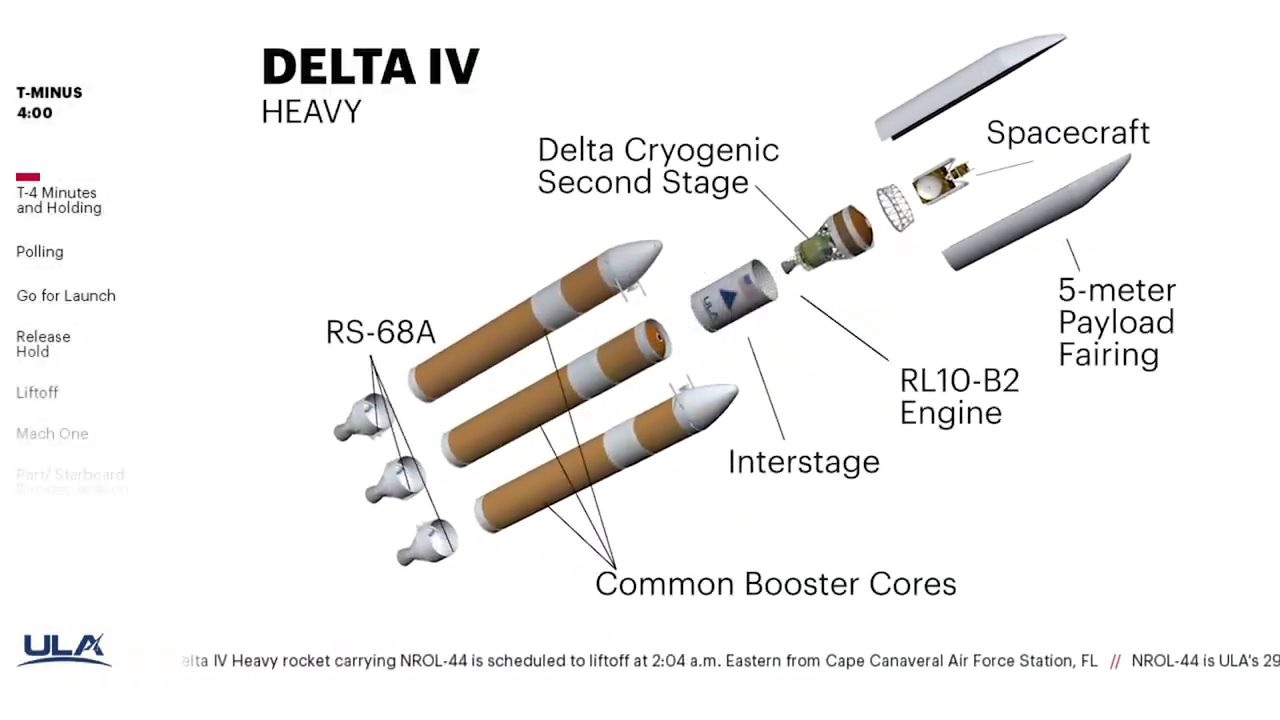
Screenshot of Delta Heavy IV split in its major parts. The spacecraft is not Parker Solar Probe

The Hydrogen tanks hold 330 000 gallon of liquid Hydrogen chilled to -252,8 0C Celsius or -423 0F Fahrenheit in 3 tanks measuring about 1 254 m3 in estimated tank volume. The three Hydrogen tanks each hold at least 418 m3 cubic meter liquid Hydrogen.

The Oxygen tanks hold 120 000 gallon of liquid Oxygen chilled to below -182,96 0C Celsius or -297,33 0F Fahrenheit in 3 tanks measuring about 454,2 m3 in estimated tank volume. The three Oxygen tanks each hold at least 151,4 m3 cubic meter liquid Oxygen.

The first stage is infamously known for lighting itself on fire just before launch to burn off extra hydrogen. It does this because it needs to get rid of any hydrogen so it does not explode unintentionally during liftoff.

The hydrogen comes from the purging or chilling of the engines prior to ignition. The engine can’t handle the freezing chock of liquid Hydrogen and Oxygen and will split itself apart especially in the turbopump bearings. They will become brittle and shatter.

The hydrogen comes from the purging of the engines prior to ignition. Each RS-68A engine has the capability to produce 3,160 kN (705,000 lbf) of thrust for a combined 9,420 kN of total thrust. The RS-68A engine has a specific impulse of 362 seconds and burns liquid hydrogen (LH2) and liquid oxygen (LOx).

During the flight, the center booster burned at a slightly slower throttle setting than the two side boosters. This is because the Delta IV Heavy needs all three boosters in order to get enough velocity to pass through the thick parts of the atmosphere. However, after that, they are expended and jettisoned as to not carry any extra weight.

As the vacuum optimized second stage is very efficient, but not very powerful, the Delta IV Heavy burns its center booster longer than other rockets so the second stage will be able to put its payload into orbit.

Graphic demonstration of Delta IV Heavy’s cargo capacity is thanks to the DCSS boost. link

Continuing up the rocket comes the second stage. The Delta Cryogenic Second Stage (DCSS) is powered by a single, vacuum optimized RL10B-2 engine. For its fuel, the DCSS uses liquid hydrogen (LH2) and for the oxidizer, liquid oxygen (LOX).

The LH2 tank - volume of 38 m3 holding 10 000 gallon LH2 - being on top, has the job of supporting the payload and the payload fairing with a strut gage of two rings and is also structurally separated from the other ‘half’ of DCSS. The clearly smaller LOX tank - volume of 23 m3 holding 6 000 gallon LOX - is suspended in a strut gage of two rings below it and is responsible for structurally supporting the RL10B-2 engine.

The RL10B-2 was originally built by Aerojet Rocketdyne and first flew in 1998. It has the capability to produce 110 kN (24,700 lbf) of thrust in a vacuum and has a specific impulse of 462 seconds. It will light up at least four times with 18 minutes 15 seconds of burn time at an unknown throttle setting during the mission.

The RL10B-2 was originally built by Aerojet Rocketdyne and first flew in 1998. It has the capability to produce 110 kN (24,700 lbf) of thrust in a vacuum and has a specific impulse of 462 seconds. In order to save costs and weight, the gimbal system either uses battery powered or fuelcell powered electromagnetic actuators over normal hydraulics; this also increases reliability.

With the propellant already consisting of liquid hydrogen (LH2) and liquid oxygen (LOx) I suspect that pumping gasses through a fuel cell to produce electric power is more weight economical than a massive lithium battery pack. But what do I know about that?

CBC RS-68A Spin Start Pressurization is complete and the CBC helium bottles are at flight pressure. ??? The engine's turbo pumps fan blades are started with Helium gas pressure or liquid Helium forced through them from a ground supply pump. I guess.

Freakin Alphabet Soup. I’m choking here.

Everyday Astronaut: Lost in pre 2020’s

NasaSpaceFlight: Chris Gebhardt link

Coauthor/Text Retriever: Johnny Nielsen

link to ULA launch list - Link to ULA Fan


ULA – Vulcan – Peregrine Lunar Lander

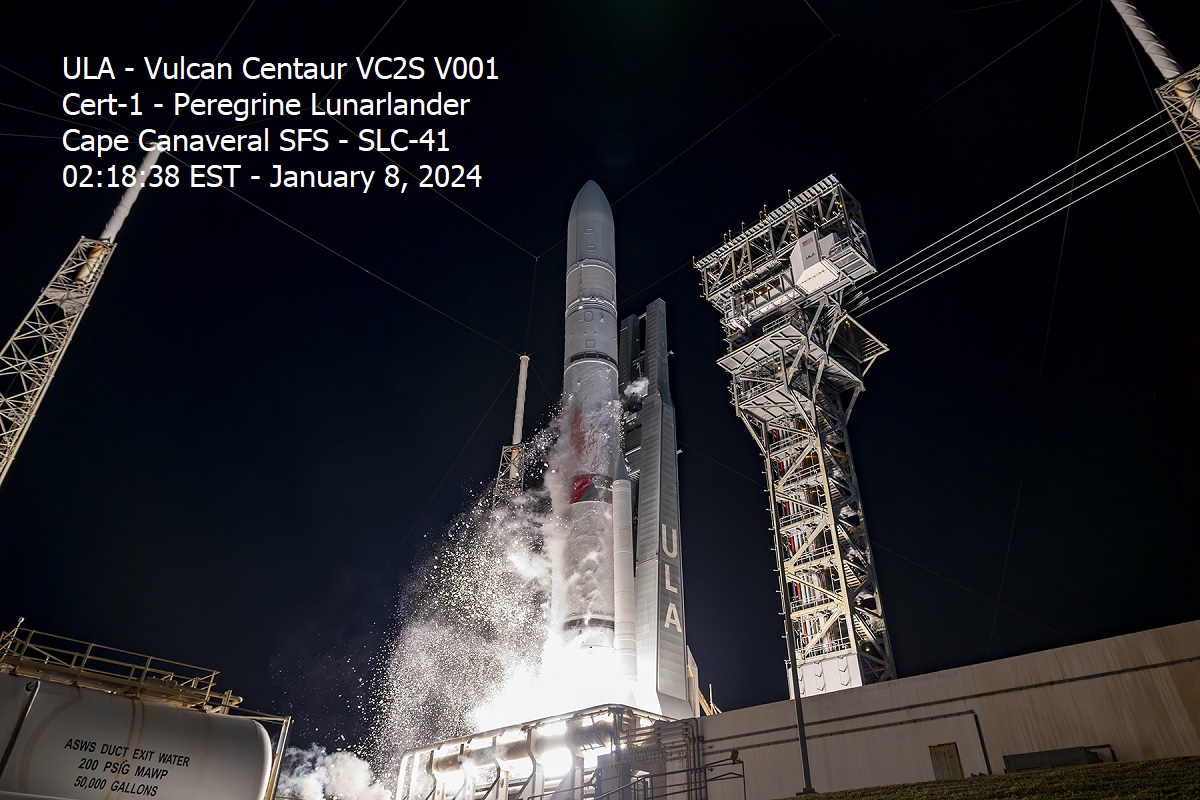
Photo from ULA of the Vulcan launch. I’ll huff. I’ll puff. And I’ll blow your pad away. Just you wait… Mission Rundown: ULA – Vulcan Centaur...